

Direct Current and Transient Analysis
141
The value of an arbitrary color-coded resistor R is specifi ed by the following rules:
1. The fi rst (A) and the second (B) band represent the fi rst (A) and the second digit (B),
of the value R.
2. The third color band (C) represents a multiplication factor of 10 raised to the power
C (10
C ), with unit ohms (Ω).
3. The fourth band (D) gives an index of the manufacturer’s tolerance given by [±(AB) *
10
C * D].
4. The fi fth color band (E) gives an index of the manufacturer’s component reliability,
which represents the probability of failure of R per the fi rst 1000 hours of use.
The nominal value of an arbitrary color-coded resistor R is given by
R = (AB) * 10
C
The tolerance of the resistor R would be bounded by
{(AB) * 10
C
− (AB) * 10
C * D} ≤ R ≤ {(AB) * 10
C
+ (AB) * 10
C * D}
Finally, the reliability of the resistor R is given either by E or E%, and that quantity indicates the probability of failure of R during the fi rst 1000 hours of usage.
For example, let a resistor R be defi ned by the following color bands:
Band 1 = Brown (A)
Band 2 = Black (B)
Band 3 = Orange (C)
Band 4 = Silver (D)
Band 5 = Brown (E)
TABLE 2.2
Band 1
(First Digit)
Band 2
(Second Digit)
Band 3
(Multiplying Factor)
Band 4
(Tolerance)
Band 5
(Reliability)
Brown = 1
Black = 0
Silver = −2
Gold = 0.05
Brown = 0.01
Red = 2
Brown = 1
Gold = −1
Silver = 0.10
Red = 0.001
Orange = 3
Orange = 3
Black = 0
None = 0.20
Orange = 0.0001
Yellow = 4
Yellow = 4
Brown = 1
Yellow = 0.00001
Green = 5
Green = 5
Red = 2
Blue = 6
Blue = 6
Orange = 3
Violet = 7
Violet = 7
Yellow = 4
Gray = 8
Gray = 8
Green = 5
White = 9
White = 9
Blue = 6
Violet = 7
Gray = 8
White = 9
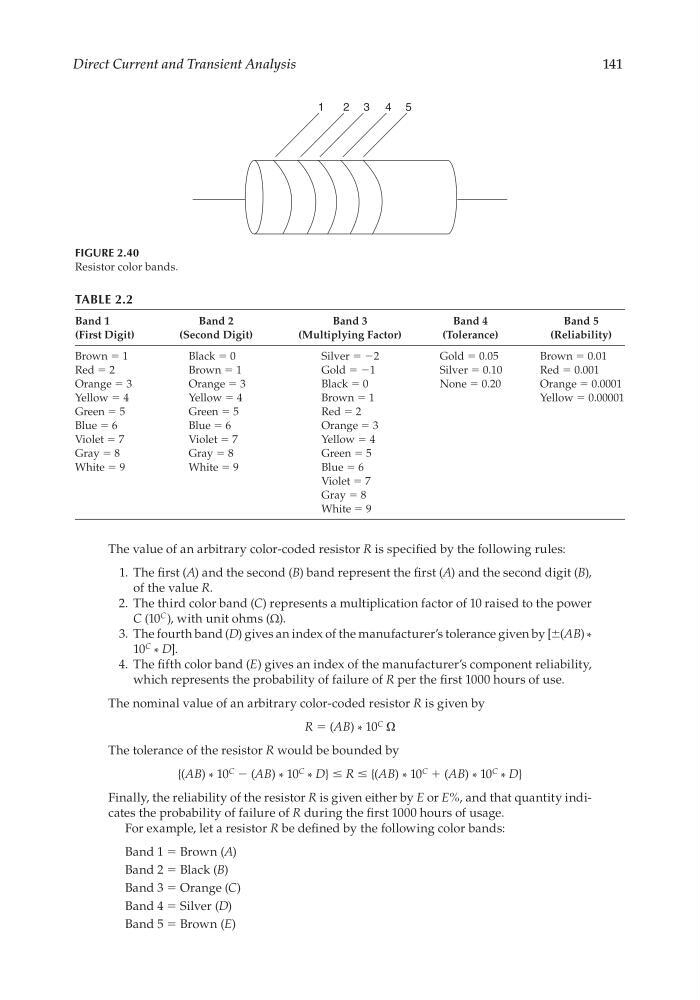
FIGURE 2.40
Resistor color bands.
1
2 3 4 5
CRC_47760_CH002.indd 141
CRC_47760_CH002.indd 141
7/23/2008 1:38:45 PM
7/23/2008 1:38:45 PM
141
The value of an arbitrary color-coded resistor R is specifi ed by the following rules:
1. The fi rst (A) and the second (B) band represent the fi rst (A) and the second digit (B),
of the value R.
2. The third color band (C) represents a multiplication factor of 10 raised to the power
C (10
C ), with unit ohms (Ω).
3. The fourth band (D) gives an index of the manufacturer’s tolerance given by [±(AB) *
10
C * D].
4. The fi fth color band (E) gives an index of the manufacturer’s component reliability,
which represents the probability of failure of R per the fi rst 1000 hours of use.
The nominal value of an arbitrary color-coded resistor R is given by
R = (AB) * 10
C
The tolerance of the resistor R would be bounded by
{(AB) * 10
C
− (AB) * 10
C * D} ≤ R ≤ {(AB) * 10
C
+ (AB) * 10
C * D}
Finally, the reliability of the resistor R is given either by E or E%, and that quantity indicates the probability of failure of R during the fi rst 1000 hours of usage.
For example, let a resistor R be defi ned by the following color bands:
Band 1 = Brown (A)
Band 2 = Black (B)
Band 3 = Orange (C)
Band 4 = Silver (D)
Band 5 = Brown (E)
TABLE 2.2
Band 1
(First Digit)
Band 2
(Second Digit)
Band 3
(Multiplying Factor)
Band 4
(Tolerance)
Band 5
(Reliability)
Brown = 1
Black = 0
Silver = −2
Gold = 0.05
Brown = 0.01
Red = 2
Brown = 1
Gold = −1
Silver = 0.10
Red = 0.001
Orange = 3
Orange = 3
Black = 0
None = 0.20
Orange = 0.0001
Yellow = 4
Yellow = 4
Brown = 1
Yellow = 0.00001
Green = 5
Green = 5
Red = 2
Blue = 6
Blue = 6
Orange = 3
Violet = 7
Violet = 7
Yellow = 4
Gray = 8
Gray = 8
Green = 5
White = 9
White = 9
Blue = 6
Violet = 7
Gray = 8
White = 9
FIGURE 2.40
Resistor color bands.
1
2 3 4 5
CRC_47760_CH002.indd 141
CRC_47760_CH002.indd 141
7/23/2008 1:38:45 PM
7/23/2008 1:38:45 PM