

126
Practical MATLAB
® Applications for Engineers
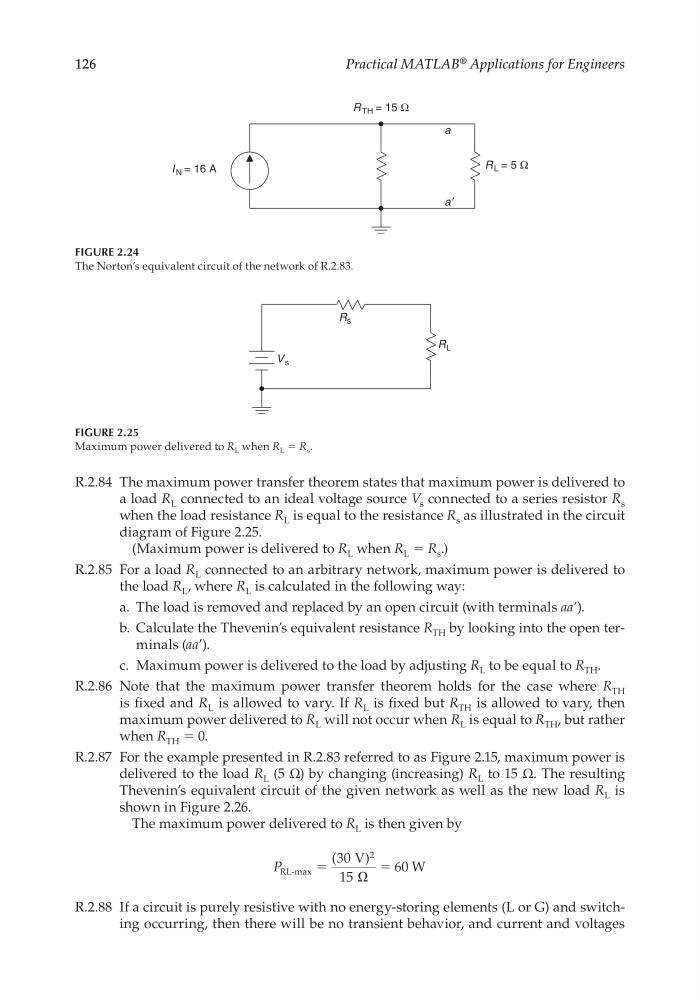
R.2.84 The maximum power transfer theorem states that maximum power is delivered to
a load R L connected to an ideal voltage source V s connected to a series resistor R s
when the load resistance R L is equal to the resistance R s as illustrated in the circuit
diagram of Figure 2.25.
(Maximum power is delivered to R L when R L = R s .)
R.2.85 For a load R L connected to an arbitrary network, maximum power is delivered to
the load R L , where R L is calculated in the following way:
a. The load is removed and replaced by an open circuit (with terminals aa’).
b. Calculate the Thevenin’s equivalent resistance R TH by looking into the open terminals (aa’).
c. Maximum power is delivered to the load by adjusting R L to be equal to R TH .
R.2.86 Note that the maximum power transfer theorem holds for the case where R TH
is fi xed and R L is allowed to vary. If R L is fi xed but R TH is allowed to vary, then
maximum power delivered to R L will not occur when R L is equal to R TH , but rather
when R TH = 0.
R.2.87 For the example presented in R.2.83 referred to as Figure 2.15, maximum power is
delivered to the load R L (5 Ω) by changing (increasing) R L to 15 Ω. The resulting
Thevenin’s equivalent circuit of the given network as well as the new load R L is
shown in Figure 2.26.
The maximum power delivered to R L is then given by
P RL-max
V
60 W
ϭ
ϭ
(
)
30
15
2
R.2.88 If a circuit is purely resistive with no energy-storing elements (L or G) and switching occurring, then there will be no transient behavior, and current and voltages
FIGURE 2.24
The Norton’s equivalent circuit of the network of R.2.83.
R L = 5 Ω
R TH = 15 Ω
I N = 16 A
a ′
a
FIGURE 2.25
Maximum power delivered to R L when R L = R s .
R L
R s
V s
CRC_47760_CH002.indd 126
CRC_47760_CH002.indd 126
7/23/2008 1:38:41 PM
7/23/2008 1:38:41 PM
Practical MATLAB
® Applications for Engineers
R.2.84 The maximum power transfer theorem states that maximum power is delivered to
a load R L connected to an ideal voltage source V s connected to a series resistor R s
when the load resistance R L is equal to the resistance R s as illustrated in the circuit
diagram of Figure 2.25.
(Maximum power is delivered to R L when R L = R s .)
R.2.85 For a load R L connected to an arbitrary network, maximum power is delivered to
the load R L , where R L is calculated in the following way:
a. The load is removed and replaced by an open circuit (with terminals aa’).
b. Calculate the Thevenin’s equivalent resistance R TH by looking into the open terminals (aa’).
c. Maximum power is delivered to the load by adjusting R L to be equal to R TH .
R.2.86 Note that the maximum power transfer theorem holds for the case where R TH
is fi xed and R L is allowed to vary. If R L is fi xed but R TH is allowed to vary, then
maximum power delivered to R L will not occur when R L is equal to R TH , but rather
when R TH = 0.
R.2.87 For the example presented in R.2.83 referred to as Figure 2.15, maximum power is
delivered to the load R L (5 Ω) by changing (increasing) R L to 15 Ω. The resulting
Thevenin’s equivalent circuit of the given network as well as the new load R L is
shown in Figure 2.26.
The maximum power delivered to R L is then given by
P RL-max
V
60 W
ϭ
ϭ
(
)
30
15
2
R.2.88 If a circuit is purely resistive with no energy-storing elements (L or G) and switching occurring, then there will be no transient behavior, and current and voltages
FIGURE 2.24
The Norton’s equivalent circuit of the network of R.2.83.
R L = 5 Ω
R TH = 15 Ω
I N = 16 A
a ′
a
FIGURE 2.25
Maximum power delivered to R L when R L = R s .
R L
R s
V s
CRC_47760_CH002.indd 126
CRC_47760_CH002.indd 126
7/23/2008 1:38:41 PM
7/23/2008 1:38:41 PM