

Direct Current and Transient Analysis
115
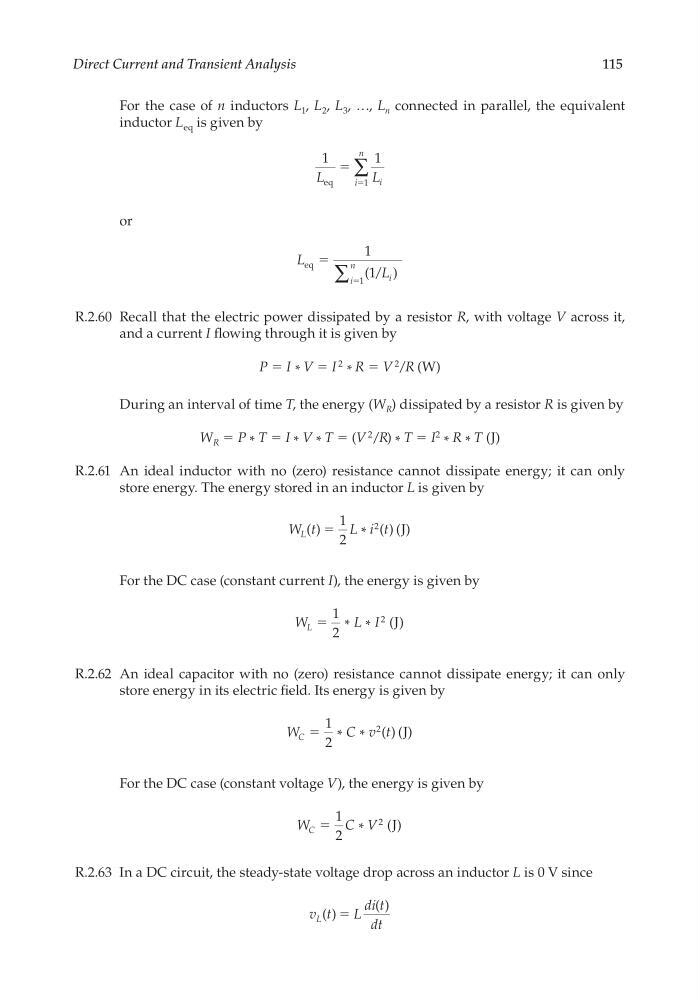
For the case of n inductors L 1 , L 2 , L 3 , …, L n connected in parallel, the equivalent
inductor L eq is given by
1
1
1
L
L i
i
n
eq
ϭ
ϭ
∑
or
L
L i
i
n
eq ϭ
ϭ
1
1
1
( / )
∑
R.2.60 Recall that the electric power dissipated by a resistor R, with voltage V across it,
and a current I fl owing through it is given by
P = I * V = I
2 * R = V
2
/R (W)
During an interval of time T, the energy (W R ) dissipated by a resistor R is given by
W R = P * T = I * V * T = (V
2
/R) * T = I
2 * R * T (J)
R.2.61 An ideal inductor with no (zero) resistance cannot dissipate energy; it can only
store energy. The energy stored in an inductor L is given by
W t
L i t
L ( )
J)
ϭ
1
2
2
* ( ) (
For the DC case (constant current I), the energy is given by
W
L I
L ϭ
1
2
2
* * ( )
J
R.2.62 An ideal capacitor with no (zero) resistance cannot dissipate energy; it can only
store energy in its electric fi eld. Its energy is given by
W
C v t
C ϭ
1
2
2
* * ( ) (J)
For the DC case (constant voltage V), the energy is given by
W
C V
C ϭ
1
2
2
*
( )
J
R.2.63 In a DC circuit, the steady-state voltage drop across an inductor L is 0 V since
v t
L
di t
dt
L ( )
( )
ϭ
CRC_47760_CH002.indd 115
CRC_47760_CH002.indd 115
7/23/2008 1:38:37 PM
7/23/2008 1:38:37 PM
115
For the case of n inductors L 1 , L 2 , L 3 , …, L n connected in parallel, the equivalent
inductor L eq is given by
1
1
1
L
L i
i
n
eq
ϭ
ϭ
∑
or
L
L i
i
n
eq ϭ
ϭ
1
1
1
( / )
∑
R.2.60 Recall that the electric power dissipated by a resistor R, with voltage V across it,
and a current I fl owing through it is given by
P = I * V = I
2 * R = V
2
/R (W)
During an interval of time T, the energy (W R ) dissipated by a resistor R is given by
W R = P * T = I * V * T = (V
2
/R) * T = I
2 * R * T (J)
R.2.61 An ideal inductor with no (zero) resistance cannot dissipate energy; it can only
store energy. The energy stored in an inductor L is given by
W t
L i t
L ( )
J)
ϭ
1
2
2
* ( ) (
For the DC case (constant current I), the energy is given by
W
L I
L ϭ
1
2
2
* * ( )
J
R.2.62 An ideal capacitor with no (zero) resistance cannot dissipate energy; it can only
store energy in its electric fi eld. Its energy is given by
W
C v t
C ϭ
1
2
2
* * ( ) (J)
For the DC case (constant voltage V), the energy is given by
W
C V
C ϭ
1
2
2
*
( )
J
R.2.63 In a DC circuit, the steady-state voltage drop across an inductor L is 0 V since
v t
L
di t
dt
L ( )
( )
ϭ
CRC_47760_CH002.indd 115
CRC_47760_CH002.indd 115
7/23/2008 1:38:37 PM
7/23/2008 1:38:37 PM