

Direct Current and Transient Analysis
113
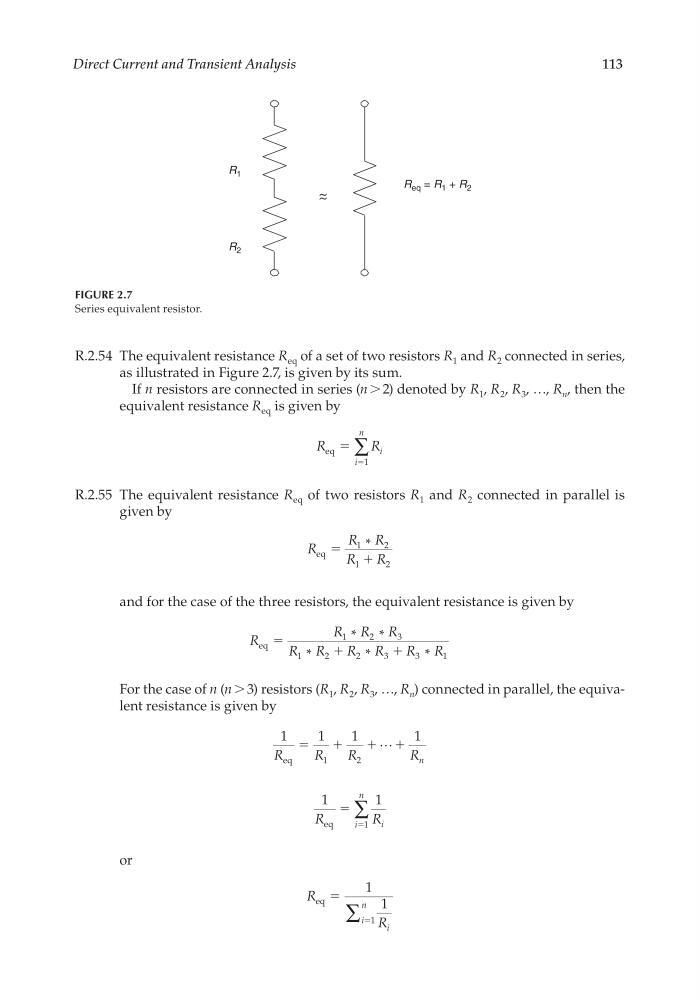
R.2.54 The equivalent resistance R eq of a set of two resistors R 1 and R 2 connected in series,
as illustrated in Figure 2.7, is given by its sum.
If n resistors are connected in series (n > 2) denoted by R 1 , R 2 , R 3 , …, R n , then the
equivalent resistance R eq is given by
R
R i
i
n
eq ϭ
ϭ1
∑
R.2.55 The equivalent resistance R eq of two resistors R 1 and R 2 connected in parallel is
given by
R
R R
R
R
eq ϭ
ϩ
1
2
1
2
*
and for the case of the three resistors, the equivalent resistance is given by
R
R R R
R R
R R
R R
eq ϭ
ϩ
ϩ
1
2
3
1
2
2
3
3
1
*
*
*
*
*
For the case of n (n > 3) resistors (R 1 , R 2 , R 3 , …, R n ) connected in parallel, the equivalent resistance is given by
1
1
1
1
1
2
R
R
R
R n
eq
ϭ
ϩ
ϩ ϩ
1
eq
R
ϭ
ϭ
1
1 R i
i
n
∑
or
R
R i
i
n
eq ϭ
ϭ
1
1
1
∑
FIGURE 2.7
Series equivalent resistor.
R 1
R 2
R eq = R 1 + R 2
~ ~
CRC_47760_CH002.indd 113
CRC_47760_CH002.indd 113
7/23/2008 1:38:37 PM
7/23/2008 1:38:37 PM
113
R.2.54 The equivalent resistance R eq of a set of two resistors R 1 and R 2 connected in series,
as illustrated in Figure 2.7, is given by its sum.
If n resistors are connected in series (n > 2) denoted by R 1 , R 2 , R 3 , …, R n , then the
equivalent resistance R eq is given by
R
R i
i
n
eq ϭ
ϭ1
∑
R.2.55 The equivalent resistance R eq of two resistors R 1 and R 2 connected in parallel is
given by
R
R R
R
R
eq ϭ
ϩ
1
2
1
2
*
and for the case of the three resistors, the equivalent resistance is given by
R
R R R
R R
R R
R R
eq ϭ
ϩ
ϩ
1
2
3
1
2
2
3
3
1
*
*
*
*
*
For the case of n (n > 3) resistors (R 1 , R 2 , R 3 , …, R n ) connected in parallel, the equivalent resistance is given by
1
1
1
1
1
2
R
R
R
R n
eq
ϭ
ϩ
ϩ ϩ
1
eq
R
ϭ
ϭ
1
1 R i
i
n
∑
or
R
R i
i
n
eq ϭ
ϭ
1
1
1
∑
FIGURE 2.7
Series equivalent resistor.
R 1
R 2
R eq = R 1 + R 2
~ ~
CRC_47760_CH002.indd 113
CRC_47760_CH002.indd 113
7/23/2008 1:38:37 PM
7/23/2008 1:38:37 PM