

monomers, whereas hemicellulose degradation gives pentoses and hexoses (Kuhad et al. 1997). The effectiveness of
the pretreatment technique depends on a number of factors
like substrate porosity (indicative of the accessible surface
area) for low digestibility substrates (Ishizawa et al. 2007),
cellulose crystallinity (cellulose breakdown is more easily
achievable when it is present in its amorphous form than
crystalline form) (Mosier et al. 2005; Béguin and Aubert
1994), and hemicellulose and lignin percentages present.
The celluloses have different degrees of crystallinity ranging
from 30 to 70%.
An efficient pretreatment technique is characterised by of
the following factors:
• Maximum degradation of the carbohydrate sources into
their respective monomeric units.
• Formation of inhibitory products should be less probable.
• The overall technique should be economically feasible.
The most commonly practised methods are:
Acid hydrolysis: This chemical pretreatment technique
can be subdivided into two categories:
• Dilute-acid hydrolysis: The operating conditions of this
process are high temperature in the range of 160–230 °C
for effective cellular hydrolysis, and high pressure around
10 atm (Kumar et al. 2009). This technique takes comparatively lesser time (1-5 min) than the concentratedacid hydrolysis technique. The ethanol yield at the end is
low. Moreover, the probability of the formation of inhibitory compounds is very high in this process. The concentration range of acid (generally sulfuric acid) in this
technique varies between 2 and 5 wt% (Lee et al. 1997).
• Concentrated-acid hydrolysis: The required conditions for
carrying out this process are temperatures less than 50 °C
and ambient pressure of *1 atm. This technique yields
very high ethanol concentration, but is carried out for a
longer time duration (1 h to 8 h, for 60–80% and 20–30%
acid concentration, respectively) (Janga et al. 2012; Farone et al. 1996). Sulfuric acid or hydrochloric acid is
generally used, within a concentration range of 10–30%
(Kumar et al. 2009; Broder et al. 1995). Recovery of the
concentrated acid is of utmost importance considering the
economics of the overall process (Sun and Cheng 2002).
Alkaline hydrolysis: Alkaline pretreatment is comparable
to the concentrated-acid hydrolysis technique with respect to
the process operating conditions of low temperature and
pressure (Kumar et al. 2009), except for the longer time
duration for which the process is to be carried out (may
extend up to weeks) and lower levels of carbohydrates
digestibility. It is done mainly using sodium hydroxide (Fox
et al. 1989; MacDonald et al. 1983) and the effectiveness of
the technique is dependent on lignin-percentage present in
the biomass (Mcmillan 1994).
Enzymatic hydrolysis: The main advantage of this biological pretreatment technique is the absence of harmful and
toxic by-products, formed otherwise by chemical treatments.
The carbohydrate chains of the fruit waste are catalyzed by
cellulase enzymes at *50 °C and pH * 5 to reducible
fermentable monomeric units. The synthesis of cellulase can
be found in fungi, bacteria, and some protozoans. Also,
some animals like cows and sheep are a source of cellulase.
8 Fermentation Strategies for Ethanol
Production
Bioethanol production from food wastes (biomass feedstocks) can be achieved using either direct or indirect fermentation. Direct fermentation involves the administration
of the feed into the bioreactor without a change in the
physical state, whereas indirect fermentation involves the
substrate gasification into syngas which is followed by its
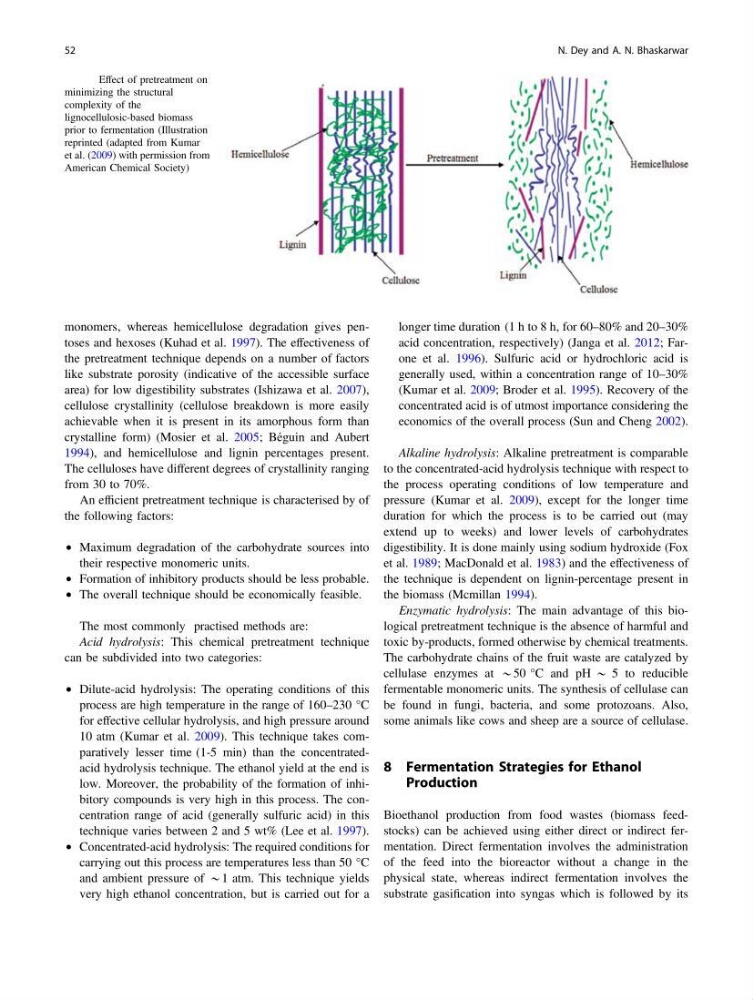
Fig. 2 Effect of pretreatment on
minimizing the structural
complexity of the
lignocellulosic-based biomass
prior to fermentation (Illustration
reprinted (adapted from Kumar
et al. (2009) with permission from
American Chemical Society)
52
N. Dey and A. N. Bhaskarwar
the pretreatment technique depends on a number of factors
like substrate porosity (indicative of the accessible surface
area) for low digestibility substrates (Ishizawa et al. 2007),
cellulose crystallinity (cellulose breakdown is more easily
achievable when it is present in its amorphous form than
crystalline form) (Mosier et al. 2005; Béguin and Aubert
1994), and hemicellulose and lignin percentages present.
The celluloses have different degrees of crystallinity ranging
from 30 to 70%.
An efficient pretreatment technique is characterised by of
the following factors:
• Maximum degradation of the carbohydrate sources into
their respective monomeric units.
• Formation of inhibitory products should be less probable.
• The overall technique should be economically feasible.
The most commonly practised methods are:
Acid hydrolysis: This chemical pretreatment technique
can be subdivided into two categories:
• Dilute-acid hydrolysis: The operating conditions of this
process are high temperature in the range of 160–230 °C
for effective cellular hydrolysis, and high pressure around
10 atm (Kumar et al. 2009). This technique takes comparatively lesser time (1-5 min) than the concentratedacid hydrolysis technique. The ethanol yield at the end is
low. Moreover, the probability of the formation of inhibitory compounds is very high in this process. The concentration range of acid (generally sulfuric acid) in this
technique varies between 2 and 5 wt% (Lee et al. 1997).
• Concentrated-acid hydrolysis: The required conditions for
carrying out this process are temperatures less than 50 °C
and ambient pressure of *1 atm. This technique yields
very high ethanol concentration, but is carried out for a
longer time duration (1 h to 8 h, for 60–80% and 20–30%
acid concentration, respectively) (Janga et al. 2012; Farone et al. 1996). Sulfuric acid or hydrochloric acid is
generally used, within a concentration range of 10–30%
(Kumar et al. 2009; Broder et al. 1995). Recovery of the
concentrated acid is of utmost importance considering the
economics of the overall process (Sun and Cheng 2002).
Alkaline hydrolysis: Alkaline pretreatment is comparable
to the concentrated-acid hydrolysis technique with respect to
the process operating conditions of low temperature and
pressure (Kumar et al. 2009), except for the longer time
duration for which the process is to be carried out (may
extend up to weeks) and lower levels of carbohydrates
digestibility. It is done mainly using sodium hydroxide (Fox
et al. 1989; MacDonald et al. 1983) and the effectiveness of
the technique is dependent on lignin-percentage present in
the biomass (Mcmillan 1994).
Enzymatic hydrolysis: The main advantage of this biological pretreatment technique is the absence of harmful and
toxic by-products, formed otherwise by chemical treatments.
The carbohydrate chains of the fruit waste are catalyzed by
cellulase enzymes at *50 °C and pH * 5 to reducible
fermentable monomeric units. The synthesis of cellulase can
be found in fungi, bacteria, and some protozoans. Also,
some animals like cows and sheep are a source of cellulase.
8 Fermentation Strategies for Ethanol
Production
Bioethanol production from food wastes (biomass feedstocks) can be achieved using either direct or indirect fermentation. Direct fermentation involves the administration
of the feed into the bioreactor without a change in the
physical state, whereas indirect fermentation involves the
substrate gasification into syngas which is followed by its
Fig. 2 Effect of pretreatment on
minimizing the structural
complexity of the
lignocellulosic-based biomass
prior to fermentation (Illustration
reprinted (adapted from Kumar
et al. (2009) with permission from
American Chemical Society)
52
N. Dey and A. N. Bhaskarwar