

Pectin is found to be present in enormous quantities in the
fruits processing industries wastes like apple pomace, citrus
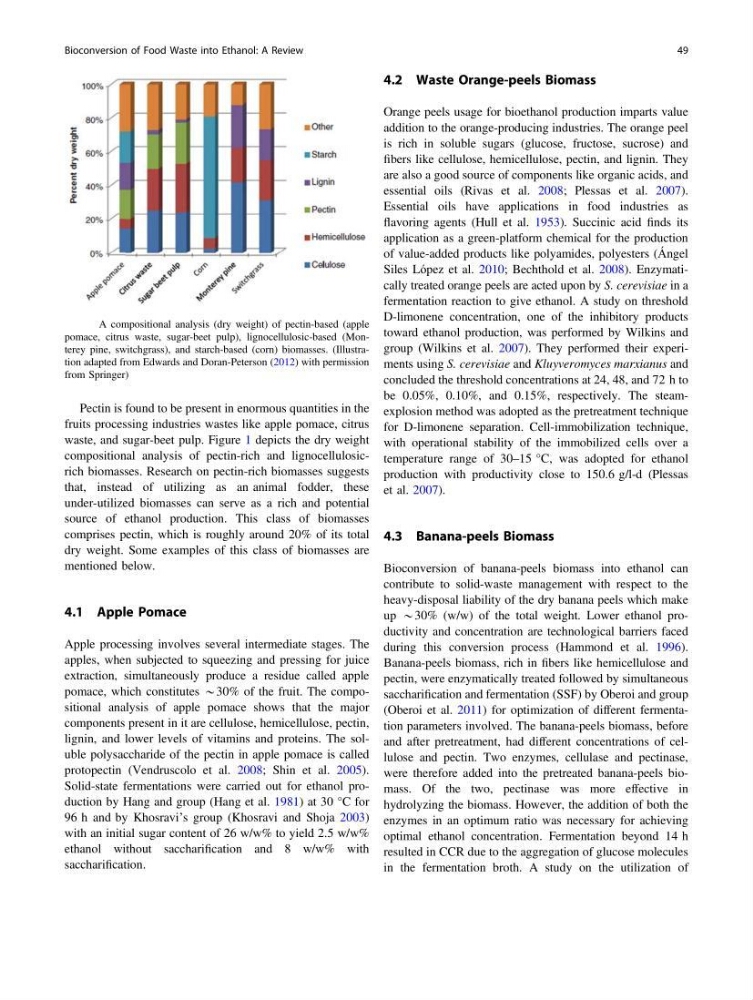
waste, and sugar-beet pulp. Figure 1 depicts the dry weight
compositional analysis of pectin-rich and lignocellulosicrich biomasses. Research on pectin-rich biomasses suggests
that, instead of utilizing as an animal fodder, these
under-utilized biomasses can serve as a rich and potential
source of ethanol production. This class of biomasses
comprises pectin, which is roughly around 20% of its total
dry weight. Some examples of this class of biomasses are
mentioned below.
4.1 Apple Pomace
Apple processing involves several intermediate stages. The
apples, when subjected to squeezing and pressing for juice
extraction, simultaneously produce a residue called apple
pomace, which constitutes *30% of the fruit. The compositional analysis of apple pomace shows that the major
components present in it are cellulose, hemicellulose, pectin,
lignin, and lower levels of vitamins and proteins. The soluble polysaccharide of the pectin in apple pomace is called
protopectin (Vendruscolo et al. 2008; Shin et al. 2005).
Solid-state fermentations were carried out for ethanol production by Hang and group (Hang et al. 1981) at 30 °C for
96 h and by Khosravi’s group (Khosravi and Shoja 2003)
with an initial sugar content of 26 w/w% to yield 2.5 w/w%
ethanol without saccharification and 8 w/w% with
saccharification.
4.2 Waste Orange-peels Biomass
Orange peels usage for bioethanol production imparts value
addition to the orange-producing industries. The orange peel
is rich in soluble sugars (glucose, fructose, sucrose) and
fibers like cellulose, hemicellulose, pectin, and lignin. They
are also a good source of components like organic acids, and
essential oils (Rivas et al. 2008; Plessas et al. 2007).
Essential oils have applications in food industries as
flavoring agents (Hull et al. 1953). Succinic acid finds its
application as a green-platform chemical for the production
of value-added products like polyamides, polyesters (Ángel
Siles López et al. 2010; Bechthold et al. 2008). Enzymatically treated orange peels are acted upon by S. cerevisiae in a
fermentation reaction to give ethanol. A study on threshold
D-limonene concentration, one of the inhibitory products
toward ethanol production, was performed by Wilkins and
group (Wilkins et al. 2007). They performed their experiments using S. cerevisiae and Kluyveromyces marxianus and
concluded the threshold concentrations at 24, 48, and 72 h to
be 0.05%, 0.10%, and 0.15%, respectively. The steamexplosion method was adopted as the pretreatment technique
for D-limonene separation. Cell-immobilization technique,
with operational stability of the immobilized cells over a
temperature range of 30–15 °C, was adopted for ethanol
production with productivity close to 150.6 g/l-d (Plessas
et al. 2007).
4.3 Banana-peels Biomass
Bioconversion of banana-peels biomass into ethanol can
contribute to solid-waste management with respect to the
heavy-disposal liability of the dry banana peels which make
up *30% (w/w) of the total weight. Lower ethanol productivity and concentration are technological barriers faced
during this conversion process (Hammond et al. 1996).
Banana-peels biomass, rich in fibers like hemicellulose and
pectin, were enzymatically treated followed by simultaneous
saccharification and fermentation (SSF) by Oberoi and group
(Oberoi et al. 2011) for optimization of different fermentation parameters involved. The banana-peels biomass, before
and after pretreatment, had different concentrations of cellulose and pectin. Two enzymes, cellulase and pectinase,
were therefore added into the pretreated banana-peels biomass. Of the two, pectinase was more effective in
hydrolyzing the biomass. However, the addition of both the
enzymes in an optimum ratio was necessary for achieving
optimal ethanol concentration. Fermentation beyond 14 h
resulted in CCR due to the aggregation of glucose molecules
in the fermentation broth. A study on the utilization of
Fig. 1 A compositional analysis (dry weight) of pectin-based (apple
pomace, citrus waste, sugar-beet pulp), lignocellulosic-based (Monterey pine, switchgrass), and starch-based (corn) biomasses. (Illustration adapted from Edwards and Doran-Peterson (2012) with permission
from Springer)
Bioconversion of Food Waste into Ethanol: A Review
49
fruits processing industries wastes like apple pomace, citrus
waste, and sugar-beet pulp. Figure 1 depicts the dry weight
compositional analysis of pectin-rich and lignocellulosicrich biomasses. Research on pectin-rich biomasses suggests
that, instead of utilizing as an animal fodder, these
under-utilized biomasses can serve as a rich and potential
source of ethanol production. This class of biomasses
comprises pectin, which is roughly around 20% of its total
dry weight. Some examples of this class of biomasses are
mentioned below.
4.1 Apple Pomace
Apple processing involves several intermediate stages. The
apples, when subjected to squeezing and pressing for juice
extraction, simultaneously produce a residue called apple
pomace, which constitutes *30% of the fruit. The compositional analysis of apple pomace shows that the major
components present in it are cellulose, hemicellulose, pectin,
lignin, and lower levels of vitamins and proteins. The soluble polysaccharide of the pectin in apple pomace is called
protopectin (Vendruscolo et al. 2008; Shin et al. 2005).
Solid-state fermentations were carried out for ethanol production by Hang and group (Hang et al. 1981) at 30 °C for
96 h and by Khosravi’s group (Khosravi and Shoja 2003)
with an initial sugar content of 26 w/w% to yield 2.5 w/w%
ethanol without saccharification and 8 w/w% with
saccharification.
4.2 Waste Orange-peels Biomass
Orange peels usage for bioethanol production imparts value
addition to the orange-producing industries. The orange peel
is rich in soluble sugars (glucose, fructose, sucrose) and
fibers like cellulose, hemicellulose, pectin, and lignin. They
are also a good source of components like organic acids, and
essential oils (Rivas et al. 2008; Plessas et al. 2007).
Essential oils have applications in food industries as
flavoring agents (Hull et al. 1953). Succinic acid finds its
application as a green-platform chemical for the production
of value-added products like polyamides, polyesters (Ángel
Siles López et al. 2010; Bechthold et al. 2008). Enzymatically treated orange peels are acted upon by S. cerevisiae in a
fermentation reaction to give ethanol. A study on threshold
D-limonene concentration, one of the inhibitory products
toward ethanol production, was performed by Wilkins and
group (Wilkins et al. 2007). They performed their experiments using S. cerevisiae and Kluyveromyces marxianus and
concluded the threshold concentrations at 24, 48, and 72 h to
be 0.05%, 0.10%, and 0.15%, respectively. The steamexplosion method was adopted as the pretreatment technique
for D-limonene separation. Cell-immobilization technique,
with operational stability of the immobilized cells over a
temperature range of 30–15 °C, was adopted for ethanol
production with productivity close to 150.6 g/l-d (Plessas
et al. 2007).
4.3 Banana-peels Biomass
Bioconversion of banana-peels biomass into ethanol can
contribute to solid-waste management with respect to the
heavy-disposal liability of the dry banana peels which make
up *30% (w/w) of the total weight. Lower ethanol productivity and concentration are technological barriers faced
during this conversion process (Hammond et al. 1996).
Banana-peels biomass, rich in fibers like hemicellulose and
pectin, were enzymatically treated followed by simultaneous
saccharification and fermentation (SSF) by Oberoi and group
(Oberoi et al. 2011) for optimization of different fermentation parameters involved. The banana-peels biomass, before
and after pretreatment, had different concentrations of cellulose and pectin. Two enzymes, cellulase and pectinase,
were therefore added into the pretreated banana-peels biomass. Of the two, pectinase was more effective in
hydrolyzing the biomass. However, the addition of both the
enzymes in an optimum ratio was necessary for achieving
optimal ethanol concentration. Fermentation beyond 14 h
resulted in CCR due to the aggregation of glucose molecules
in the fermentation broth. A study on the utilization of
Fig. 1 A compositional analysis (dry weight) of pectin-based (apple
pomace, citrus waste, sugar-beet pulp), lignocellulosic-based (Monterey pine, switchgrass), and starch-based (corn) biomasses. (Illustration adapted from Edwards and Doran-Peterson (2012) with permission
from Springer)
Bioconversion of Food Waste into Ethanol: A Review
49