

temperature for the depolymerization reaction of polyamides. The decomposition of the IL, however, takes place
at a temperature of 330 °C and higher. Over a decade now,
many insights reveal effective depolymerization of polyamide to its monomeric unit: caprolactam.
3.3.1 Depolymerization of Plastics
Depolymerization of Polyamides in ILs
ILs are effectively used in the depolymerization processes of
polyamides. Kaimimura et al. reported the first successful
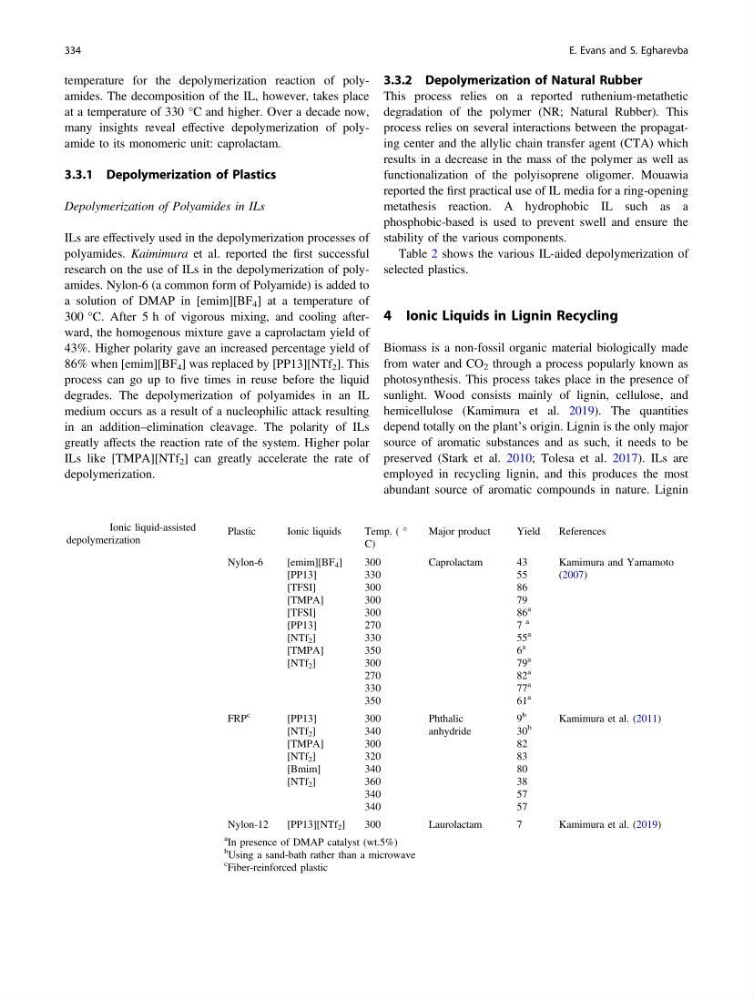
research on the use of ILs in the depolymerization of polyamides. Nylon-6 (a common form of Polyamide) is added to
a solution of DMAP in [emim][BF 4 ] at a temperature of
300 °C. After 5 h of vigorous mixing, and cooling afterward, the homogenous mixture gave a caprolactam yield of
43%. Higher polarity gave an increased percentage yield of
86% when [emim][BF 4 ] was replaced by [PP13][NTf 2 ]. This
process can go up to five times in reuse before the liquid
degrades. The depolymerization of polyamides in an IL
medium occurs as a result of a nucleophilic attack resulting
in an addition–elimination cleavage. The polarity of ILs
greatly affects the reaction rate of the system. Higher polar
ILs like [TMPA][NTf 2 ] can greatly accelerate the rate of
depolymerization.
3.3.2 Depolymerization of Natural Rubber
This process relies on a reported ruthenium-metathetic
degradation of the polymer (NR; Natural Rubber). This
process relies on several interactions between the propagating center and the allylic chain transfer agent (CTA) which
results in a decrease in the mass of the polymer as well as
functionalization of the polyisoprene oligomer. Mouawia
reported the first practical use of IL media for a ring-opening
metathesis reaction. A hydrophobic IL such as a
phosphobic-based is used to prevent swell and ensure the
stability of the various components.
Table 2 shows the various IL-aided depolymerization of
selected plastics.
4 Ionic Liquids in Lignin Recycling
Biomass is a non-fossil organic material biologically made
from water and CO 2 through a process popularly known as
photosynthesis. This process takes place in the presence of
sunlight. Wood consists mainly of lignin, cellulose, and
hemicellulose (Kamimura et al. 2019). The quantities
depend totally on the plant’s origin. Lignin is the only major
source of aromatic substances and as such, it needs to be
preserved (Stark et al. 2010; Tolesa et al. 2017). ILs are
employed in recycling lignin, and this produces the most
abundant source of aromatic compounds in nature. Lignin
Table 2 Ionic liquid-assisted
depolymerization
Plastic
Ionic liquids
Temp. ( °
C)
Major product
Yield
References
Nylon-6
[emim][BF 4 ]
[PP13]
[TFSI]
[TMPA]
[TFSI]
[PP13]
[NTf 2 ]
[TMPA]
[NTf 2 ]
300
330
300
300
300
270
330
350
300
270
330
350
Caprolactam
43
55
86
79
86
a
7
a
55
a
6
a
79
a
82
a
77
a
61
a
Kamimura and Yamamoto
(2007)
FRP
c
[PP13]
[NTf 2 ]
[TMPA]
[NTf 2 ]
[Bmim]
[NTf 2 ]
300
340
300
320
340
360
340
340
Phthalic
anhydride
9
b
30
b
82
83
80
38
57
57
Kamimura et al. (2011)
Nylon-12
[PP13][NTf 2 ]
300
Laurolactam
7
Kamimura et al. (2019)
a In presence of DMAP catalyst (wt.5%)
b
Using a sand-bath rather than a microwave
c Fiber-reinforced plastic
334
E. Evans and S. Egharevba
at a temperature of 330 °C and higher. Over a decade now,
many insights reveal effective depolymerization of polyamide to its monomeric unit: caprolactam.
3.3.1 Depolymerization of Plastics
Depolymerization of Polyamides in ILs
ILs are effectively used in the depolymerization processes of
polyamides. Kaimimura et al. reported the first successful
research on the use of ILs in the depolymerization of polyamides. Nylon-6 (a common form of Polyamide) is added to
a solution of DMAP in [emim][BF 4 ] at a temperature of
300 °C. After 5 h of vigorous mixing, and cooling afterward, the homogenous mixture gave a caprolactam yield of
43%. Higher polarity gave an increased percentage yield of
86% when [emim][BF 4 ] was replaced by [PP13][NTf 2 ]. This
process can go up to five times in reuse before the liquid
degrades. The depolymerization of polyamides in an IL
medium occurs as a result of a nucleophilic attack resulting
in an addition–elimination cleavage. The polarity of ILs
greatly affects the reaction rate of the system. Higher polar
ILs like [TMPA][NTf 2 ] can greatly accelerate the rate of
depolymerization.
3.3.2 Depolymerization of Natural Rubber
This process relies on a reported ruthenium-metathetic
degradation of the polymer (NR; Natural Rubber). This
process relies on several interactions between the propagating center and the allylic chain transfer agent (CTA) which
results in a decrease in the mass of the polymer as well as
functionalization of the polyisoprene oligomer. Mouawia
reported the first practical use of IL media for a ring-opening
metathesis reaction. A hydrophobic IL such as a
phosphobic-based is used to prevent swell and ensure the
stability of the various components.
Table 2 shows the various IL-aided depolymerization of
selected plastics.
4 Ionic Liquids in Lignin Recycling
Biomass is a non-fossil organic material biologically made
from water and CO 2 through a process popularly known as
photosynthesis. This process takes place in the presence of
sunlight. Wood consists mainly of lignin, cellulose, and
hemicellulose (Kamimura et al. 2019). The quantities
depend totally on the plant’s origin. Lignin is the only major
source of aromatic substances and as such, it needs to be
preserved (Stark et al. 2010; Tolesa et al. 2017). ILs are
employed in recycling lignin, and this produces the most
abundant source of aromatic compounds in nature. Lignin
Table 2 Ionic liquid-assisted
depolymerization
Plastic
Ionic liquids
Temp. ( °
C)
Major product
Yield
References
Nylon-6
[emim][BF 4 ]
[PP13]
[TFSI]
[TMPA]
[TFSI]
[PP13]
[NTf 2 ]
[TMPA]
[NTf 2 ]
300
330
300
300
300
270
330
350
300
270
330
350
Caprolactam
43
55
86
79
86
a
7
a
55
a
6
a
79
a
82
a
77
a
61
a
Kamimura and Yamamoto
(2007)
FRP
c
[PP13]
[NTf 2 ]
[TMPA]
[NTf 2 ]
[Bmim]
[NTf 2 ]
300
340
300
320
340
360
340
340
Phthalic
anhydride
9
b
30
b
82
83
80
38
57
57
Kamimura et al. (2011)
Nylon-12
[PP13][NTf 2 ]
300
Laurolactam
7
Kamimura et al. (2019)
a In presence of DMAP catalyst (wt.5%)
b
Using a sand-bath rather than a microwave
c Fiber-reinforced plastic
334
E. Evans and S. Egharevba