

methodology is inexpensive, use non-toxic solvent (water),
take short time, have good selectivity and is evaluated as
environmental-friendly technology (Abdelmoez et al. 2014).
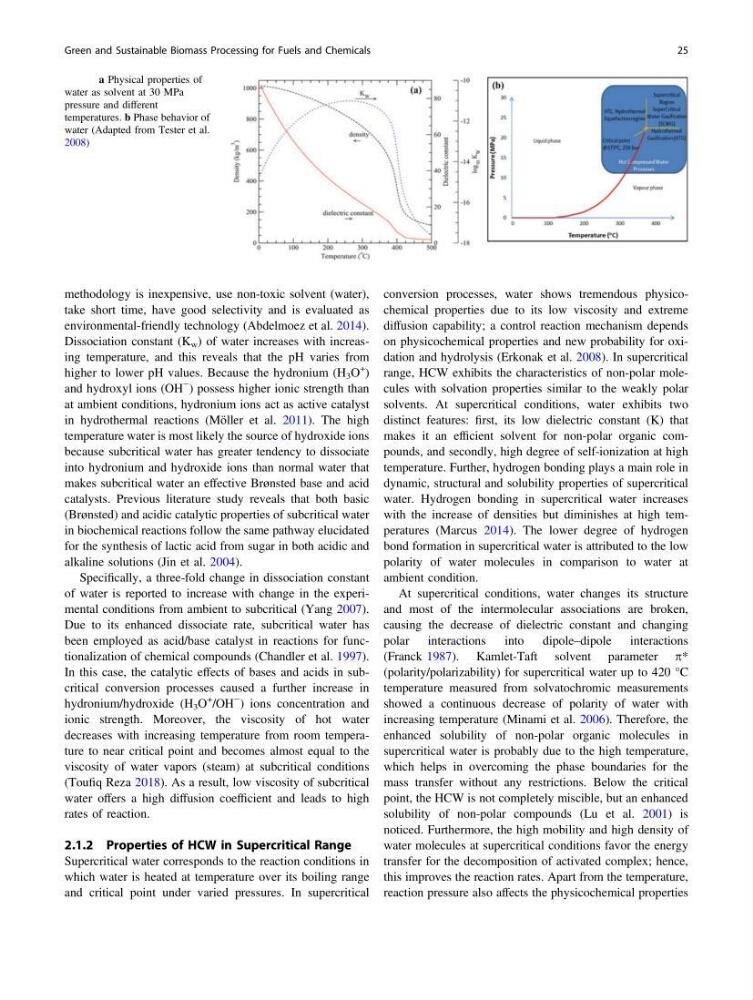
Dissociation constant (K w ) of water increases with increasing temperature, and this reveals that the pH varies from
higher to lower pH values. Because the hydronium (H 3 O
+
)
and hydroxyl ions (OH
− ) possess higher ionic strength than
at ambient conditions, hydronium ions act as active catalyst
in hydrothermal reactions (Möller et al. 2011). The high
temperature water is most likely the source of hydroxide ions
because subcritical water has greater tendency to dissociate
into hydronium and hydroxide ions than normal water that
makes subcritical water an effective Brønsted base and acid
catalysts. Previous literature study reveals that both basic
(Brønsted) and acidic catalytic properties of subcritical water
in biochemical reactions follow the same pathway elucidated
for the synthesis of lactic acid from sugar in both acidic and
alkaline solutions (Jin et al. 2004).
Specifically, a three-fold change in dissociation constant
of water is reported to increase with change in the experimental conditions from ambient to subcritical (Yang 2007).
Due to its enhanced dissociate rate, subcritical water has
been employed as acid/base catalyst in reactions for functionalization of chemical compounds (Chandler et al. 1997).
In this case, the catalytic effects of bases and acids in subcritical conversion processes caused a further increase in
hydronium/hydroxide (H 3 O
+
/OH
− ) ions concentration and
ionic strength. Moreover, the viscosity of hot water
decreases with increasing temperature from room temperature to near critical point and becomes almost equal to the
viscosity of water vapors (steam) at subcritical conditions
(Toufiq Reza 2018). As a result, low viscosity of subcritical
water offers a high diffusion coefficient and leads to high
rates of reaction.
2.1.2 Properties of HCW in Supercritical Range
Supercritical water corresponds to the reaction conditions in
which water is heated at temperature over its boiling range
and critical point under varied pressures. In supercritical
conversion processes, water shows tremendous physicochemical properties due to its low viscosity and extreme
diffusion capability; a control reaction mechanism depends
on physicochemical properties and new probability for oxidation and hydrolysis (Erkonak et al. 2008). In supercritical
range, HCW exhibits the characteristics of non-polar molecules with solvation properties similar to the weakly polar
solvents. At supercritical conditions, water exhibits two
distinct features: first, its low dielectric constant (K) that
makes it an efficient solvent for non-polar organic compounds, and secondly, high degree of self-ionization at high
temperature. Further, hydrogen bonding plays a main role in
dynamic, structural and solubility properties of supercritical
water. Hydrogen bonding in supercritical water increases
with the increase of densities but diminishes at high temperatures (Marcus 2014). The lower degree of hydrogen
bond formation in supercritical water is attributed to the low
polarity of water molecules in comparison to water at
ambient condition.
At supercritical conditions, water changes its structure
and most of the intermolecular associations are broken,
causing the decrease of dielectric constant and changing
polar interactions into dipole–dipole interactions
(Franck 1987). Kamlet-Taft solvent parameter p*
(polarity/polarizability) for supercritical water up to 420 °C
temperature measured from solvatochromic measurements
showed a continuous decrease of polarity of water with
increasing temperature (Minami et al. 2006). Therefore, the
enhanced solubility of non-polar organic molecules in
supercritical water is probably due to the high temperature,
which helps in overcoming the phase boundaries for the
mass transfer without any restrictions. Below the critical
point, the HCW is not completely miscible, but an enhanced
solubility of non-polar compounds (Lu et al. 2001) is
noticed. Furthermore, the high mobility and high density of
water molecules at supercritical conditions favor the energy
transfer for the decomposition of activated complex; hence,
this improves the reaction rates. Apart from the temperature,
reaction pressure also affects the physicochemical properties
Fig. 1 a Physical properties of
water as solvent at 30 MPa
pressure and different
temperatures. b Phase behavior of
water (Adapted from Tester et al.
2008)
Green and Sustainable Biomass Processing for Fuels and Chemicals
25
take short time, have good selectivity and is evaluated as
environmental-friendly technology (Abdelmoez et al. 2014).
Dissociation constant (K w ) of water increases with increasing temperature, and this reveals that the pH varies from
higher to lower pH values. Because the hydronium (H 3 O
+
)
and hydroxyl ions (OH
− ) possess higher ionic strength than
at ambient conditions, hydronium ions act as active catalyst
in hydrothermal reactions (Möller et al. 2011). The high
temperature water is most likely the source of hydroxide ions
because subcritical water has greater tendency to dissociate
into hydronium and hydroxide ions than normal water that
makes subcritical water an effective Brønsted base and acid
catalysts. Previous literature study reveals that both basic
(Brønsted) and acidic catalytic properties of subcritical water
in biochemical reactions follow the same pathway elucidated
for the synthesis of lactic acid from sugar in both acidic and
alkaline solutions (Jin et al. 2004).
Specifically, a three-fold change in dissociation constant
of water is reported to increase with change in the experimental conditions from ambient to subcritical (Yang 2007).
Due to its enhanced dissociate rate, subcritical water has
been employed as acid/base catalyst in reactions for functionalization of chemical compounds (Chandler et al. 1997).
In this case, the catalytic effects of bases and acids in subcritical conversion processes caused a further increase in
hydronium/hydroxide (H 3 O
+
/OH
− ) ions concentration and
ionic strength. Moreover, the viscosity of hot water
decreases with increasing temperature from room temperature to near critical point and becomes almost equal to the
viscosity of water vapors (steam) at subcritical conditions
(Toufiq Reza 2018). As a result, low viscosity of subcritical
water offers a high diffusion coefficient and leads to high
rates of reaction.
2.1.2 Properties of HCW in Supercritical Range
Supercritical water corresponds to the reaction conditions in
which water is heated at temperature over its boiling range
and critical point under varied pressures. In supercritical
conversion processes, water shows tremendous physicochemical properties due to its low viscosity and extreme
diffusion capability; a control reaction mechanism depends
on physicochemical properties and new probability for oxidation and hydrolysis (Erkonak et al. 2008). In supercritical
range, HCW exhibits the characteristics of non-polar molecules with solvation properties similar to the weakly polar
solvents. At supercritical conditions, water exhibits two
distinct features: first, its low dielectric constant (K) that
makes it an efficient solvent for non-polar organic compounds, and secondly, high degree of self-ionization at high
temperature. Further, hydrogen bonding plays a main role in
dynamic, structural and solubility properties of supercritical
water. Hydrogen bonding in supercritical water increases
with the increase of densities but diminishes at high temperatures (Marcus 2014). The lower degree of hydrogen
bond formation in supercritical water is attributed to the low
polarity of water molecules in comparison to water at
ambient condition.
At supercritical conditions, water changes its structure
and most of the intermolecular associations are broken,
causing the decrease of dielectric constant and changing
polar interactions into dipole–dipole interactions
(Franck 1987). Kamlet-Taft solvent parameter p*
(polarity/polarizability) for supercritical water up to 420 °C
temperature measured from solvatochromic measurements
showed a continuous decrease of polarity of water with
increasing temperature (Minami et al. 2006). Therefore, the
enhanced solubility of non-polar organic molecules in
supercritical water is probably due to the high temperature,
which helps in overcoming the phase boundaries for the
mass transfer without any restrictions. Below the critical
point, the HCW is not completely miscible, but an enhanced
solubility of non-polar compounds (Lu et al. 2001) is
noticed. Furthermore, the high mobility and high density of
water molecules at supercritical conditions favor the energy
transfer for the decomposition of activated complex; hence,
this improves the reaction rates. Apart from the temperature,
reaction pressure also affects the physicochemical properties
Fig. 1 a Physical properties of
water as solvent at 30 MPa
pressure and different
temperatures. b Phase behavior of
water (Adapted from Tester et al.
2008)
Green and Sustainable Biomass Processing for Fuels and Chemicals
25