

role in substituting fossil oil. Half of it is made up of cellulose while three-tenths is hemicellulose, with the remaining containing more of lignin. The biomass-derived glucose
feedstock is a major operating cost driver for hydrogen gas
production via fermentation (Maness et al. 2005; Giuseppe
et al. 2019). Among the various renewable energy sources,
biohydrogen is gradually gaining research interest due to its
high efficiency. Several methods are readily available to
generate biohydrogen from lignocellulosic biomass such as
direct biophotolysis and dark fermentations (Kusmardini
et al. 2018). The share of hydrogen in the energy market is
increasing with the implementation of fuel cell systems and
the growing demand for zero-emission fuels (Milne et al. n.
d) making microbial hydrogen production route an important
approach.
2 Hemicellulose
Hemicellulose is an important component present in wood
materials in native softwood and hardwood. The main
hemicellulose is galactoglucomannan and glucuronoxylan,
respectively (Willför et al. 2005a, b; Li et al. 2013). Hemicellulose belongs to a group of heterogeneous polysaccharides which are formed through biosynthetic routes different
from that of cellulose. It can also be seen as cell wall
polysaccharides that are not characterized as being either
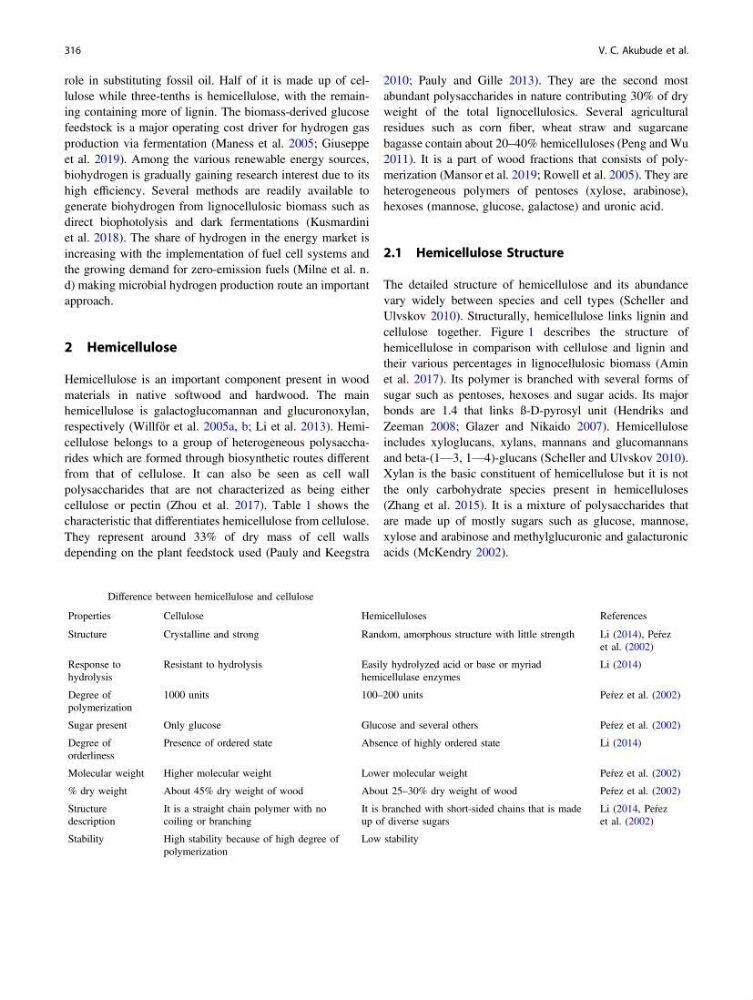
cellulose or pectin (Zhou et al. 2017). Table 1 shows the
characteristic that differentiates hemicellulose from cellulose.
They represent around 33% of dry mass of cell walls
depending on the plant feedstock used (Pauly and Keegstra
2010; Pauly and Gille 2013). They are the second most
abundant polysaccharides in nature contributing 30% of dry
weight of the total lignocellulosics. Several agricultural
residues such as corn fiber, wheat straw and sugarcane
bagasse contain about 20–40% hemicelluloses (Peng and Wu
2011). It is a part of wood fractions that consists of polymerization (Mansor et al. 2019; Rowell et al. 2005). They are
heterogeneous polymers of pentoses (xylose, arabinose),
hexoses (mannose, glucose, galactose) and uronic acid.
2.1 Hemicellulose Structure
The detailed structure of hemicellulose and its abundance
vary widely between species and cell types (Scheller and
Ulvskov 2010). Structurally, hemicellulose links lignin and
cellulose together. Figure 1 describes the structure of
hemicellulose in comparison with cellulose and lignin and
their various percentages in lignocellulosic biomass (Amin
et al. 2017). Its polymer is branched with several forms of
sugar such as pentoses, hexoses and sugar acids. Its major
bonds are 1.4 that links ß-D-pyrosyl unit (Hendriks and
Zeeman 2008; Glazer and Nikaido 2007). Hemicellulose
includes xyloglucans, xylans, mannans and glucomannans
and beta-(1—3, 1—4)-glucans (Scheller and Ulvskov 2010).
Xylan is the basic constituent of hemicellulose but it is not
the only carbohydrate species present in hemicelluloses
(Zhang et al. 2015). It is a mixture of polysaccharides that
are made up of mostly sugars such as glucose, mannose,
xylose and arabinose and methylglucuronic and galacturonic
acids (McKendry 2002).
Table 1 Difference between hemicellulose and cellulose
Properties
Cellulose
Hemicelluloses
References
Structure
Crystalline and strong
Random, amorphous structure with little strength
Li (2014), Peŕez
et al. (2002)
Response to
hydrolysis
Resistant to hydrolysis
Easily hydrolyzed acid or base or myriad
hemicellulase enzymes
Li (2014)
Degree of
polymerization
1000 units
100–200 units
Peŕez et al. (2002)
Sugar present
Only glucose
Glucose and several others
Peŕez et al. (2002)
Degree of
orderliness
Presence of ordered state
Absence of highly ordered state
Li (2014)
Molecular weight
Higher molecular weight
Lower molecular weight
Peŕez et al. (2002)
% dry weight
About 45% dry weight of wood
About 25–30% dry weight of wood
Peŕez et al. (2002)
Structure
description
It is a straight chain polymer with no
coiling or branching
It is branched with short-sided chains that is made
up of diverse sugars
Li (2014, Peŕez
et al. (2002)
Stability
High stability because of high degree of
polymerization
Low stability
316
V. C. Akubude et al.
feedstock is a major operating cost driver for hydrogen gas
production via fermentation (Maness et al. 2005; Giuseppe
et al. 2019). Among the various renewable energy sources,
biohydrogen is gradually gaining research interest due to its
high efficiency. Several methods are readily available to
generate biohydrogen from lignocellulosic biomass such as
direct biophotolysis and dark fermentations (Kusmardini
et al. 2018). The share of hydrogen in the energy market is
increasing with the implementation of fuel cell systems and
the growing demand for zero-emission fuels (Milne et al. n.
d) making microbial hydrogen production route an important
approach.
2 Hemicellulose
Hemicellulose is an important component present in wood
materials in native softwood and hardwood. The main
hemicellulose is galactoglucomannan and glucuronoxylan,
respectively (Willför et al. 2005a, b; Li et al. 2013). Hemicellulose belongs to a group of heterogeneous polysaccharides which are formed through biosynthetic routes different
from that of cellulose. It can also be seen as cell wall
polysaccharides that are not characterized as being either
cellulose or pectin (Zhou et al. 2017). Table 1 shows the
characteristic that differentiates hemicellulose from cellulose.
They represent around 33% of dry mass of cell walls
depending on the plant feedstock used (Pauly and Keegstra
2010; Pauly and Gille 2013). They are the second most
abundant polysaccharides in nature contributing 30% of dry
weight of the total lignocellulosics. Several agricultural
residues such as corn fiber, wheat straw and sugarcane
bagasse contain about 20–40% hemicelluloses (Peng and Wu
2011). It is a part of wood fractions that consists of polymerization (Mansor et al. 2019; Rowell et al. 2005). They are
heterogeneous polymers of pentoses (xylose, arabinose),
hexoses (mannose, glucose, galactose) and uronic acid.
2.1 Hemicellulose Structure
The detailed structure of hemicellulose and its abundance
vary widely between species and cell types (Scheller and
Ulvskov 2010). Structurally, hemicellulose links lignin and
cellulose together. Figure 1 describes the structure of
hemicellulose in comparison with cellulose and lignin and
their various percentages in lignocellulosic biomass (Amin
et al. 2017). Its polymer is branched with several forms of
sugar such as pentoses, hexoses and sugar acids. Its major
bonds are 1.4 that links ß-D-pyrosyl unit (Hendriks and
Zeeman 2008; Glazer and Nikaido 2007). Hemicellulose
includes xyloglucans, xylans, mannans and glucomannans
and beta-(1—3, 1—4)-glucans (Scheller and Ulvskov 2010).
Xylan is the basic constituent of hemicellulose but it is not
the only carbohydrate species present in hemicelluloses
(Zhang et al. 2015). It is a mixture of polysaccharides that
are made up of mostly sugars such as glucose, mannose,
xylose and arabinose and methylglucuronic and galacturonic
acids (McKendry 2002).
Table 1 Difference between hemicellulose and cellulose
Properties
Cellulose
Hemicelluloses
References
Structure
Crystalline and strong
Random, amorphous structure with little strength
Li (2014), Peŕez
et al. (2002)
Response to
hydrolysis
Resistant to hydrolysis
Easily hydrolyzed acid or base or myriad
hemicellulase enzymes
Li (2014)
Degree of
polymerization
1000 units
100–200 units
Peŕez et al. (2002)
Sugar present
Only glucose
Glucose and several others
Peŕez et al. (2002)
Degree of
orderliness
Presence of ordered state
Absence of highly ordered state
Li (2014)
Molecular weight
Higher molecular weight
Lower molecular weight
Peŕez et al. (2002)
% dry weight
About 45% dry weight of wood
About 25–30% dry weight of wood
Peŕez et al. (2002)
Structure
description
It is a straight chain polymer with no
coiling or branching
It is branched with short-sided chains that is made
up of diverse sugars
Li (2014, Peŕez
et al. (2002)
Stability
High stability because of high degree of
polymerization
Low stability
316
V. C. Akubude et al.