

be close to the range between 33 and 37% of the coal firing
(DOE 2000). Figure 12 presents the advantages and disadvantages of cofiring of manure and base fuel.
4.8 Emerging Technologies for Manure
Conversion
Many options developed in the previous sections relate to
the technologies that are generally used for conversion of
manure effluents for the last few decades. There are
emerging technologies which are growing and they could be
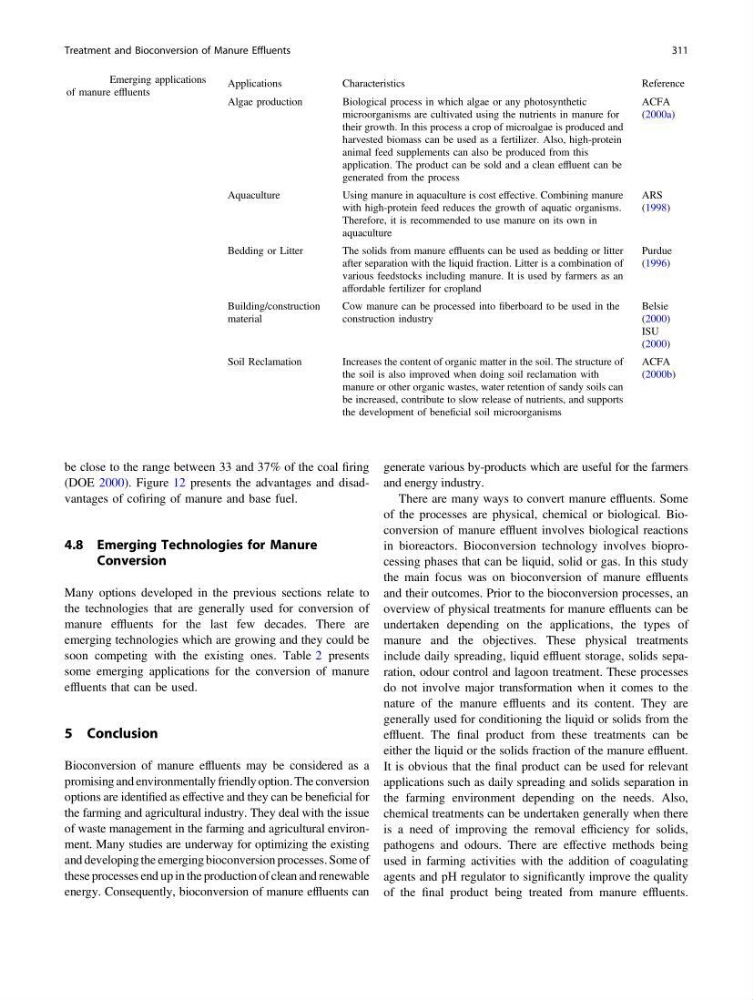
soon competing with the existing ones. Table 2 presents
some emerging applications for the conversion of manure
effluents that can be used.
5 Conclusion
Bioconversion of manure effluents may be considered as a
promising and environmentally friendly option. The conversion
options are identified as effective and they can be beneficial for
the farming and agricultural industry. They deal with the issue
of waste management in the farming and agricultural environment. Many studies are underway for optimizing the existing
and developing the emerging bioconversion processes. Some of
these processes end up in the production of clean and renewable
energy. Consequently, bioconversion of manure effluents can
generate various by-products which are useful for the farmers
and energy industry.
There are many ways to convert manure effluents. Some
of the processes are physical, chemical or biological. Bioconversion of manure effluent involves biological reactions
in bioreactors. Bioconversion technology involves bioprocessing phases that can be liquid, solid or gas. In this study
the main focus was on bioconversion of manure effluents
and their outcomes. Prior to the bioconversion processes, an
overview of physical treatments for manure effluents can be
undertaken depending on the applications, the types of
manure and the objectives. These physical treatments
include daily spreading, liquid effluent storage, solids separation, odour control and lagoon treatment. These processes
do not involve major transformation when it comes to the
nature of the manure effluents and its content. They are
generally used for conditioning the liquid or solids from the
effluent. The final product from these treatments can be
either the liquid or the solids fraction of the manure effluent.
It is obvious that the final product can be used for relevant
applications such as daily spreading and solids separation in
the farming environment depending on the needs. Also,
chemical treatments can be undertaken generally when there
is a need of improving the removal efficiency for solids,
pathogens and odours. There are effective methods being
used in farming activities with the addition of coagulating
agents and pH regulator to significantly improve the quality
of the final product being treated from manure effluents.
Table 2 Emerging applications
of manure effluents
Applications
Characteristics
Reference
Algae production
Biological process in which algae or any photosynthetic
microorganisms are cultivated using the nutrients in manure for
their growth. In this process a crop of microalgae is produced and
harvested biomass can be used as a fertilizer. Also, high-protein
animal feed supplements can also be produced from this
application. The product can be sold and a clean effluent can be
generated from the process
ACFA
(2000a)
Aquaculture
Using manure in aquaculture is cost effective. Combining manure
with high-protein feed reduces the growth of aquatic organisms.
Therefore, it is recommended to use manure on its own in
aquaculture
ARS
(1998)
Bedding or Litter
The solids from manure effluents can be used as bedding or litter
after separation with the liquid fraction. Litter is a combination of
various feedstocks including manure. It is used by farmers as an
affordable fertilizer for cropland
Purdue
(1996)
Building/construction
material
Cow manure can be processed into fiberboard to be used in the
construction industry
Belsie
(2000)
ISU
(2000)
Soil Reclamation
Increases the content of organic matter in the soil. The structure of
the soil is also improved when doing soil reclamation with
manure or other organic wastes, water retention of sandy soils can
be increased, contribute to slow release of nutrients, and supports
the development of beneficial soil microorganisms
ACFA
(2000b)
Treatment and Bioconversion of Manure Effluents
311
(DOE 2000). Figure 12 presents the advantages and disadvantages of cofiring of manure and base fuel.
4.8 Emerging Technologies for Manure
Conversion
Many options developed in the previous sections relate to
the technologies that are generally used for conversion of
manure effluents for the last few decades. There are
emerging technologies which are growing and they could be
soon competing with the existing ones. Table 2 presents
some emerging applications for the conversion of manure
effluents that can be used.
5 Conclusion
Bioconversion of manure effluents may be considered as a
promising and environmentally friendly option. The conversion
options are identified as effective and they can be beneficial for
the farming and agricultural industry. They deal with the issue
of waste management in the farming and agricultural environment. Many studies are underway for optimizing the existing
and developing the emerging bioconversion processes. Some of
these processes end up in the production of clean and renewable
energy. Consequently, bioconversion of manure effluents can
generate various by-products which are useful for the farmers
and energy industry.
There are many ways to convert manure effluents. Some
of the processes are physical, chemical or biological. Bioconversion of manure effluent involves biological reactions
in bioreactors. Bioconversion technology involves bioprocessing phases that can be liquid, solid or gas. In this study
the main focus was on bioconversion of manure effluents
and their outcomes. Prior to the bioconversion processes, an
overview of physical treatments for manure effluents can be
undertaken depending on the applications, the types of
manure and the objectives. These physical treatments
include daily spreading, liquid effluent storage, solids separation, odour control and lagoon treatment. These processes
do not involve major transformation when it comes to the
nature of the manure effluents and its content. They are
generally used for conditioning the liquid or solids from the
effluent. The final product from these treatments can be
either the liquid or the solids fraction of the manure effluent.
It is obvious that the final product can be used for relevant
applications such as daily spreading and solids separation in
the farming environment depending on the needs. Also,
chemical treatments can be undertaken generally when there
is a need of improving the removal efficiency for solids,
pathogens and odours. There are effective methods being
used in farming activities with the addition of coagulating
agents and pH regulator to significantly improve the quality
of the final product being treated from manure effluents.
Table 2 Emerging applications
of manure effluents
Applications
Characteristics
Reference
Algae production
Biological process in which algae or any photosynthetic
microorganisms are cultivated using the nutrients in manure for
their growth. In this process a crop of microalgae is produced and
harvested biomass can be used as a fertilizer. Also, high-protein
animal feed supplements can also be produced from this
application. The product can be sold and a clean effluent can be
generated from the process
ACFA
(2000a)
Aquaculture
Using manure in aquaculture is cost effective. Combining manure
with high-protein feed reduces the growth of aquatic organisms.
Therefore, it is recommended to use manure on its own in
aquaculture
ARS
(1998)
Bedding or Litter
The solids from manure effluents can be used as bedding or litter
after separation with the liquid fraction. Litter is a combination of
various feedstocks including manure. It is used by farmers as an
affordable fertilizer for cropland
Purdue
(1996)
Building/construction
material
Cow manure can be processed into fiberboard to be used in the
construction industry
Belsie
(2000)
ISU
(2000)
Soil Reclamation
Increases the content of organic matter in the soil. The structure of
the soil is also improved when doing soil reclamation with
manure or other organic wastes, water retention of sandy soils can
be increased, contribute to slow release of nutrients, and supports
the development of beneficial soil microorganisms
ACFA
(2000b)
Treatment and Bioconversion of Manure Effluents
311