

2.1.4 Odour Control
The control of odour for stored liquid manure is a major
need whenever it comes to manure effluent management (Liu
and Wang 2020; Kleinman et al. 2017). Chemical and biological treatments are tested and proposed in order to deal
with the issue of smelling or odour generation from manure
effluents. Figure 4 presents a brief summary related to
strengths and weaknesses of this operation.
2.1.5 Lagoon Treatments for Solids Settling
In this treatment manure is diluted; consequently, solid
particles will settle down in large narrow pool. There will be
a flow of the effluent as flush water to a facultative lagoon.
This constitutes a recycling process in which more manure
will be diluted. The removal of liquid and solid fractions out
of the lagoon treatment system is done periodically
depending on the extent of the system loadings. A patented
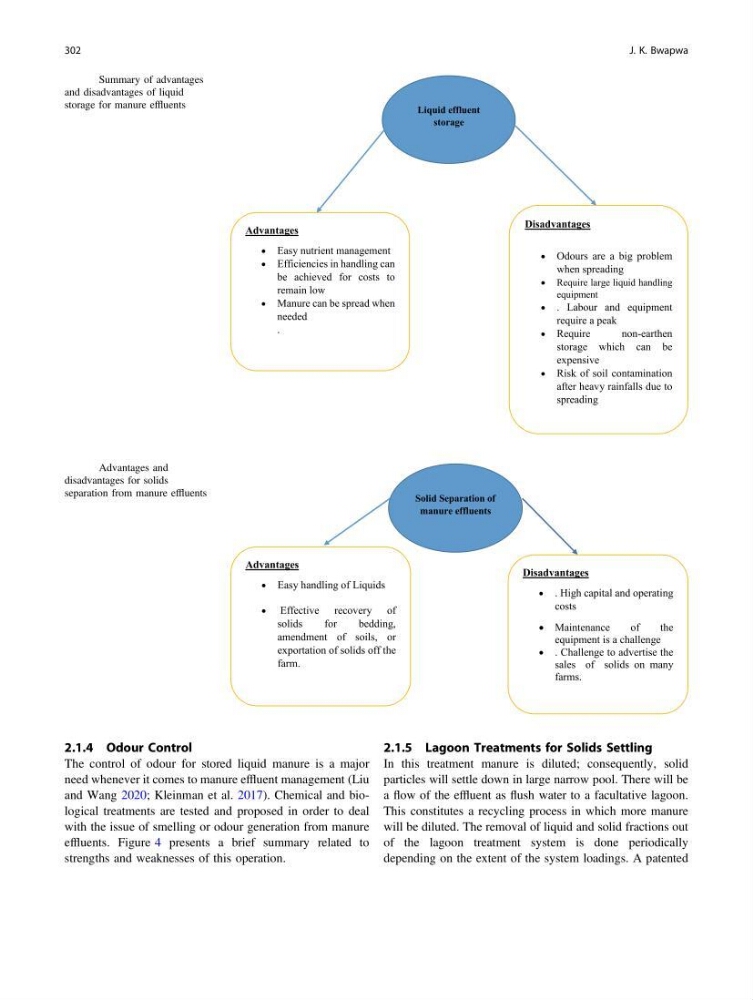
Fig. 2 Summary of advantages
and disadvantages of liquid
storage for manure effluents
Fig. 3 Advantages and
disadvantages for solids
separation from manure effluents
302
J. K. Bwapwa
The control of odour for stored liquid manure is a major
need whenever it comes to manure effluent management (Liu
and Wang 2020; Kleinman et al. 2017). Chemical and biological treatments are tested and proposed in order to deal
with the issue of smelling or odour generation from manure
effluents. Figure 4 presents a brief summary related to
strengths and weaknesses of this operation.
2.1.5 Lagoon Treatments for Solids Settling
In this treatment manure is diluted; consequently, solid
particles will settle down in large narrow pool. There will be
a flow of the effluent as flush water to a facultative lagoon.
This constitutes a recycling process in which more manure
will be diluted. The removal of liquid and solid fractions out
of the lagoon treatment system is done periodically
depending on the extent of the system loadings. A patented
Fig. 2 Summary of advantages
and disadvantages of liquid
storage for manure effluents
Fig. 3 Advantages and
disadvantages for solids
separation from manure effluents
302
J. K. Bwapwa