

5.2 Use of Alkali
Pretreatment of feedstock at higher pH is carried out by using
concentrated or dilute alkali at low pressure and temperature
(Qadir et al. 2018). Along with lignin removal, removal of
uronic acid and acetyl substitution in the hemicellulose is also
possible by using potassium hydroxide, sodium hydroxide,
calcium hydroxide, and ammonium hydroxide (Chang and
Holtzapple 2000; Soto et al. 1994). Intermolecular ester bonds
between polysaccharides and lignin are hydrolyzed by alkaline pretreatment (Sun and Cheng 2002). However, polysaccharides undergo oxidation reaction or these are hydrolyzed
due to alkaline conditions (Bhaumik and Dhepe 2016).
5.3 Use of Concentrated Acids
Concentrated acids not only decrystallize cellulose but also
cleave the hemicellulose and cellulose into sugars and catalyze
the hydrolysis of glycosidic bonds (Smeets et al. 2007). In the
United States, 80–90% conversion of hemicellulose and cellulose into sugars is carried out by sulfuric acid (Dunning and
Lathrop 1945; Farone WA 1998). However, hazards are
associated with the use of concentrated acids and also recycling is difficult which limits the adoption of this technology.
5.4 Use of Dilute Acids
Acids such as HCl, HNO 3 , H 2 SO 4, or H 3 PO 4 are used in
industries for catalytic hydrolysis of hemicellulose. Carvalheiro et al. (2008) reported the hydrolysis of hemicellulose
by 0.5–1.5% sulfuric acid at 120–160 °C. Some advantages
of using dilute acid pretreatment were reported by Esteghlalian et al. (1997) as
a. higher reaction rate,
b. low acid consumption,
c. cost-effective than alkaline pretreatment,
d. recycling is not required.
It is worthy to consider that pretreatment temperature
and catalyst concentration affect the formation of chemical
inhibitors (Mussatto and Roberto 2004). Processes at
high-temperature result in the formation of inhibitory
compounds in the hydrolysate (Téllez-Luis et al. 2002).
According to Carrasco and Roy (1992), acid-catalyzed
hydrolysis of hemicellulose at higher temperature favors
the depolymerization. Nonetheless, inhibitory compounds
are essentially generated and considered as the major
drawback of dilute acid catalyzed hydrolysis (Jeffries
1983).
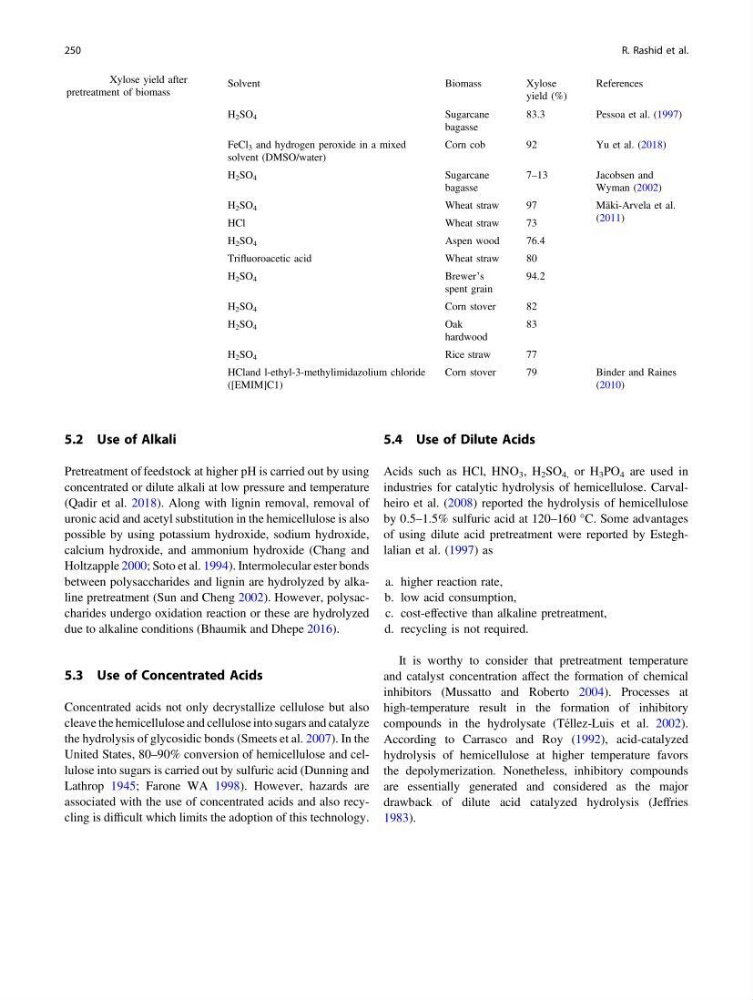
Table 4 Xylose yield after
pretreatment of biomass
Solvent
Biomass
Xylose
yield (%)
References
H 2 SO 4
Sugarcane
bagasse
83.3
Pessoa et al. (1997)
FeCl 3 and hydrogen peroxide in a mixed
solvent (DMSO/water)
Corn cob
92
Yu et al. (2018)
H 2 SO 4
Sugarcane
bagasse
7–13
Jacobsen and
Wyman (2002)
H 2 SO 4
Wheat straw
97
Mäki-Arvela et al.
(2011)
HCl
Wheat straw
73
H 2 SO 4
Aspen wood
76.4
Trifluoroacetic acid
Wheat straw
80
H 2 SO 4
Brewer’s
spent grain
94.2
H 2 SO 4
Corn stover
82
H 2 SO 4
Oak
hardwood
83
H 2 SO 4
Rice straw
77
HCland l-ethyl-3-methylimidazolium chloride
([EMIM]C1)
Corn stover
79
Binder and Raines
(2010)
250
R. Rashid et al.
Pretreatment of feedstock at higher pH is carried out by using
concentrated or dilute alkali at low pressure and temperature
(Qadir et al. 2018). Along with lignin removal, removal of
uronic acid and acetyl substitution in the hemicellulose is also
possible by using potassium hydroxide, sodium hydroxide,
calcium hydroxide, and ammonium hydroxide (Chang and
Holtzapple 2000; Soto et al. 1994). Intermolecular ester bonds
between polysaccharides and lignin are hydrolyzed by alkaline pretreatment (Sun and Cheng 2002). However, polysaccharides undergo oxidation reaction or these are hydrolyzed
due to alkaline conditions (Bhaumik and Dhepe 2016).
5.3 Use of Concentrated Acids
Concentrated acids not only decrystallize cellulose but also
cleave the hemicellulose and cellulose into sugars and catalyze
the hydrolysis of glycosidic bonds (Smeets et al. 2007). In the
United States, 80–90% conversion of hemicellulose and cellulose into sugars is carried out by sulfuric acid (Dunning and
Lathrop 1945; Farone WA 1998). However, hazards are
associated with the use of concentrated acids and also recycling is difficult which limits the adoption of this technology.
5.4 Use of Dilute Acids
Acids such as HCl, HNO 3 , H 2 SO 4, or H 3 PO 4 are used in
industries for catalytic hydrolysis of hemicellulose. Carvalheiro et al. (2008) reported the hydrolysis of hemicellulose
by 0.5–1.5% sulfuric acid at 120–160 °C. Some advantages
of using dilute acid pretreatment were reported by Esteghlalian et al. (1997) as
a. higher reaction rate,
b. low acid consumption,
c. cost-effective than alkaline pretreatment,
d. recycling is not required.
It is worthy to consider that pretreatment temperature
and catalyst concentration affect the formation of chemical
inhibitors (Mussatto and Roberto 2004). Processes at
high-temperature result in the formation of inhibitory
compounds in the hydrolysate (Téllez-Luis et al. 2002).
According to Carrasco and Roy (1992), acid-catalyzed
hydrolysis of hemicellulose at higher temperature favors
the depolymerization. Nonetheless, inhibitory compounds
are essentially generated and considered as the major
drawback of dilute acid catalyzed hydrolysis (Jeffries
1983).
Table 4 Xylose yield after
pretreatment of biomass
Solvent
Biomass
Xylose
yield (%)
References
H 2 SO 4
Sugarcane
bagasse
83.3
Pessoa et al. (1997)
FeCl 3 and hydrogen peroxide in a mixed
solvent (DMSO/water)
Corn cob
92
Yu et al. (2018)
H 2 SO 4
Sugarcane
bagasse
7–13
Jacobsen and
Wyman (2002)
H 2 SO 4
Wheat straw
97
Mäki-Arvela et al.
(2011)
HCl
Wheat straw
73
H 2 SO 4
Aspen wood
76.4
Trifluoroacetic acid
Wheat straw
80
H 2 SO 4
Brewer’s
spent grain
94.2
H 2 SO 4
Corn stover
82
H 2 SO 4
Oak
hardwood
83
H 2 SO 4
Rice straw
77
HCland l-ethyl-3-methylimidazolium chloride
([EMIM]C1)
Corn stover
79
Binder and Raines
(2010)
250
R. Rashid et al.