

2.1 Structure of Plant Cell Wall
The structure of plant cell wall varies from different tissues
within a plant and also from species to species. It exists in
two forms, primary and secondary. During the plant cell
division, primary cell wall is formed which is responsible for
the protection and cell to cell interaction and to support the
basic structure. However, secondary cell wall is formed after
the cell division (Houston et al. 2016).
2.2 Composition of Lignocellulosic Feedstock
Lignocellulosic (LC) feedstock is mainly consists of an
aromatic polymer lignin, and polymeric carbohydrates, i.e.,
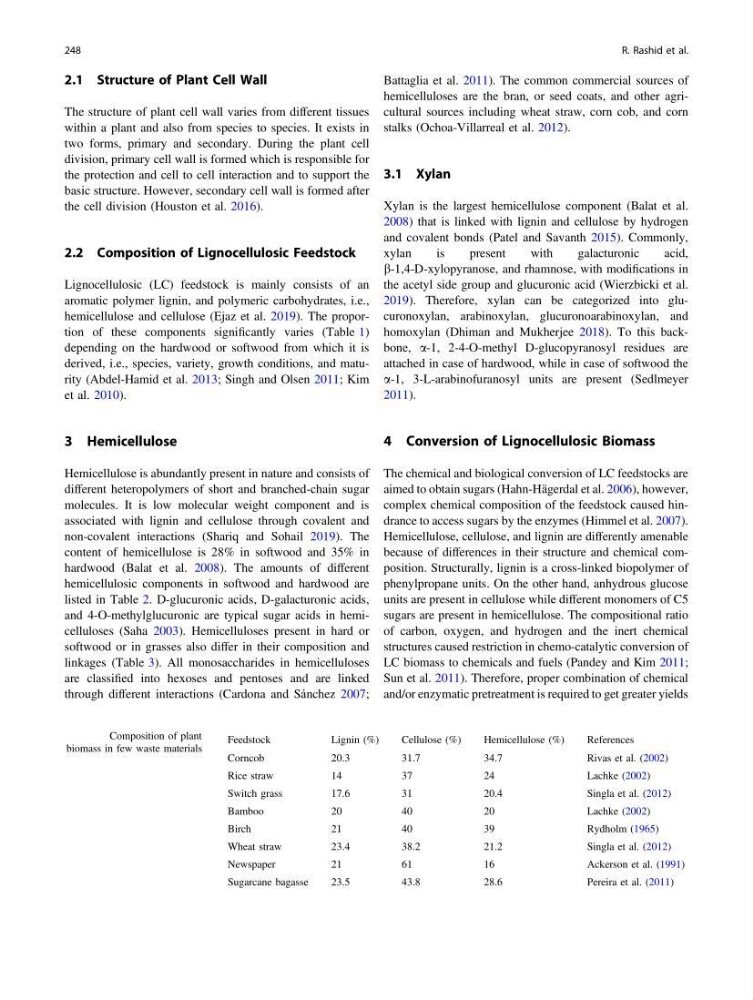
hemicellulose and cellulose (Ejaz et al. 2019). The proportion of these components significantly varies (Table 1)
depending on the hardwood or softwood from which it is
derived, i.e., species, variety, growth conditions, and maturity (Abdel-Hamid et al. 2013; Singh and Olsen 2011; Kim
et al. 2010).
3 Hemicellulose
Hemicellulose is abundantly present in nature and consists of
different heteropolymers of short and branched-chain sugar
molecules. It is low molecular weight component and is
associated with lignin and cellulose through covalent and
non-covalent interactions (Shariq and Sohail 2019). The
content of hemicellulose is 28% in softwood and 35% in
hardwood (Balat et al. 2008). The amounts of different
hemicellulosic components in softwood and hardwood are
listed in Table 2. D-glucuronic acids, D-galacturonic acids,
and 4-O-methylglucuronic are typical sugar acids in hemicelluloses (Saha 2003). Hemicelluloses present in hard or
softwood or in grasses also differ in their composition and
linkages (Table 3). All monosaccharides in hemicelluloses
are classified into hexoses and pentoses and are linked
through different interactions (Cardona and Sánchez 2007;
Battaglia et al. 2011). The common commercial sources of
hemicelluloses are the bran, or seed coats, and other agricultural sources including wheat straw, corn cob, and corn
stalks (Ochoa-Villarreal et al. 2012).
3.1 Xylan
Xylan is the largest hemicellulose component (Balat et al.
2008) that is linked with lignin and cellulose by hydrogen
and covalent bonds (Patel and Savanth 2015). Commonly,
xylan
is
present
with
galacturonic
acid,
b-1,4-D-xylopyranose, and rhamnose, with modifications in
the acetyl side group and glucuronic acid (Wierzbicki et al.
2019). Therefore, xylan can be categorized into glucuronoxylan, arabinoxylan, glucuronoarabinoxylan, and
homoxylan (Dhiman and Mukherjee 2018). To this backbone, a-1, 2-4-O-methyl D-glucopyranosyl residues are
attached in case of hardwood, while in case of softwood the
a-1, 3-L-arabinofuranosyl units are present (Sedlmeyer
2011).
4 Conversion of Lignocellulosic Biomass
The chemical and biological conversion of LC feedstocks are
aimed to obtain sugars (Hahn-Hägerdal et al. 2006), however,
complex chemical composition of the feedstock caused hindrance to access sugars by the enzymes (Himmel et al. 2007).
Hemicellulose, cellulose, and lignin are differently amenable
because of differences in their structure and chemical composition. Structurally, lignin is a cross-linked biopolymer of
phenylpropane units. On the other hand, anhydrous glucose
units are present in cellulose while different monomers of C5
sugars are present in hemicellulose. The compositional ratio
of carbon, oxygen, and hydrogen and the inert chemical
structures caused restriction in chemo-catalytic conversion of
LC biomass to chemicals and fuels (Pandey and Kim 2011;
Sun et al. 2011). Therefore, proper combination of chemical
and/or enzymatic pretreatment is required to get greater yields
Table 1 Composition of plant
biomass in few waste materials
Feedstock
Lignin (%)
Cellulose (%)
Hemicellulose (%)
References
Corncob
20.3
31.7
34.7
Rivas et al. (2002)
Rice straw
14
37
24
Lachke (2002)
Switch grass
17.6
31
20.4
Singla et al. (2012)
Bamboo
20
40
20
Lachke (2002)
Birch
21
40
39
Rydholm (1965)
Wheat straw
23.4
38.2
21.2
Singla et al. (2012)
Newspaper
21
61
16
Ackerson et al. (1991)
Sugarcane bagasse
23.5
43.8
28.6
Pereira et al. (2011)
248
R. Rashid et al.
The structure of plant cell wall varies from different tissues
within a plant and also from species to species. It exists in
two forms, primary and secondary. During the plant cell
division, primary cell wall is formed which is responsible for
the protection and cell to cell interaction and to support the
basic structure. However, secondary cell wall is formed after
the cell division (Houston et al. 2016).
2.2 Composition of Lignocellulosic Feedstock
Lignocellulosic (LC) feedstock is mainly consists of an
aromatic polymer lignin, and polymeric carbohydrates, i.e.,
hemicellulose and cellulose (Ejaz et al. 2019). The proportion of these components significantly varies (Table 1)
depending on the hardwood or softwood from which it is
derived, i.e., species, variety, growth conditions, and maturity (Abdel-Hamid et al. 2013; Singh and Olsen 2011; Kim
et al. 2010).
3 Hemicellulose
Hemicellulose is abundantly present in nature and consists of
different heteropolymers of short and branched-chain sugar
molecules. It is low molecular weight component and is
associated with lignin and cellulose through covalent and
non-covalent interactions (Shariq and Sohail 2019). The
content of hemicellulose is 28% in softwood and 35% in
hardwood (Balat et al. 2008). The amounts of different
hemicellulosic components in softwood and hardwood are
listed in Table 2. D-glucuronic acids, D-galacturonic acids,
and 4-O-methylglucuronic are typical sugar acids in hemicelluloses (Saha 2003). Hemicelluloses present in hard or
softwood or in grasses also differ in their composition and
linkages (Table 3). All monosaccharides in hemicelluloses
are classified into hexoses and pentoses and are linked
through different interactions (Cardona and Sánchez 2007;
Battaglia et al. 2011). The common commercial sources of
hemicelluloses are the bran, or seed coats, and other agricultural sources including wheat straw, corn cob, and corn
stalks (Ochoa-Villarreal et al. 2012).
3.1 Xylan
Xylan is the largest hemicellulose component (Balat et al.
2008) that is linked with lignin and cellulose by hydrogen
and covalent bonds (Patel and Savanth 2015). Commonly,
xylan
is
present
with
galacturonic
acid,
b-1,4-D-xylopyranose, and rhamnose, with modifications in
the acetyl side group and glucuronic acid (Wierzbicki et al.
2019). Therefore, xylan can be categorized into glucuronoxylan, arabinoxylan, glucuronoarabinoxylan, and
homoxylan (Dhiman and Mukherjee 2018). To this backbone, a-1, 2-4-O-methyl D-glucopyranosyl residues are
attached in case of hardwood, while in case of softwood the
a-1, 3-L-arabinofuranosyl units are present (Sedlmeyer
2011).
4 Conversion of Lignocellulosic Biomass
The chemical and biological conversion of LC feedstocks are
aimed to obtain sugars (Hahn-Hägerdal et al. 2006), however,
complex chemical composition of the feedstock caused hindrance to access sugars by the enzymes (Himmel et al. 2007).
Hemicellulose, cellulose, and lignin are differently amenable
because of differences in their structure and chemical composition. Structurally, lignin is a cross-linked biopolymer of
phenylpropane units. On the other hand, anhydrous glucose
units are present in cellulose while different monomers of C5
sugars are present in hemicellulose. The compositional ratio
of carbon, oxygen, and hydrogen and the inert chemical
structures caused restriction in chemo-catalytic conversion of
LC biomass to chemicals and fuels (Pandey and Kim 2011;
Sun et al. 2011). Therefore, proper combination of chemical
and/or enzymatic pretreatment is required to get greater yields
Table 1 Composition of plant
biomass in few waste materials
Feedstock
Lignin (%)
Cellulose (%)
Hemicellulose (%)
References
Corncob
20.3
31.7
34.7
Rivas et al. (2002)
Rice straw
14
37
24
Lachke (2002)
Switch grass
17.6
31
20.4
Singla et al. (2012)
Bamboo
20
40
20
Lachke (2002)
Birch
21
40
39
Rydholm (1965)
Wheat straw
23.4
38.2
21.2
Singla et al. (2012)
Newspaper
21
61
16
Ackerson et al. (1991)
Sugarcane bagasse
23.5
43.8
28.6
Pereira et al. (2011)
248
R. Rashid et al.