

Østergård 2016). Other examples are the use of olive mill
wastewater and wine-grape by-products for methane production. To this end, an anaerobic co-digestion of these
residues was carried out obtaining efficient results (Fountoulakis et al. 2008).
2.2 Animal Feeding
The use of agri-food by-products for animal feeding is an
ancient use. For this reason and because of the great availability of produced agro-industrial residues, the incorporation of these industrial by-products in the animal feeding is a
potential strategy to decrease the ecological and water
footprint associated with crop cultivation (Correddu et al.
2020). In addition, the presence of bioactive phytochemicals
in these residues provides an added value in animal health.
For example, the positive effect of polyphenols from
agro-industrial residues on oxidative status in wethers has
been demonstrated (Ishida et al. 2015). Furthermore, in case
of ruminants, these have the unique capacity to use fibre due
to their rumen microbes. Hence, cereals can be replaced for
these residues (Mirzaei-aghsaghali and Maheri-sis 2013).
However, some aspects should be considered since it has
been demonstrated that agro-industrial residues rich in phenolic compounds, usually deprive nutrient digestibility
versus traditional feedstuffs. This fact is related to a high
content of lignin and tannin (Correddu et al. 2020).
2.3 Functional Food
Agro-industrial by-products from fruit and vegetable processing provide an important source of bioactive compounds
such as fibre, antioxidants, and prebiotics. This fact makes
that these co-products could be incorporated for the development of functional food (Hernández-Alcántara et al.
2016). For example, olive mill wastewater is a by-product
with high phenolic content from the virgin olive oil production. When this agro-industrial residue is added into
vegetable oils, milk beverages, or meat products, it reduces
the lipid oxidation, improves the oxidative status of the
products, and provides antimicrobial effects (Caporaso et al.
2018). In other studies, the fruit and vegetable solid residue
generated from the manufacture of an isotonic beverage was
used for functional biscuits and cereal bars, with high fibre
and mineral content (Ferreira et al. 2013). A similar process
has been also applied in the case of cactus pear flour and
pineapple peel flour when they were incorporated in cooked
sausages inoculated with lactic acid bacteria, which
improved the thermostability lactic acid bacteria in this food
during storage (Díaz-Vela et al. 2015).
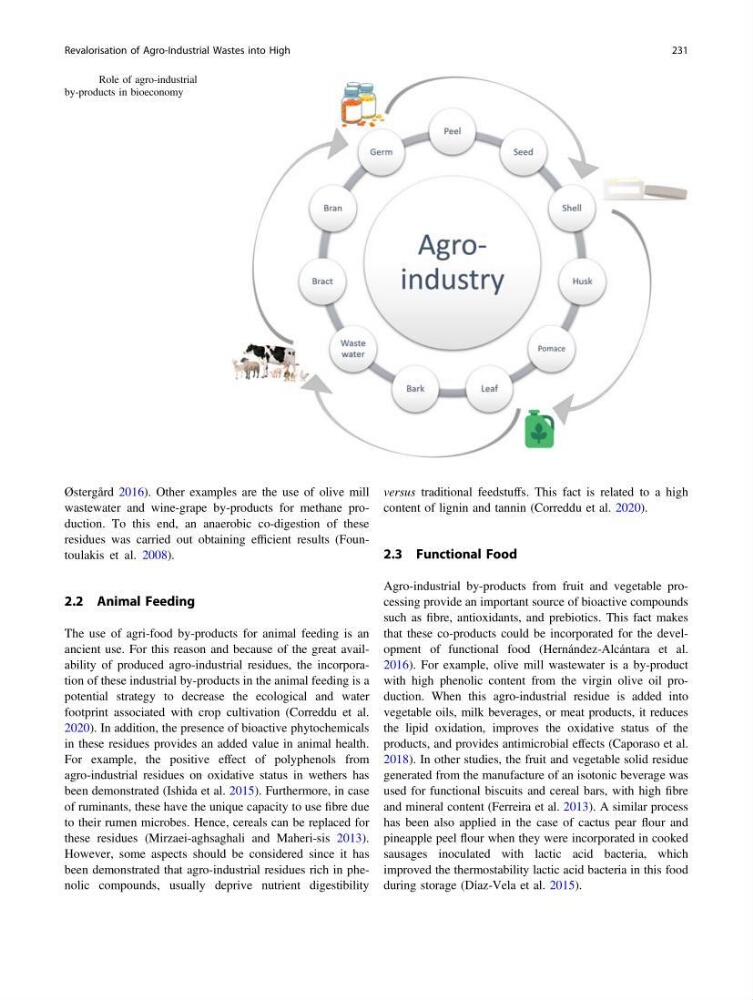
Fig. 1 Role of agro-industrial
by-products in bioeconomy
Revalorisation of Agro-Industrial Wastes into High
231
wastewater and wine-grape by-products for methane production. To this end, an anaerobic co-digestion of these
residues was carried out obtaining efficient results (Fountoulakis et al. 2008).
2.2 Animal Feeding
The use of agri-food by-products for animal feeding is an
ancient use. For this reason and because of the great availability of produced agro-industrial residues, the incorporation of these industrial by-products in the animal feeding is a
potential strategy to decrease the ecological and water
footprint associated with crop cultivation (Correddu et al.
2020). In addition, the presence of bioactive phytochemicals
in these residues provides an added value in animal health.
For example, the positive effect of polyphenols from
agro-industrial residues on oxidative status in wethers has
been demonstrated (Ishida et al. 2015). Furthermore, in case
of ruminants, these have the unique capacity to use fibre due
to their rumen microbes. Hence, cereals can be replaced for
these residues (Mirzaei-aghsaghali and Maheri-sis 2013).
However, some aspects should be considered since it has
been demonstrated that agro-industrial residues rich in phenolic compounds, usually deprive nutrient digestibility
versus traditional feedstuffs. This fact is related to a high
content of lignin and tannin (Correddu et al. 2020).
2.3 Functional Food
Agro-industrial by-products from fruit and vegetable processing provide an important source of bioactive compounds
such as fibre, antioxidants, and prebiotics. This fact makes
that these co-products could be incorporated for the development of functional food (Hernández-Alcántara et al.
2016). For example, olive mill wastewater is a by-product
with high phenolic content from the virgin olive oil production. When this agro-industrial residue is added into
vegetable oils, milk beverages, or meat products, it reduces
the lipid oxidation, improves the oxidative status of the
products, and provides antimicrobial effects (Caporaso et al.
2018). In other studies, the fruit and vegetable solid residue
generated from the manufacture of an isotonic beverage was
used for functional biscuits and cereal bars, with high fibre
and mineral content (Ferreira et al. 2013). A similar process
has been also applied in the case of cactus pear flour and
pineapple peel flour when they were incorporated in cooked
sausages inoculated with lactic acid bacteria, which
improved the thermostability lactic acid bacteria in this food
during storage (Díaz-Vela et al. 2015).
Fig. 1 Role of agro-industrial
by-products in bioeconomy
Revalorisation of Agro-Industrial Wastes into High
231