

as in different stages of food supply chain. In addition, a huge
amount of food waste is also generated in different food
processing industries (FAO 2019; Ravindran and Jaiswal
2016). These food wastes are classified into two major groups
as the waste obtained from plants and the waste obtained from
animals based on biochemical characteristics of food waste
and origin. The wastes obtained from animals are mainly
produced from the dairy, meat, fisheries, and seafood processing industries. Similarly, plant-derived wastes include
different types of residues obtained from different crops
including FV (Ravindran and Jaiswal 2016). These FV are
produced seasonally and overproduction during the season
must be stored properly for future use. However, the perishable nature of FV, inappropriate storage conditions mainly in
tropical regions lead to increased production of waste. In
addition, the remains of FV like stem, stalks, leaves, roots,
and tubers impart in waste. FV processing waste includes
pomace, peels, and seeds accounting for 25–30% waste.
Thus, it is revealed that FV losses or wastes are mostly due to
post-harvest grading quality standards of FV set by retailers.
This type of loss and deterioration of crops mainly occur in
hot and moist climates, the seasonality that results in insufficient access (FAO 2019).
According to FAO (2011) a combined data from Canada,
New Zealand, the USA, and Australia nearly half the amount
of the FV produced in the world annually end up as wastes
(FAO 2011) in the garbage. Other factors like improper
drying, storage, and transportation play important roles in
the production of FV waste. FV processing industries generate a larger portion (30–50%) of fruits and vegetable waste
(FVW) as by-products during different stages of processing,
distribution, and consumption (Di Donato et al. 2011).
Moreover, the fruit wastes are also generated during the
production of pickle, puree, sauces, fresh-cut fruit, canned
fruit, juices, dehydrated fruit, jams, etc. (Di Donato et al.
2011; Coman et al. 2020).
2 Potentials of FVWs in Production
of Value-Added Products
FV are organic matter and contain macronutrients like proteins, lipids and carbohydrates, bioactive compounds, and
phytochemicals. The high costs of drying, storing, and
transportation of the organic wastes produced during different
processes make them used as feed or composted to produce
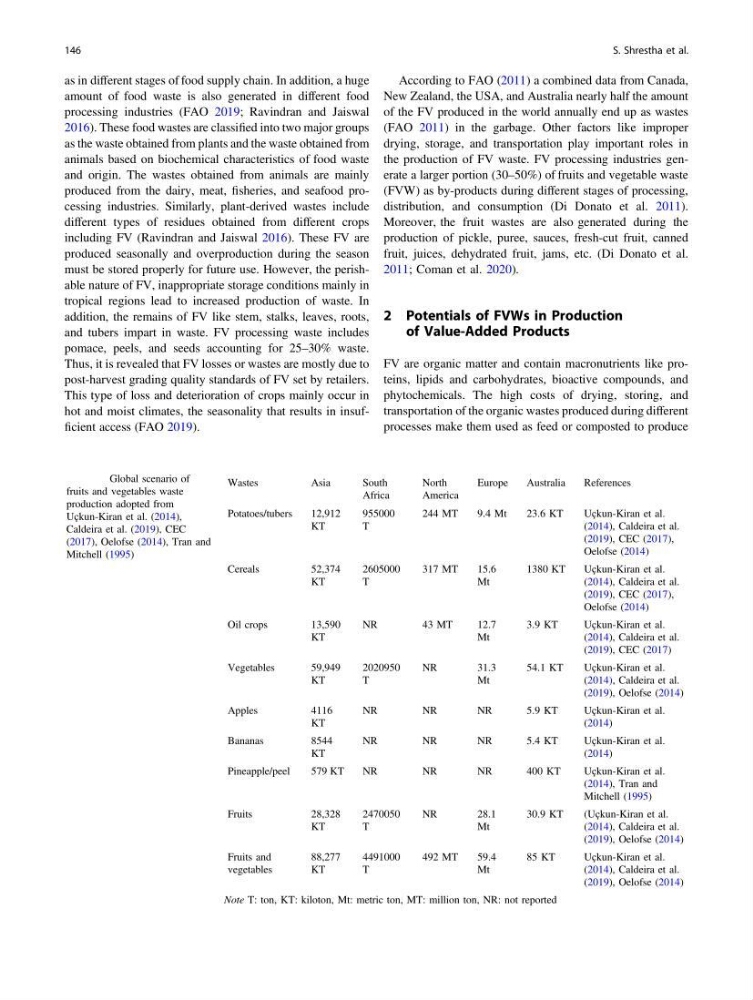
Table 1 Global scenario of
fruits and vegetables waste
production adopted from
Uçkun-Kiran et al. (2014),
Caldeira et al. (2019), CEC
(2017), Oelofse (2014), Tran and
Mitchell (1995)
Wastes
Asia
South
Africa
North
America
Europe
Australia
References
Potatoes/tubers
12,912
KT
955000
T
244 MT
9.4 Mt
23.6 KT
Uçkun-Kiran et al.
(2014), Caldeira et al.
(2019), CEC (2017),
Oelofse (2014)
Cereals
52,374
KT
2605000
T
317 MT
15.6
Mt
1380 KT
Uçkun-Kiran et al.
(2014), Caldeira et al.
(2019), CEC (2017),
Oelofse (2014)
Oil crops
13,590
KT
NR
43 MT
12.7
Mt
3.9 KT
Uçkun-Kiran et al.
(2014), Caldeira et al.
(2019), CEC (2017)
Vegetables
59,949
KT
2020950
T
NR
31.3
Mt
54.1 KT
Uçkun-Kiran et al.
(2014), Caldeira et al.
(2019), Oelofse (2014)
Apples
4116
KT
NR
NR
NR
5.9 KT
Uçkun-Kiran et al.
(2014)
Bananas
8544
KT
NR
NR
NR
5.4 KT
Uçkun-Kiran et al.
(2014)
Pineapple/peel
579 KT
NR
NR
NR
400 KT
Uçkun-Kiran et al.
(2014), Tran and
Mitchell (1995)
Fruits
28,328
KT
2470050
T
NR
28.1
Mt
30.9 KT
(Uçkun-Kiran et al.
(2014), Caldeira et al.
(2019), Oelofse (2014)
Fruits and
vegetables
88,277
KT
4491000
T
492 MT
59.4
Mt
85 KT
Uçkun-Kiran et al.
(2014), Caldeira et al.
(2019), Oelofse (2014)
Note T: ton, KT: kiloton, Mt: metric ton, MT: million ton, NR: not reported
146
S. Shrestha et al.
amount of food waste is also generated in different food
processing industries (FAO 2019; Ravindran and Jaiswal
2016). These food wastes are classified into two major groups
as the waste obtained from plants and the waste obtained from
animals based on biochemical characteristics of food waste
and origin. The wastes obtained from animals are mainly
produced from the dairy, meat, fisheries, and seafood processing industries. Similarly, plant-derived wastes include
different types of residues obtained from different crops
including FV (Ravindran and Jaiswal 2016). These FV are
produced seasonally and overproduction during the season
must be stored properly for future use. However, the perishable nature of FV, inappropriate storage conditions mainly in
tropical regions lead to increased production of waste. In
addition, the remains of FV like stem, stalks, leaves, roots,
and tubers impart in waste. FV processing waste includes
pomace, peels, and seeds accounting for 25–30% waste.
Thus, it is revealed that FV losses or wastes are mostly due to
post-harvest grading quality standards of FV set by retailers.
This type of loss and deterioration of crops mainly occur in
hot and moist climates, the seasonality that results in insufficient access (FAO 2019).
According to FAO (2011) a combined data from Canada,
New Zealand, the USA, and Australia nearly half the amount
of the FV produced in the world annually end up as wastes
(FAO 2011) in the garbage. Other factors like improper
drying, storage, and transportation play important roles in
the production of FV waste. FV processing industries generate a larger portion (30–50%) of fruits and vegetable waste
(FVW) as by-products during different stages of processing,
distribution, and consumption (Di Donato et al. 2011).
Moreover, the fruit wastes are also generated during the
production of pickle, puree, sauces, fresh-cut fruit, canned
fruit, juices, dehydrated fruit, jams, etc. (Di Donato et al.
2011; Coman et al. 2020).
2 Potentials of FVWs in Production
of Value-Added Products
FV are organic matter and contain macronutrients like proteins, lipids and carbohydrates, bioactive compounds, and
phytochemicals. The high costs of drying, storing, and
transportation of the organic wastes produced during different
processes make them used as feed or composted to produce
Table 1 Global scenario of
fruits and vegetables waste
production adopted from
Uçkun-Kiran et al. (2014),
Caldeira et al. (2019), CEC
(2017), Oelofse (2014), Tran and
Mitchell (1995)
Wastes
Asia
South
Africa
North
America
Europe
Australia
References
Potatoes/tubers
12,912
KT
955000
T
244 MT
9.4 Mt
23.6 KT
Uçkun-Kiran et al.
(2014), Caldeira et al.
(2019), CEC (2017),
Oelofse (2014)
Cereals
52,374
KT
2605000
T
317 MT
15.6
Mt
1380 KT
Uçkun-Kiran et al.
(2014), Caldeira et al.
(2019), CEC (2017),
Oelofse (2014)
Oil crops
13,590
KT
NR
43 MT
12.7
Mt
3.9 KT
Uçkun-Kiran et al.
(2014), Caldeira et al.
(2019), CEC (2017)
Vegetables
59,949
KT
2020950
T
NR
31.3
Mt
54.1 KT
Uçkun-Kiran et al.
(2014), Caldeira et al.
(2019), Oelofse (2014)
Apples
4116
KT
NR
NR
NR
5.9 KT
Uçkun-Kiran et al.
(2014)
Bananas
8544
KT
NR
NR
NR
5.4 KT
Uçkun-Kiran et al.
(2014)
Pineapple/peel
579 KT
NR
NR
NR
400 KT
Uçkun-Kiran et al.
(2014), Tran and
Mitchell (1995)
Fruits
28,328
KT
2470050
T
NR
28.1
Mt
30.9 KT
(Uçkun-Kiran et al.
(2014), Caldeira et al.
(2019), Oelofse (2014)
Fruits and
vegetables
88,277
KT
4491000
T
492 MT
59.4
Mt
85 KT
Uçkun-Kiran et al.
(2014), Caldeira et al.
(2019), Oelofse (2014)
Note T: ton, KT: kiloton, Mt: metric ton, MT: million ton, NR: not reported
146
S. Shrestha et al.