

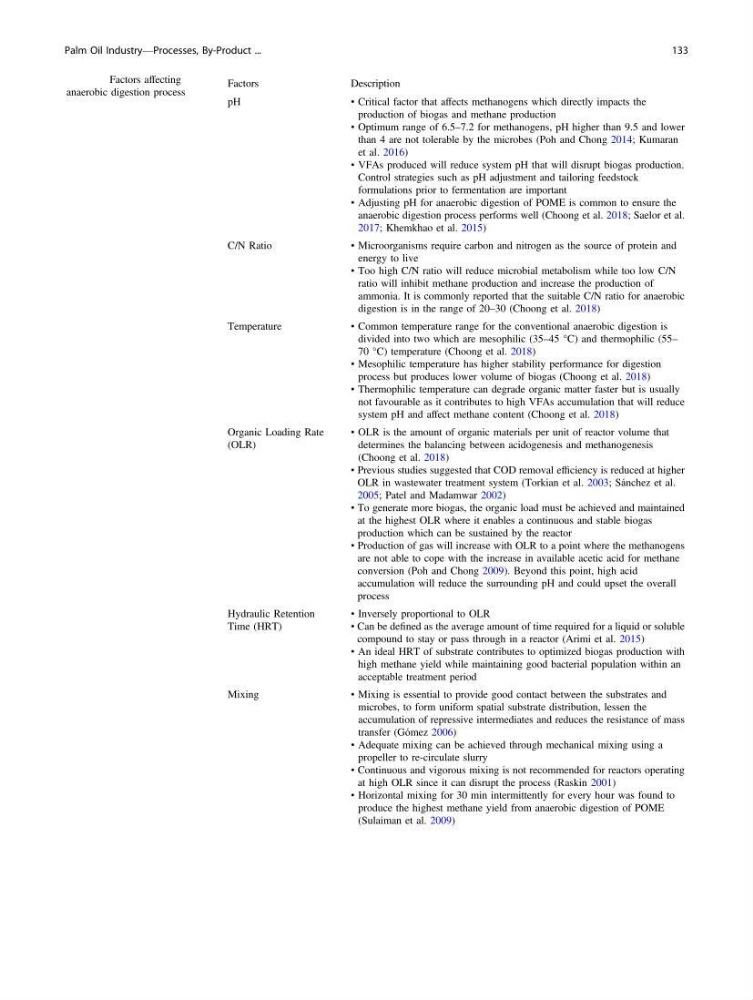
Table 3 Factors affecting
anaerobic digestion process
Factors
Description
pH
• Critical factor that affects methanogens which directly impacts the
production of biogas and methane production
• Optimum range of 6.5–7.2 for methanogens, pH higher than 9.5 and lower
than 4 are not tolerable by the microbes (Poh and Chong 2014; Kumaran
et al. 2016)
• VFAs produced will reduce system pH that will disrupt biogas production.
Control strategies such as pH adjustment and tailoring feedstock
formulations prior to fermentation are important
• Adjusting pH for anaerobic digestion of POME is common to ensure the
anaerobic digestion process performs well (Choong et al. 2018; Saelor et al.
2017; Khemkhao et al. 2015)
C/N Ratio
• Microorganisms require carbon and nitrogen as the source of protein and
energy to live
• Too high C/N ratio will reduce microbial metabolism while too low C/N
ratio will inhibit methane production and increase the production of
ammonia. It is commonly reported that the suitable C/N ratio for anaerobic
digestion is in the range of 20–30 (Choong et al. 2018)
Temperature
• Common temperature range for the conventional anaerobic digestion is
divided into two which are mesophilic (35–45 °C) and thermophilic (55–
70 °C) temperature (Choong et al. 2018)
• Mesophilic temperature has higher stability performance for digestion
process but produces lower volume of biogas (Choong et al. 2018)
• Thermophilic temperature can degrade organic matter faster but is usually
not favourable as it contributes to high VFAs accumulation that will reduce
system pH and affect methane content (Choong et al. 2018)
Organic Loading Rate
(OLR)
• OLR is the amount of organic materials per unit of reactor volume that
determines the balancing between acidogenesis and methanogenesis
(Choong et al. 2018)
• Previous studies suggested that COD removal efficiency is reduced at higher
OLR in wastewater treatment system (Torkian et al. 2003; Sánchez et al.
2005; Patel and Madamwar 2002)
• To generate more biogas, the organic load must be achieved and maintained
at the highest OLR where it enables a continuous and stable biogas
production which can be sustained by the reactor
• Production of gas will increase with OLR to a point where the methanogens
are not able to cope with the increase in available acetic acid for methane
conversion (Poh and Chong 2009). Beyond this point, high acid
accumulation will reduce the surrounding pH and could upset the overall
process
Hydraulic Retention
Time (HRT)
• Inversely proportional to OLR
• Can be defined as the average amount of time required for a liquid or soluble
compound to stay or pass through in a reactor (Arimi et al. 2015)
• An ideal HRT of substrate contributes to optimized biogas production with
high methane yield while maintaining good bacterial population within an
acceptable treatment period
Mixing
• Mixing is essential to provide good contact between the substrates and
microbes, to form uniform spatial substrate distribution, lessen the
accumulation of repressive intermediates and reduces the resistance of mass
transfer (Gómez 2006)
• Adequate mixing can be achieved through mechanical mixing using a
propeller to re-circulate slurry
• Continuous and vigorous mixing is not recommended for reactors operating
at high OLR since it can disrupt the process (Raskin 2001)
• Horizontal mixing for 30 min intermittently for every hour was found to
produce the highest methane yield from anaerobic digestion of POME
(Sulaiman et al. 2009)
Palm Oil Industry—Processes, By-Product ...
133
anaerobic digestion process
Factors
Description
pH
• Critical factor that affects methanogens which directly impacts the
production of biogas and methane production
• Optimum range of 6.5–7.2 for methanogens, pH higher than 9.5 and lower
than 4 are not tolerable by the microbes (Poh and Chong 2014; Kumaran
et al. 2016)
• VFAs produced will reduce system pH that will disrupt biogas production.
Control strategies such as pH adjustment and tailoring feedstock
formulations prior to fermentation are important
• Adjusting pH for anaerobic digestion of POME is common to ensure the
anaerobic digestion process performs well (Choong et al. 2018; Saelor et al.
2017; Khemkhao et al. 2015)
C/N Ratio
• Microorganisms require carbon and nitrogen as the source of protein and
energy to live
• Too high C/N ratio will reduce microbial metabolism while too low C/N
ratio will inhibit methane production and increase the production of
ammonia. It is commonly reported that the suitable C/N ratio for anaerobic
digestion is in the range of 20–30 (Choong et al. 2018)
Temperature
• Common temperature range for the conventional anaerobic digestion is
divided into two which are mesophilic (35–45 °C) and thermophilic (55–
70 °C) temperature (Choong et al. 2018)
• Mesophilic temperature has higher stability performance for digestion
process but produces lower volume of biogas (Choong et al. 2018)
• Thermophilic temperature can degrade organic matter faster but is usually
not favourable as it contributes to high VFAs accumulation that will reduce
system pH and affect methane content (Choong et al. 2018)
Organic Loading Rate
(OLR)
• OLR is the amount of organic materials per unit of reactor volume that
determines the balancing between acidogenesis and methanogenesis
(Choong et al. 2018)
• Previous studies suggested that COD removal efficiency is reduced at higher
OLR in wastewater treatment system (Torkian et al. 2003; Sánchez et al.
2005; Patel and Madamwar 2002)
• To generate more biogas, the organic load must be achieved and maintained
at the highest OLR where it enables a continuous and stable biogas
production which can be sustained by the reactor
• Production of gas will increase with OLR to a point where the methanogens
are not able to cope with the increase in available acetic acid for methane
conversion (Poh and Chong 2009). Beyond this point, high acid
accumulation will reduce the surrounding pH and could upset the overall
process
Hydraulic Retention
Time (HRT)
• Inversely proportional to OLR
• Can be defined as the average amount of time required for a liquid or soluble
compound to stay or pass through in a reactor (Arimi et al. 2015)
• An ideal HRT of substrate contributes to optimized biogas production with
high methane yield while maintaining good bacterial population within an
acceptable treatment period
Mixing
• Mixing is essential to provide good contact between the substrates and
microbes, to form uniform spatial substrate distribution, lessen the
accumulation of repressive intermediates and reduces the resistance of mass
transfer (Gómez 2006)
• Adequate mixing can be achieved through mechanical mixing using a
propeller to re-circulate slurry
• Continuous and vigorous mixing is not recommended for reactors operating
at high OLR since it can disrupt the process (Raskin 2001)
• Horizontal mixing for 30 min intermittently for every hour was found to
produce the highest methane yield from anaerobic digestion of POME
(Sulaiman et al. 2009)
Palm Oil Industry—Processes, By-Product ...
133