

due to the limited information on most of these microalgae
and their distinct characteristics (Sydney et al. 2019).
In general, the desired characteristics of microalgae strain
for biodiesel production include rapid growth rate, high lipid
content, growth over a wide range of temperature, salinity
and irradiation (for photosynthetic cultures), high shear and
oxygen tolerance, growth in a selective environment to
reduce the possibility of contamination, ease of harvesting,
weak cell wall, and suitable fatty acid profile (Borowitzka
2013, 2018). Considering that the building blocks for biodiesel production are lipids and that they are intracellular,
lipid productivity is typically considered as a decisive
parameter in the choice of the strain, since it considers both
the lipid content and the biomass productivity (Griffiths and
Harrison 2009; Queiroz et al. 2011). Additionally, when the
culture medium is wastewater, the selected strain must have
resistance to the nutrients present, especially ammoniacal
nitrogen, which at high concentrations can become toxic and
inhibit growth (Osundeko et al. 2019).
As for their origin, microalgae strains can either be
obtained from stock culture collections or be isolated from
environmental samples (Neofotis et al. 2016). Still, it is
difficult to find a strain that includes all the required properties. In this sense, one option to improve the strains is to
modify them by mutagenesis or genetic engineering techniques, including genome editing tools and metabolomic
re-programming. The use of these techniques becomes
increasingly crucial for the industrial viability of
microalgal-based products, especially for low-value products
such as biodiesel. This becomes even more imperative when
using industrial wastes as a culture medium, as it requires
greater robustness of the culture (Bharadwaj et al. 2020).
Once defined the strain, the cultivation aspects need to be
addressed, especially the unresolved bottlenecks. The first
point to consider is the cultivation mode and system. One of
the advantages of microalgae is their metabolic versatility.
Although the preferred route is photoautotrophic, these
microorganisms can also assume other types of metabolisms,
including heterotrophic and mixotrophic. Regarding cultivation systems, on industrial scale, microalgae are usually
cultured in open or closed systems (Maroneze and Queiroz
2018).
Photoautotrophic cultivation refers to the process in
which light energy is captured and an inorganic source of
carbon is used to form chemical energy through the photosynthesis process. In this cultivation model, microalgae
primarily require an inorganic carbon source, like CO 2 , and
light energy (Maroneze et al. 2019). Since CO 2 can come
from industrial waste and light energy can be supplied by
sunlight, this type of process is considered environmentally
friendly and has so far been the most widely used. In this
type of cultivation, open raceway ponds are still the most
adopted system to cultivate microalgae for industrial production of low-cost products, including biofuels, since these
facilities are inexpensive and easy to operate than closed
systems. On the downside, open systems have some operational problems as the dependence on climate conditions,
contamination, evaporation, and extensive land requirements. Due to the high cost, closed photobioreactors are
more suitable to be used to produce higher market value
products like carotenoids and fatty acids. Besides this, the
dependence on light energy restricts the scale-up and hinders
the design of the cultivation systems (Severo et al. 2019;
Suparmaniam et al. 2019).
A feasible alternative is the heterotrophic growth in the
absence of light, supported by an exogenous carbon source,
which can overcome the major limitations of autotrophic
cultures. Although not all species can use respiratory metabolism, when possible, the heterotrophic cultures can be
efficiently conducted in conventional fermenters, e.g., stirred
tank and bubble column bioreactors, where, in general, are
cheap, simple to construct, and easy to scale and maintain on
a large scale (Perez-Garcia et al. 2011; Francisco et al.
2014). On the other hand, the biggest challenge of
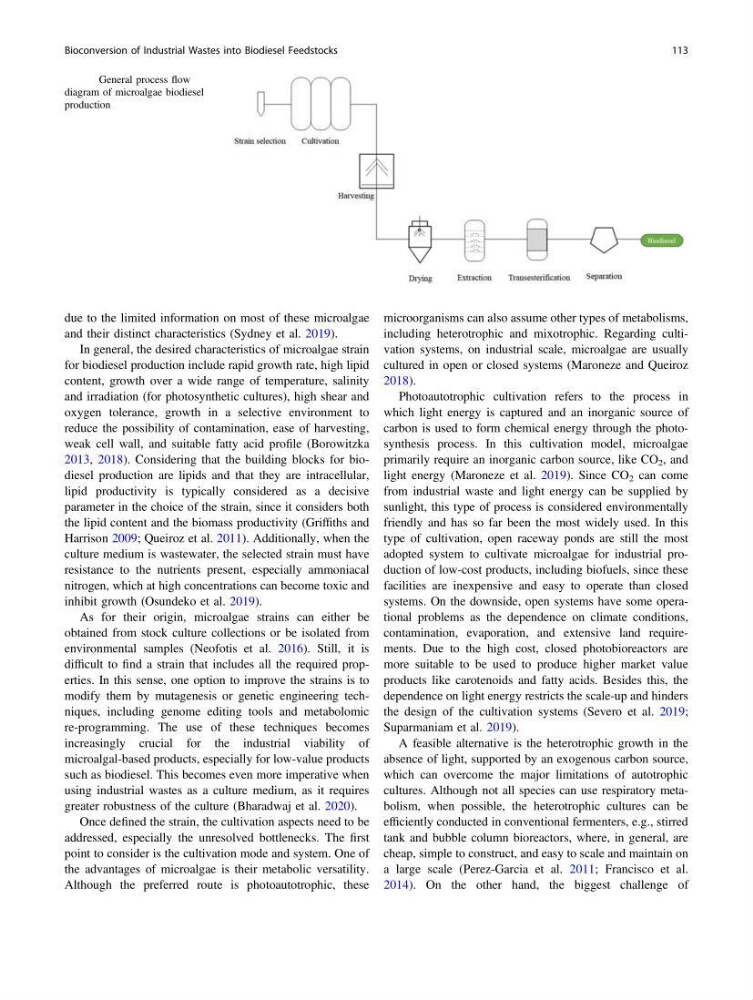
Fig. 1 General process flow
diagram of microalgae biodiesel
production
Bioconversion of Industrial Wastes into Biodiesel Feedstocks
113
and their distinct characteristics (Sydney et al. 2019).
In general, the desired characteristics of microalgae strain
for biodiesel production include rapid growth rate, high lipid
content, growth over a wide range of temperature, salinity
and irradiation (for photosynthetic cultures), high shear and
oxygen tolerance, growth in a selective environment to
reduce the possibility of contamination, ease of harvesting,
weak cell wall, and suitable fatty acid profile (Borowitzka
2013, 2018). Considering that the building blocks for biodiesel production are lipids and that they are intracellular,
lipid productivity is typically considered as a decisive
parameter in the choice of the strain, since it considers both
the lipid content and the biomass productivity (Griffiths and
Harrison 2009; Queiroz et al. 2011). Additionally, when the
culture medium is wastewater, the selected strain must have
resistance to the nutrients present, especially ammoniacal
nitrogen, which at high concentrations can become toxic and
inhibit growth (Osundeko et al. 2019).
As for their origin, microalgae strains can either be
obtained from stock culture collections or be isolated from
environmental samples (Neofotis et al. 2016). Still, it is
difficult to find a strain that includes all the required properties. In this sense, one option to improve the strains is to
modify them by mutagenesis or genetic engineering techniques, including genome editing tools and metabolomic
re-programming. The use of these techniques becomes
increasingly crucial for the industrial viability of
microalgal-based products, especially for low-value products
such as biodiesel. This becomes even more imperative when
using industrial wastes as a culture medium, as it requires
greater robustness of the culture (Bharadwaj et al. 2020).
Once defined the strain, the cultivation aspects need to be
addressed, especially the unresolved bottlenecks. The first
point to consider is the cultivation mode and system. One of
the advantages of microalgae is their metabolic versatility.
Although the preferred route is photoautotrophic, these
microorganisms can also assume other types of metabolisms,
including heterotrophic and mixotrophic. Regarding cultivation systems, on industrial scale, microalgae are usually
cultured in open or closed systems (Maroneze and Queiroz
2018).
Photoautotrophic cultivation refers to the process in
which light energy is captured and an inorganic source of
carbon is used to form chemical energy through the photosynthesis process. In this cultivation model, microalgae
primarily require an inorganic carbon source, like CO 2 , and
light energy (Maroneze et al. 2019). Since CO 2 can come
from industrial waste and light energy can be supplied by
sunlight, this type of process is considered environmentally
friendly and has so far been the most widely used. In this
type of cultivation, open raceway ponds are still the most
adopted system to cultivate microalgae for industrial production of low-cost products, including biofuels, since these
facilities are inexpensive and easy to operate than closed
systems. On the downside, open systems have some operational problems as the dependence on climate conditions,
contamination, evaporation, and extensive land requirements. Due to the high cost, closed photobioreactors are
more suitable to be used to produce higher market value
products like carotenoids and fatty acids. Besides this, the
dependence on light energy restricts the scale-up and hinders
the design of the cultivation systems (Severo et al. 2019;
Suparmaniam et al. 2019).
A feasible alternative is the heterotrophic growth in the
absence of light, supported by an exogenous carbon source,
which can overcome the major limitations of autotrophic
cultures. Although not all species can use respiratory metabolism, when possible, the heterotrophic cultures can be
efficiently conducted in conventional fermenters, e.g., stirred
tank and bubble column bioreactors, where, in general, are
cheap, simple to construct, and easy to scale and maintain on
a large scale (Perez-Garcia et al. 2011; Francisco et al.
2014). On the other hand, the biggest challenge of
Fig. 1 General process flow
diagram of microalgae biodiesel
production
Bioconversion of Industrial Wastes into Biodiesel Feedstocks
113