

The application of residues as a media of cultivation to
decrease the high expense of producing microalgae has been
an alternative option favorable. This type of process has
similar or superior potential in the production of lipids in
microorganisms, besides reducing charge mainly nitrogen
and phosphorus of residues to treated, these substrates are
ideal for the generation and development of algae lipids
(Cho et al. 2017). It is worth mentioning that besides residue’s composition, the efficiency of each strain must be
explored simultaneously, according to the number of nutrients available for the development and production of lipids
(Cho and Park 2018).
There are several types of waste, including agricultural,
industrial, and municipal wastewater, and each can offer a
different lipid production potential (Chiu et al. 2015).
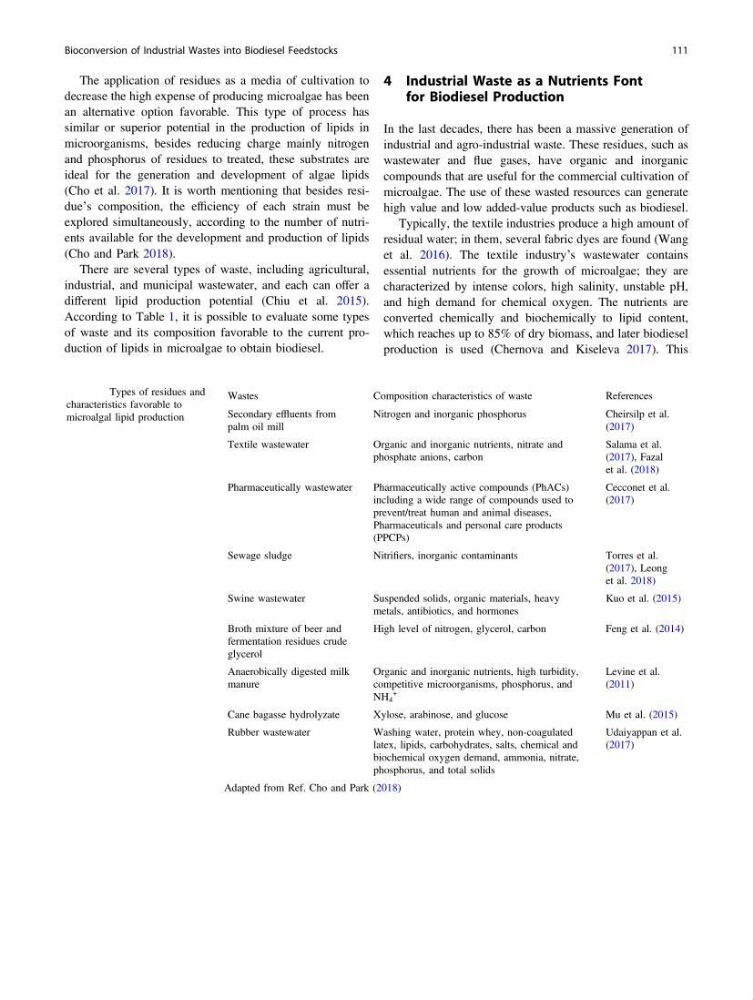
According to Table 1, it is possible to evaluate some types
of waste and its composition favorable to the current production of lipids in microalgae to obtain biodiesel.
4 Industrial Waste as a Nutrients Font
for Biodiesel Production
In the last decades, there has been a massive generation of
industrial and agro-industrial waste. These residues, such as
wastewater and flue gases, have organic and inorganic
compounds that are useful for the commercial cultivation of
microalgae. The use of these wasted resources can generate
high value and low added-value products such as biodiesel.
Typically, the textile industries produce a high amount of
residual water; in them, several fabric dyes are found (Wang
et al. 2016). The textile industry’s wastewater contains
essential nutrients for the growth of microalgae; they are
characterized by intense colors, high salinity, unstable pH,
and high demand for chemical oxygen. The nutrients are
converted chemically and biochemically to lipid content,
which reaches up to 85% of dry biomass, and later biodiesel
production is used (Chernova and Kiseleva 2017). This
Table 1 Types of residues and
characteristics favorable to
microalgal lipid production
Wastes
Composition characteristics of waste
References
Secondary effluents from
palm oil mill
Nitrogen and inorganic phosphorus
Cheirsilp et al.
(2017)
Textile wastewater
Organic and inorganic nutrients, nitrate and
phosphate anions, carbon
Salama et al.
(2017), Fazal
et al. (2018)
Pharmaceutically wastewater
Pharmaceutically active compounds (PhACs)
including a wide range of compounds used to
prevent/treat human and animal diseases,
Pharmaceuticals and personal care products
(PPCPs)
Cecconet et al.
(2017)
Sewage sludge
Nitrifiers, inorganic contaminants
Torres et al.
(2017), Leong
et al. 2018)
Swine wastewater
Suspended solids, organic materials, heavy
metals, antibiotics, and hormones
Kuo et al. (2015)
Broth mixture of beer and
fermentation residues crude
glycerol
High level of nitrogen, glycerol, carbon
Feng et al. (2014)
Anaerobically digested milk
manure
Organic and inorganic nutrients, high turbidity,
competitive microorganisms, phosphorus, and
NH 4
+
Levine et al.
(2011)
Cane bagasse hydrolyzate
Xylose, arabinose, and glucose
Mu et al. (2015)
Rubber wastewater
Washing water, protein whey, non-coagulated
latex, lipids, carbohydrates, salts, chemical and
biochemical oxygen demand, ammonia, nitrate,
phosphorus, and total solids
Udaiyappan et al.
(2017)
Adapted from Ref. Cho and Park (2018)
Bioconversion of Industrial Wastes into Biodiesel Feedstocks
111
decrease the high expense of producing microalgae has been
an alternative option favorable. This type of process has
similar or superior potential in the production of lipids in
microorganisms, besides reducing charge mainly nitrogen
and phosphorus of residues to treated, these substrates are
ideal for the generation and development of algae lipids
(Cho et al. 2017). It is worth mentioning that besides residue’s composition, the efficiency of each strain must be
explored simultaneously, according to the number of nutrients available for the development and production of lipids
(Cho and Park 2018).
There are several types of waste, including agricultural,
industrial, and municipal wastewater, and each can offer a
different lipid production potential (Chiu et al. 2015).
According to Table 1, it is possible to evaluate some types
of waste and its composition favorable to the current production of lipids in microalgae to obtain biodiesel.
4 Industrial Waste as a Nutrients Font
for Biodiesel Production
In the last decades, there has been a massive generation of
industrial and agro-industrial waste. These residues, such as
wastewater and flue gases, have organic and inorganic
compounds that are useful for the commercial cultivation of
microalgae. The use of these wasted resources can generate
high value and low added-value products such as biodiesel.
Typically, the textile industries produce a high amount of
residual water; in them, several fabric dyes are found (Wang
et al. 2016). The textile industry’s wastewater contains
essential nutrients for the growth of microalgae; they are
characterized by intense colors, high salinity, unstable pH,
and high demand for chemical oxygen. The nutrients are
converted chemically and biochemically to lipid content,
which reaches up to 85% of dry biomass, and later biodiesel
production is used (Chernova and Kiseleva 2017). This
Table 1 Types of residues and
characteristics favorable to
microalgal lipid production
Wastes
Composition characteristics of waste
References
Secondary effluents from
palm oil mill
Nitrogen and inorganic phosphorus
Cheirsilp et al.
(2017)
Textile wastewater
Organic and inorganic nutrients, nitrate and
phosphate anions, carbon
Salama et al.
(2017), Fazal
et al. (2018)
Pharmaceutically wastewater
Pharmaceutically active compounds (PhACs)
including a wide range of compounds used to
prevent/treat human and animal diseases,
Pharmaceuticals and personal care products
(PPCPs)
Cecconet et al.
(2017)
Sewage sludge
Nitrifiers, inorganic contaminants
Torres et al.
(2017), Leong
et al. 2018)
Swine wastewater
Suspended solids, organic materials, heavy
metals, antibiotics, and hormones
Kuo et al. (2015)
Broth mixture of beer and
fermentation residues crude
glycerol
High level of nitrogen, glycerol, carbon
Feng et al. (2014)
Anaerobically digested milk
manure
Organic and inorganic nutrients, high turbidity,
competitive microorganisms, phosphorus, and
NH 4
+
Levine et al.
(2011)
Cane bagasse hydrolyzate
Xylose, arabinose, and glucose
Mu et al. (2015)
Rubber wastewater
Washing water, protein whey, non-coagulated
latex, lipids, carbohydrates, salts, chemical and
biochemical oxygen demand, ammonia, nitrate,
phosphorus, and total solids
Udaiyappan et al.
(2017)
Adapted from Ref. Cho and Park (2018)
Bioconversion of Industrial Wastes into Biodiesel Feedstocks
111