

CIBiogás Biogas Laboratory was the first in Brazil to be
accredited by the ISO/ IEC/ 17025: 2017 standard for the
determination of the biochemical potential of methane
[PBM].
The BPM test is performed based on the German guide
“VDI 4630 (2016)—Fermentation of organic materials
characterization of the substrate, sampling, collection of
material data, fermentation tests and DIN 38414—Part 8
(1985)—Sludge and sediments (group S): Determination of
the amenability to anaerobic digestion” and reproduces in a
batch reactor the anaerobic digestion of the substrate under
normal conditions of temperature and pressure. This
methodology has great relevance with regard to the characterization of a sample regarding the production of biogas
and methane for sizing anaerobic reactors for biogas plants;
inclusion of new substrates to feed biodigesters;
decision-making on types and proportions of substrates in
codigestion. Since 2011, they have carried out approximately 31,000 tests from more than 150 different samples at
the CIBiogás Biogas Laboratory.
The Itaipu demonstrative unit is operated by CIBiogás
and was designed to convert food waste from restaurants in
the Itaipu Binacional complex. This type of waste is composed of food scraps discarded in meal preparation and not
consumed (totally or partially) by users. Generally, it produces more methane than animal waste and domestic sewage
(Bozym et al. 2015). In 2019, the unit processed an average
of 426 kg/day of restaurant waste and operated with an
average volumetric organic load (VOC) of 0.59. The reactor
is supplied on a daily basis according to the availability of
waste to meet working VOCs. The restaurant waste is quite
rich in relation to the macro and micronutrients necessary for
the growth of microorganisms and has a high potential for
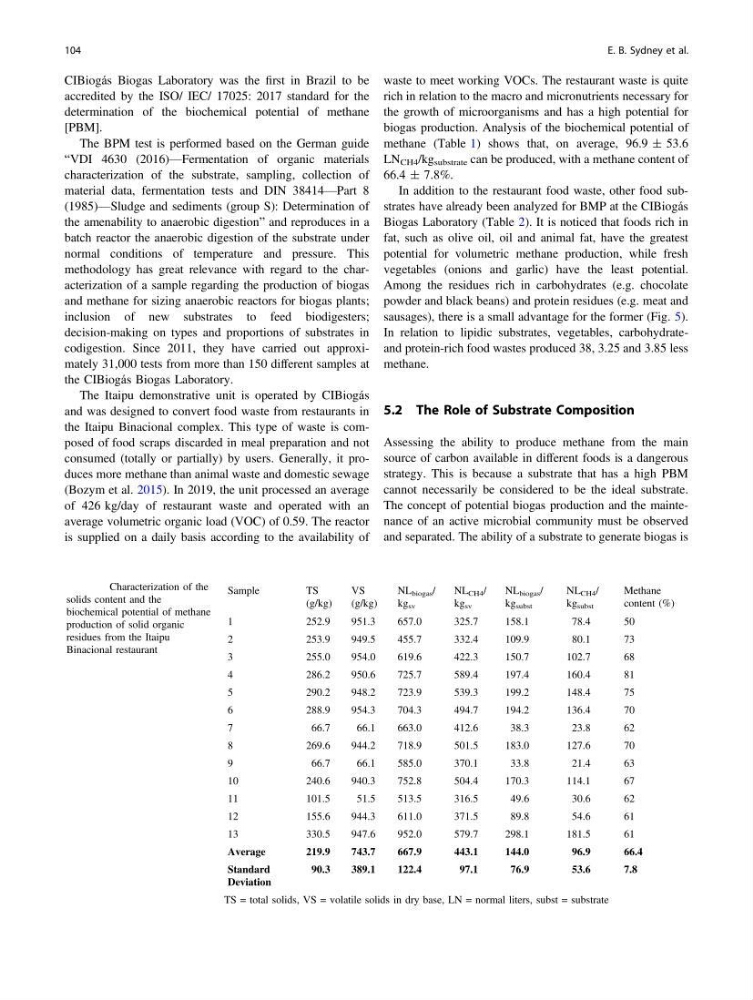
biogas production. Analysis of the biochemical potential of
methane (Table 1) shows that, on average, 96.9 ± 53.6
LN CH4 /kg substrate can be produced, with a methane content of
66.4 ± 7.8%.
In addition to the restaurant food waste, other food substrates have already been analyzed for BMP at the CIBiogás
Biogas Laboratory (Table 2). It is noticed that foods rich in
fat, such as olive oil, oil and animal fat, have the greatest
potential for volumetric methane production, while fresh
vegetables (onions and garlic) have the least potential.
Among the residues rich in carbohydrates (e.g. chocolate
powder and black beans) and protein residues (e.g. meat and
sausages), there is a small advantage for the former (Fig. 5).
In relation to lipidic substrates, vegetables, carbohydrateand protein-rich food wastes produced 38, 3.25 and 3.85 less
methane.
5.2 The Role of Substrate Composition
Assessing the ability to produce methane from the main
source of carbon available in different foods is a dangerous
strategy. This is because a substrate that has a high PBM
cannot necessarily be considered to be the ideal substrate.
The concept of potential biogas production and the maintenance of an active microbial community must be observed
and separated. The ability of a substrate to generate biogas is
Table 1 Characterization of the
solids content and the
biochemical potential of methane
production of solid organic
residues from the Itaipu
Binacional restaurant
Sample
TS
(g/kg)
VS
(g/kg)
NL biogas /
kg sv
NL CH4 /
kg sv
NL biogas /
kg subst
NL CH4 /
kg subst
Methane
content (%)
1
252.9
951.3
657.0
325.7
158.1
78.4
50
2
253.9
949.5
455.7
332.4
109.9
80.1
73
3
255.0
954.0
619.6
422.3
150.7
102.7
68
4
286.2
950.6
725.7
589.4
197.4
160.4
81
5
290.2
948.2
723.9
539.3
199.2
148.4
75
6
288.9
954.3
704.3
494.7
194.2
136.4
70
7
66.7
66.1
663.0
412.6
38.3
23.8
62
8
269.6
944.2
718.9
501.5
183.0
127.6
70
9
66.7
66.1
585.0
370.1
33.8
21.4
63
10
240.6
940.3
752.8
504.4
170.3
114.1
67
11
101.5
51.5
513.5
316.5
49.6
30.6
62
12
155.6
944.3
611.0
371.5
89.8
54.6
61
13
330.5
947.6
952.0
579.7
298.1
181.5
61
Average
219.9
743.7
667.9
443.1
144.0
96.9
66.4
Standard
Deviation
90.3
389.1
122.4
97.1
76.9
53.6
7.8
TS = total solids, VS = volatile solids in dry base, LN = normal liters, subst = substrate
104
E. B. Sydney et al.
accredited by the ISO/ IEC/ 17025: 2017 standard for the
determination of the biochemical potential of methane
[PBM].
The BPM test is performed based on the German guide
“VDI 4630 (2016)—Fermentation of organic materials
characterization of the substrate, sampling, collection of
material data, fermentation tests and DIN 38414—Part 8
(1985)—Sludge and sediments (group S): Determination of
the amenability to anaerobic digestion” and reproduces in a
batch reactor the anaerobic digestion of the substrate under
normal conditions of temperature and pressure. This
methodology has great relevance with regard to the characterization of a sample regarding the production of biogas
and methane for sizing anaerobic reactors for biogas plants;
inclusion of new substrates to feed biodigesters;
decision-making on types and proportions of substrates in
codigestion. Since 2011, they have carried out approximately 31,000 tests from more than 150 different samples at
the CIBiogás Biogas Laboratory.
The Itaipu demonstrative unit is operated by CIBiogás
and was designed to convert food waste from restaurants in
the Itaipu Binacional complex. This type of waste is composed of food scraps discarded in meal preparation and not
consumed (totally or partially) by users. Generally, it produces more methane than animal waste and domestic sewage
(Bozym et al. 2015). In 2019, the unit processed an average
of 426 kg/day of restaurant waste and operated with an
average volumetric organic load (VOC) of 0.59. The reactor
is supplied on a daily basis according to the availability of
waste to meet working VOCs. The restaurant waste is quite
rich in relation to the macro and micronutrients necessary for
the growth of microorganisms and has a high potential for
biogas production. Analysis of the biochemical potential of
methane (Table 1) shows that, on average, 96.9 ± 53.6
LN CH4 /kg substrate can be produced, with a methane content of
66.4 ± 7.8%.
In addition to the restaurant food waste, other food substrates have already been analyzed for BMP at the CIBiogás
Biogas Laboratory (Table 2). It is noticed that foods rich in
fat, such as olive oil, oil and animal fat, have the greatest
potential for volumetric methane production, while fresh
vegetables (onions and garlic) have the least potential.
Among the residues rich in carbohydrates (e.g. chocolate
powder and black beans) and protein residues (e.g. meat and
sausages), there is a small advantage for the former (Fig. 5).
In relation to lipidic substrates, vegetables, carbohydrateand protein-rich food wastes produced 38, 3.25 and 3.85 less
methane.
5.2 The Role of Substrate Composition
Assessing the ability to produce methane from the main
source of carbon available in different foods is a dangerous
strategy. This is because a substrate that has a high PBM
cannot necessarily be considered to be the ideal substrate.
The concept of potential biogas production and the maintenance of an active microbial community must be observed
and separated. The ability of a substrate to generate biogas is
Table 1 Characterization of the
solids content and the
biochemical potential of methane
production of solid organic
residues from the Itaipu
Binacional restaurant
Sample
TS
(g/kg)
VS
(g/kg)
NL biogas /
kg sv
NL CH4 /
kg sv
NL biogas /
kg subst
NL CH4 /
kg subst
Methane
content (%)
1
252.9
951.3
657.0
325.7
158.1
78.4
50
2
253.9
949.5
455.7
332.4
109.9
80.1
73
3
255.0
954.0
619.6
422.3
150.7
102.7
68
4
286.2
950.6
725.7
589.4
197.4
160.4
81
5
290.2
948.2
723.9
539.3
199.2
148.4
75
6
288.9
954.3
704.3
494.7
194.2
136.4
70
7
66.7
66.1
663.0
412.6
38.3
23.8
62
8
269.6
944.2
718.9
501.5
183.0
127.6
70
9
66.7
66.1
585.0
370.1
33.8
21.4
63
10
240.6
940.3
752.8
504.4
170.3
114.1
67
11
101.5
51.5
513.5
316.5
49.6
30.6
62
12
155.6
944.3
611.0
371.5
89.8
54.6
61
13
330.5
947.6
952.0
579.7
298.1
181.5
61
Average
219.9
743.7
667.9
443.1
144.0
96.9
66.4
Standard
Deviation
90.3
389.1
122.4
97.1
76.9
53.6
7.8
TS = total solids, VS = volatile solids in dry base, LN = normal liters, subst = substrate
104
E. B. Sydney et al.