

automated way and separating bags that are classified as
waste, and organic waste follows in the process.
Through a conveyor belt, the residues can be carried to a
magnetic separator where the entire metallic fraction is
segregated from the organic material.
2.4 Milling
Some factors, including particle size, influence anaerobic
digestion. Physical pre-treatments are used to modify the
structure of the substrate and facilitate the degradation of
organic matter in anaerobic digestion by increasing the solubility of organic material and the total area for attack by
microorganisms (Deublein and Steinhauser 2008). The
smaller the particle size of the substrate at the beginning of the
anaerobic digestion, the higher the efficiency in the degradation of the material and the shorter the retention time in the
biodigester. The two most common techniques used for particle size reduction are grinding discs and mechanized sorting.
Separation by grinding discs is mainly used to treat
packaged food scraps and restaurant leftovers. Due to its low
density, the plastic fraction is separated by suction of air
from the grinding discs. Those plastics that are not detected
are crushed together with the organic residue but is further
separated in a sieve based on its higher particle size. The
resulted crushed organic material free of contaminants is fed
into the biodigester.
Mechanized sorting technology is based on a shredder to
open plastic bags and reduce the particle size of organic
waste. The pre-crushed residue is mixed with process water
to produce a homogeneous substrate with approximately
10% of solids. In both mechanized sorting and grinding
discs pre-treatments freshwater is commonly added to
improve the separation (Andrade 2007).
After plastic removal, the organic substrate can contain
inert materials such as sand, glass and stones that must be
removed to avoid attrition on the machines and
sedimentation inside the digester. Hydrocyclone system is
generally used for this purpose (Jank et al. 2017).
2.5 Fermentation
As stated earlier, biodigestion is a sequence of microbiological process of decomposing organic matter in an
oxygen-free environment, resulting in the production of
biogas and digestate.
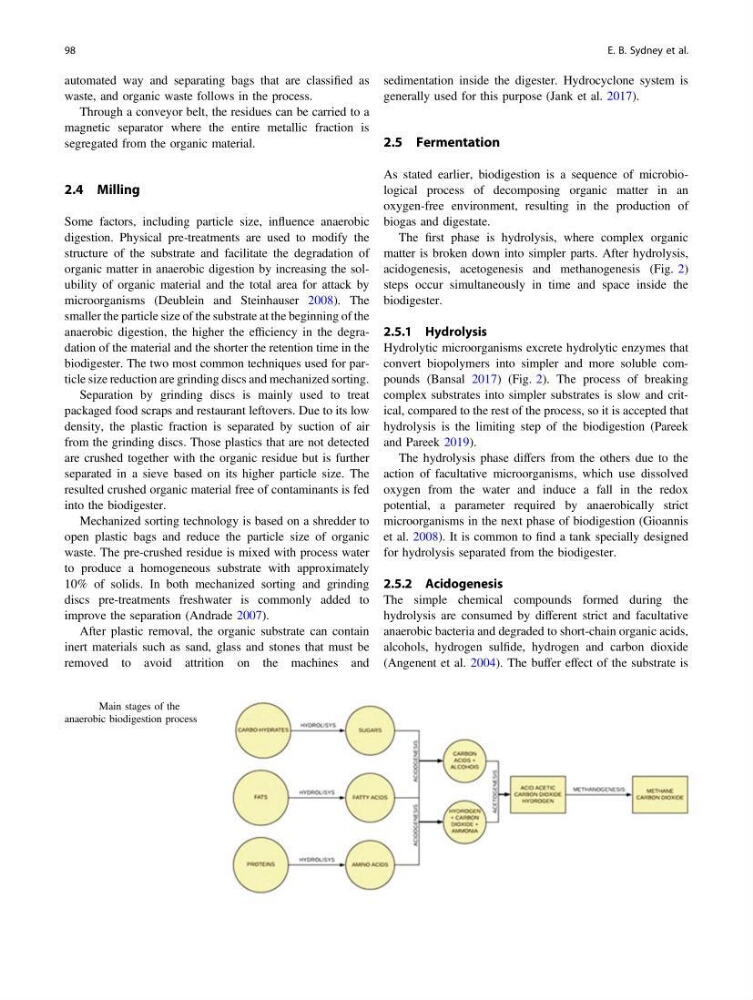
The first phase is hydrolysis, where complex organic
matter is broken down into simpler parts. After hydrolysis,
acidogenesis, acetogenesis and methanogenesis (Fig. 2)
steps occur simultaneously in time and space inside the
biodigester.
2.5.1 Hydrolysis
Hydrolytic microorganisms excrete hydrolytic enzymes that
convert biopolymers into simpler and more soluble compounds (Bansal 2017) (Fig. 2). The process of breaking
complex substrates into simpler substrates is slow and critical, compared to the rest of the process, so it is accepted that
hydrolysis is the limiting step of the biodigestion (Pareek
and Pareek 2019).
The hydrolysis phase differs from the others due to the
action of facultative microorganisms, which use dissolved
oxygen from the water and induce a fall in the redox
potential, a parameter required by anaerobically strict
microorganisms in the next phase of biodigestion (Gioannis
et al. 2008). It is common to find a tank specially designed
for hydrolysis separated from the biodigester.
2.5.2 Acidogenesis
The simple chemical compounds formed during the
hydrolysis are consumed by different strict and facultative
anaerobic bacteria and degraded to short-chain organic acids,
alcohols, hydrogen sulfide, hydrogen and carbon dioxide
(Angenent et al. 2004). The buffer effect of the substrate is
Fig. 2 Main stages of the
anaerobic biodigestion process
98
E. B. Sydney et al.
waste, and organic waste follows in the process.
Through a conveyor belt, the residues can be carried to a
magnetic separator where the entire metallic fraction is
segregated from the organic material.
2.4 Milling
Some factors, including particle size, influence anaerobic
digestion. Physical pre-treatments are used to modify the
structure of the substrate and facilitate the degradation of
organic matter in anaerobic digestion by increasing the solubility of organic material and the total area for attack by
microorganisms (Deublein and Steinhauser 2008). The
smaller the particle size of the substrate at the beginning of the
anaerobic digestion, the higher the efficiency in the degradation of the material and the shorter the retention time in the
biodigester. The two most common techniques used for particle size reduction are grinding discs and mechanized sorting.
Separation by grinding discs is mainly used to treat
packaged food scraps and restaurant leftovers. Due to its low
density, the plastic fraction is separated by suction of air
from the grinding discs. Those plastics that are not detected
are crushed together with the organic residue but is further
separated in a sieve based on its higher particle size. The
resulted crushed organic material free of contaminants is fed
into the biodigester.
Mechanized sorting technology is based on a shredder to
open plastic bags and reduce the particle size of organic
waste. The pre-crushed residue is mixed with process water
to produce a homogeneous substrate with approximately
10% of solids. In both mechanized sorting and grinding
discs pre-treatments freshwater is commonly added to
improve the separation (Andrade 2007).
After plastic removal, the organic substrate can contain
inert materials such as sand, glass and stones that must be
removed to avoid attrition on the machines and
sedimentation inside the digester. Hydrocyclone system is
generally used for this purpose (Jank et al. 2017).
2.5 Fermentation
As stated earlier, biodigestion is a sequence of microbiological process of decomposing organic matter in an
oxygen-free environment, resulting in the production of
biogas and digestate.
The first phase is hydrolysis, where complex organic
matter is broken down into simpler parts. After hydrolysis,
acidogenesis, acetogenesis and methanogenesis (Fig. 2)
steps occur simultaneously in time and space inside the
biodigester.
2.5.1 Hydrolysis
Hydrolytic microorganisms excrete hydrolytic enzymes that
convert biopolymers into simpler and more soluble compounds (Bansal 2017) (Fig. 2). The process of breaking
complex substrates into simpler substrates is slow and critical, compared to the rest of the process, so it is accepted that
hydrolysis is the limiting step of the biodigestion (Pareek
and Pareek 2019).
The hydrolysis phase differs from the others due to the
action of facultative microorganisms, which use dissolved
oxygen from the water and induce a fall in the redox
potential, a parameter required by anaerobically strict
microorganisms in the next phase of biodigestion (Gioannis
et al. 2008). It is common to find a tank specially designed
for hydrolysis separated from the biodigester.
2.5.2 Acidogenesis
The simple chemical compounds formed during the
hydrolysis are consumed by different strict and facultative
anaerobic bacteria and degraded to short-chain organic acids,
alcohols, hydrogen sulfide, hydrogen and carbon dioxide
(Angenent et al. 2004). The buffer effect of the substrate is
Fig. 2 Main stages of the
anaerobic biodigestion process
98
E. B. Sydney et al.