

(ABRELPE), published in the Panorama of Solid Waste in
Brazil 2018/2019 (ABRELPE 2019), among the 72.7 million
tons of solid wastes collected in 2018, 59.5% had correct final
disposal and were sent to landfills. However, controlled dumps
and landfills still persist in the country, with a significant share
of 23% and 17.5%, respectively, in the same period. About
3,000 dumps are in operation in the country and received,
together, 30 million tons of waste in 2018 (BRAZIL 2010).
When it comes to food disposal, the survey by the World
Resources Institute (WRI) indicates that 41,000 tons of food
per year is wasted in Brazil, with restaurants being responsible
for 6,000 tons (15%).
Although challenging, to achieve an adequate management of urban solid waste, it is strategic to recognize the
energy value that biomass has and to expand its use for energy
production. Technologies for the use of urban waste have
been explored in order to combine environmental treatment
and energy supply. Biogas is a growing fuel in Brazil (ratified
by the 31% growth in the number of plants in operation in
2019) that, given its productive characteristics, can be considered as a solution for the treatment of urban solid waste.
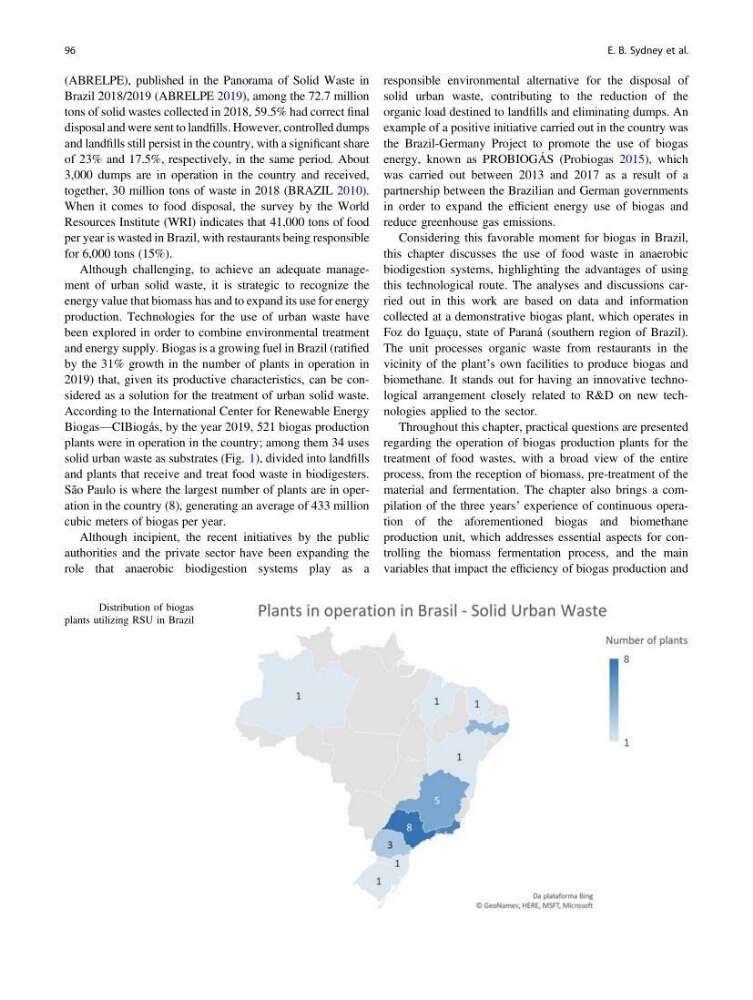
According to the International Center for Renewable Energy
Biogas—CIBiogás, by the year 2019, 521 biogas production
plants were in operation in the country; among them 34 uses
solid urban waste as substrates (Fig. 1), divided into landfills
and plants that receive and treat food waste in biodigesters.
São Paulo is where the largest number of plants are in operation in the country (8), generating an average of 433 million
cubic meters of biogas per year.
Although incipient, the recent initiatives by the public
authorities and the private sector have been expanding the
role that anaerobic biodigestion systems play as a
responsible environmental alternative for the disposal of
solid urban waste, contributing to the reduction of the
organic load destined to landfills and eliminating dumps. An
example of a positive initiative carried out in the country was
the Brazil-Germany Project to promote the use of biogas
energy, known as PROBIOGÁS (Probiogas 2015), which
was carried out between 2013 and 2017 as a result of a
partnership between the Brazilian and German governments
in order to expand the efficient energy use of biogas and
reduce greenhouse gas emissions.
Considering this favorable moment for biogas in Brazil,
this chapter discusses the use of food waste in anaerobic
biodigestion systems, highlighting the advantages of using
this technological route. The analyses and discussions carried out in this work are based on data and information
collected at a demonstrative biogas plant, which operates in
Foz do Iguaçu, state of Paraná (southern region of Brazil).
The unit processes organic waste from restaurants in the
vicinity of the plant’s own facilities to produce biogas and
biomethane. It stands out for having an innovative technological arrangement closely related to R&D on new technologies applied to the sector.
Throughout this chapter, practical questions are presented
regarding the operation of biogas production plants for the
treatment of food wastes, with a broad view of the entire
process, from the reception of biomass, pre-treatment of the
material and fermentation. The chapter also brings a compilation of the three years’ experience of continuous operation of the aforementioned biogas and biomethane
production unit, which addresses essential aspects for controlling the biomass fermentation process, and the main
variables that impact the efficiency of biogas production and
Fig. 1 Distribution of biogas
plants utilizing RSU in Brazil
96
E. B. Sydney et al.
Brazil 2018/2019 (ABRELPE 2019), among the 72.7 million
tons of solid wastes collected in 2018, 59.5% had correct final
disposal and were sent to landfills. However, controlled dumps
and landfills still persist in the country, with a significant share
of 23% and 17.5%, respectively, in the same period. About
3,000 dumps are in operation in the country and received,
together, 30 million tons of waste in 2018 (BRAZIL 2010).
When it comes to food disposal, the survey by the World
Resources Institute (WRI) indicates that 41,000 tons of food
per year is wasted in Brazil, with restaurants being responsible
for 6,000 tons (15%).
Although challenging, to achieve an adequate management of urban solid waste, it is strategic to recognize the
energy value that biomass has and to expand its use for energy
production. Technologies for the use of urban waste have
been explored in order to combine environmental treatment
and energy supply. Biogas is a growing fuel in Brazil (ratified
by the 31% growth in the number of plants in operation in
2019) that, given its productive characteristics, can be considered as a solution for the treatment of urban solid waste.
According to the International Center for Renewable Energy
Biogas—CIBiogás, by the year 2019, 521 biogas production
plants were in operation in the country; among them 34 uses
solid urban waste as substrates (Fig. 1), divided into landfills
and plants that receive and treat food waste in biodigesters.
São Paulo is where the largest number of plants are in operation in the country (8), generating an average of 433 million
cubic meters of biogas per year.
Although incipient, the recent initiatives by the public
authorities and the private sector have been expanding the
role that anaerobic biodigestion systems play as a
responsible environmental alternative for the disposal of
solid urban waste, contributing to the reduction of the
organic load destined to landfills and eliminating dumps. An
example of a positive initiative carried out in the country was
the Brazil-Germany Project to promote the use of biogas
energy, known as PROBIOGÁS (Probiogas 2015), which
was carried out between 2013 and 2017 as a result of a
partnership between the Brazilian and German governments
in order to expand the efficient energy use of biogas and
reduce greenhouse gas emissions.
Considering this favorable moment for biogas in Brazil,
this chapter discusses the use of food waste in anaerobic
biodigestion systems, highlighting the advantages of using
this technological route. The analyses and discussions carried out in this work are based on data and information
collected at a demonstrative biogas plant, which operates in
Foz do Iguaçu, state of Paraná (southern region of Brazil).
The unit processes organic waste from restaurants in the
vicinity of the plant’s own facilities to produce biogas and
biomethane. It stands out for having an innovative technological arrangement closely related to R&D on new technologies applied to the sector.
Throughout this chapter, practical questions are presented
regarding the operation of biogas production plants for the
treatment of food wastes, with a broad view of the entire
process, from the reception of biomass, pre-treatment of the
material and fermentation. The chapter also brings a compilation of the three years’ experience of continuous operation of the aforementioned biogas and biomethane
production unit, which addresses essential aspects for controlling the biomass fermentation process, and the main
variables that impact the efficiency of biogas production and
Fig. 1 Distribution of biogas
plants utilizing RSU in Brazil
96
E. B. Sydney et al.