

is an important priority for the state.
3
Postal
offices are also important providers of Internet
access. VoIP is an increasingly popular means of
communication. 4 Although the state affirmatively
seeks to enhance the competitive edge of
domestic enterprises, Vietnamese online services are still nascent, and there are few search
engines currently available to Vietnamese users.
State regulation determines how Internet
connectivity in Vietnam is organized and managed, and facilitates Internet content filtering by
limiting external access points that must be controlled. 5
Only Internet exchange points (IXPs) can
connect to the international Internet, while online
service providers (OSPs) and Internet content
providers (ICPs) may connect to ISPs and IXPs. 6
At the edge of the network, Internet agents, such
as cybercafés, connect to their contracted ISP.
7
ISPs may connect with each other and with IXPs,
but private ISPs may not connect with each other
in peering arrangements.
8
Currently, IXPs can
theoretically maintain independent connections
to the international Internet, but it is not clear
how many do so in practice. Vietnam controls the
allocation of domain names under the country
code top-level domain, “.vn,” through the
Vietnam Internet Center, 9 and is also planning to
implement a state-controlled Vietnameselanguage second-level domain.
10
Legal and regulatory frameworks
Vietnam’s legal regulation of Internet access and
content is multilayered and complex, and can
occur at the level of National Assembly legislation, ministerial decisions, or through VNPT rules
created for the management of the Internet infrastructure. Although Vietnam nominally guarantees
freedom of speech, of the press, and of assembly through constitutional provisions, 11 state
security laws and other regulations trump or eliminate these formal protections. Media in Vietnam
are state-owned, and they are under increasingly
tight control by the state. Effective July 1, 2006,
the Decree on Cultural and Information Activities
subjects those who disseminate “reactionary ideology” including revealing secrets (party, state,
military, and economic), who deny revolutionary
achievements, and who do not submit articles for
review before publication to fines of up to thirty
million dong (USD2,000). 12 These regulations
appear to target journalists, as criminal liability
already exists for some of the proscribed activities, including the dissemination of state secrets.
Country Summaries
421
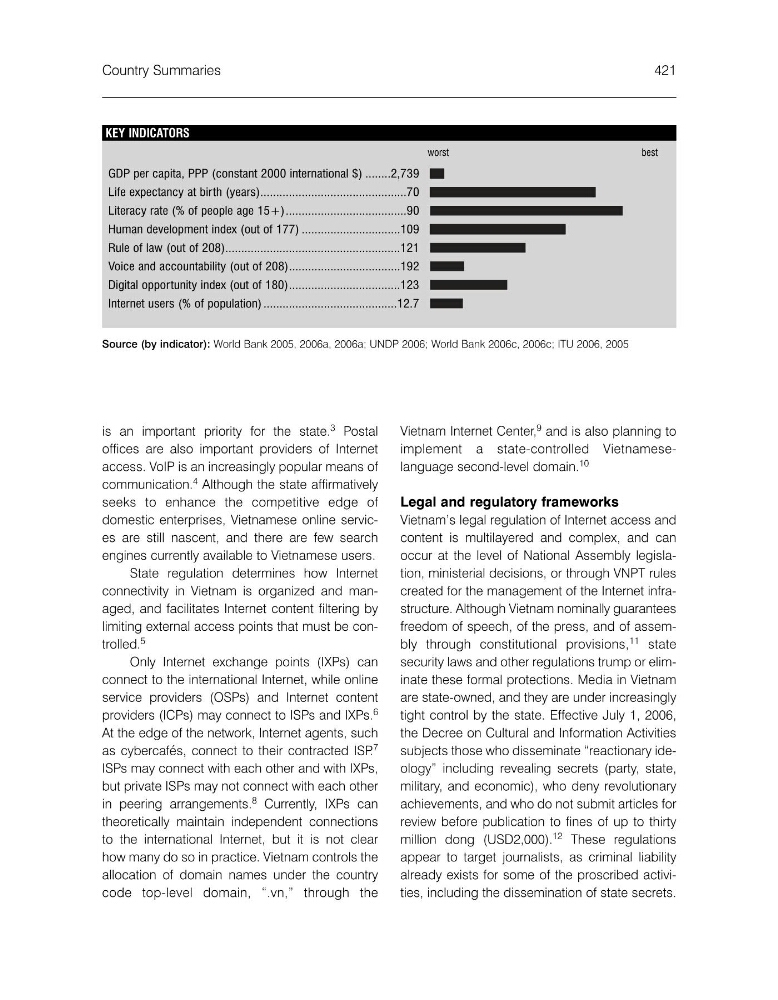
KEY INDICATORS
worst
best
GDP per capita, PPP (constant 2000 international $) ........2,739 3.75
Life expectancy at birth (years)..............................................70 5.64
Literacy rate (% of people age 15+)......................................90 6.00
Human development index (out of 177) ...............................109 4.97
Rule of law (out of 208).......................................................121 4.11
Voice and accountability (out of 208)...................................192 1.80
Digital opportunity index (out of 180)...................................123 4.01
Internet users (% of population) ..........................................12.7 4.25
Source (by indicator): World Bank 2005, 2006a, 2006a; UNDP 2006; World Bank 2006c, 2006c; ITU 2006, 2005
3
Postal
offices are also important providers of Internet
access. VoIP is an increasingly popular means of
communication. 4 Although the state affirmatively
seeks to enhance the competitive edge of
domestic enterprises, Vietnamese online services are still nascent, and there are few search
engines currently available to Vietnamese users.
State regulation determines how Internet
connectivity in Vietnam is organized and managed, and facilitates Internet content filtering by
limiting external access points that must be controlled. 5
Only Internet exchange points (IXPs) can
connect to the international Internet, while online
service providers (OSPs) and Internet content
providers (ICPs) may connect to ISPs and IXPs. 6
At the edge of the network, Internet agents, such
as cybercafés, connect to their contracted ISP.
7
ISPs may connect with each other and with IXPs,
but private ISPs may not connect with each other
in peering arrangements.
8
Currently, IXPs can
theoretically maintain independent connections
to the international Internet, but it is not clear
how many do so in practice. Vietnam controls the
allocation of domain names under the country
code top-level domain, “.vn,” through the
Vietnam Internet Center, 9 and is also planning to
implement a state-controlled Vietnameselanguage second-level domain.
10
Legal and regulatory frameworks
Vietnam’s legal regulation of Internet access and
content is multilayered and complex, and can
occur at the level of National Assembly legislation, ministerial decisions, or through VNPT rules
created for the management of the Internet infrastructure. Although Vietnam nominally guarantees
freedom of speech, of the press, and of assembly through constitutional provisions, 11 state
security laws and other regulations trump or eliminate these formal protections. Media in Vietnam
are state-owned, and they are under increasingly
tight control by the state. Effective July 1, 2006,
the Decree on Cultural and Information Activities
subjects those who disseminate “reactionary ideology” including revealing secrets (party, state,
military, and economic), who deny revolutionary
achievements, and who do not submit articles for
review before publication to fines of up to thirty
million dong (USD2,000). 12 These regulations
appear to target journalists, as criminal liability
already exists for some of the proscribed activities, including the dissemination of state secrets.
Country Summaries
421
KEY INDICATORS
worst
best
GDP per capita, PPP (constant 2000 international $) ........2,739 3.75
Life expectancy at birth (years)..............................................70 5.64
Literacy rate (% of people age 15+)......................................90 6.00
Human development index (out of 177) ...............................109 4.97
Rule of law (out of 208).......................................................121 4.11
Voice and accountability (out of 208)...................................192 1.80
Digital opportunity index (out of 180)...................................123 4.01
Internet users (% of population) ..........................................12.7 4.25
Source (by indicator): World Bank 2005, 2006a, 2006a; UNDP 2006; World Bank 2006c, 2006c; ITU 2006, 2005