

investigation into the murder of Danilo Anderson,
the lead prosecutor in the investigation of the
failed 2002 coup. The state’s lead witness, a psychiatrist, was labeled an imposter by members of
the media. 3 The second law, the Criminal Code
Reform Law, expanded sections of the criminal
code relevant to “disrespect” of the government
and increased their penalties. A television journalist critical of Chávez, José Ovidio Rodríguez
Cuesta, was prosecuted in February 2006 under
these newly expanded statutes. One judge
rejected the case, but a Caracas court has since
reopened it. 4
Internet in Venezuela
Between 1998 and 2002, the number of Internet
users in Venezuela grew from 207,000 to
1,585,000, but then decreased to 1,365,000 in
2003 for a current Internet penetration rate of 12.4
percent. 5 The vast majority of personal computers are not connected to the Internet.
6
The
Venezuelan government estimates that 50.4 percent of the population have never used the
Internet and would not be interested in doing so,
while 28.9 percent are possible future Internet
users, primarily young, educated, middle-class
individuals. 7 Though there are sixty licensed
ISPs, CANTV Servicios and Telcel control over 90
percent of the Internet market.
8
Internet use is strongly concentrated among
young, educated city residents, with 76 percent
of users younger than thirty-five,
9
67 percent having
schooling beyond high school,
10
and more than
60 percent of users coming from Caracas.
11
Approximately 26 percent of Internet users log on
daily. These users tend to be upper-class individuals using home connections for educational or
work research and downloading. Over half of
Internet users connect between once and five
times per week, using cybercafés for e-mailing
and chatting. This group is generally male and
represents all socioeconomic levels with the
exception of the lowest income segment. A
smaller portion of users, 16.9 percent, connect
between once every other week and once per
month. These light users come from all economic strata except the lowest class, and they almost
exclusively use cybercafés for job search purposes. 12 Hotmail, Google, and Yahoo are by far
the most popular sites, followed by news sites
and other search engines.
13
Despite programs promoting Internet use
by poor and rural Venezuelans, access for this
segment of the population, about 60 percent of
Country Summaries
417
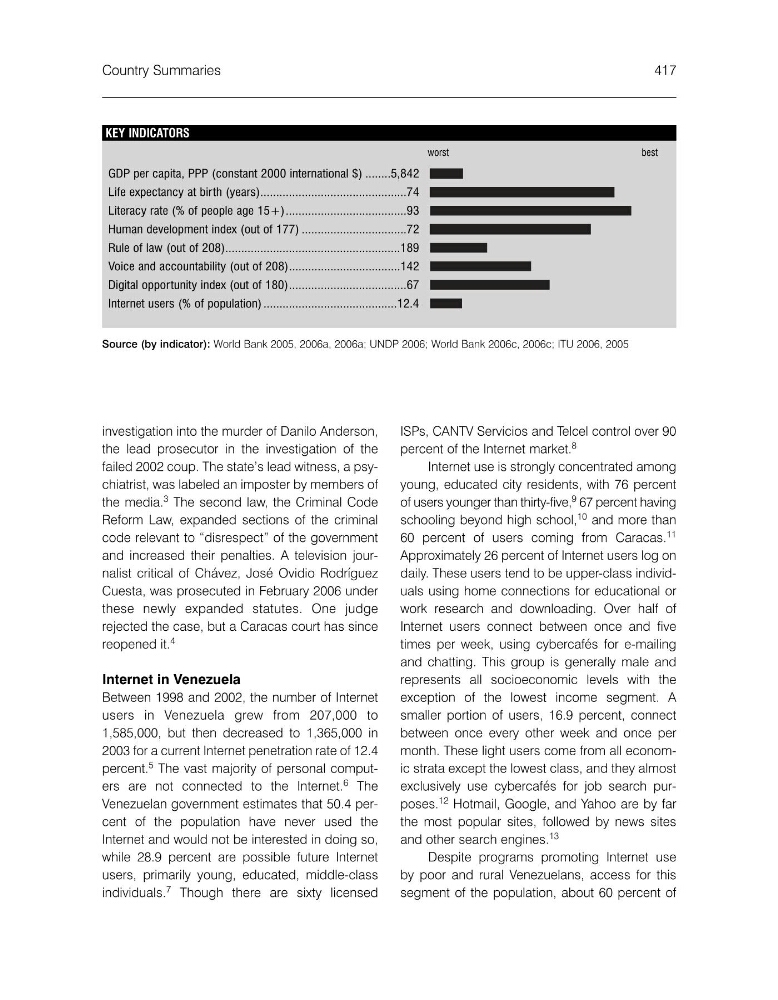
KEY INDICATORS
worst
best
GDP per capita, PPP (constant 2000 international $) ........5,842 4.34
Life expectancy at birth (years)..............................................74 6.28
Literacy rate (% of people age 15+)......................................93 6.29
Human development index (out of 177) .................................72 5.82
Rule of law (out of 208).......................................................189 2.55
Voice and accountability (out of 208)...................................142 4.01
Digital opportunity index (out of 180).....................................67 5.67
Internet users (% of population) ..........................................12.4 4.22
Source (by indicator): World Bank 2005, 2006a, 2006a; UNDP 2006; World Bank 2006c, 2006c; ITU 2006, 2005
the lead prosecutor in the investigation of the
failed 2002 coup. The state’s lead witness, a psychiatrist, was labeled an imposter by members of
the media. 3 The second law, the Criminal Code
Reform Law, expanded sections of the criminal
code relevant to “disrespect” of the government
and increased their penalties. A television journalist critical of Chávez, José Ovidio Rodríguez
Cuesta, was prosecuted in February 2006 under
these newly expanded statutes. One judge
rejected the case, but a Caracas court has since
reopened it. 4
Internet in Venezuela
Between 1998 and 2002, the number of Internet
users in Venezuela grew from 207,000 to
1,585,000, but then decreased to 1,365,000 in
2003 for a current Internet penetration rate of 12.4
percent. 5 The vast majority of personal computers are not connected to the Internet.
6
The
Venezuelan government estimates that 50.4 percent of the population have never used the
Internet and would not be interested in doing so,
while 28.9 percent are possible future Internet
users, primarily young, educated, middle-class
individuals. 7 Though there are sixty licensed
ISPs, CANTV Servicios and Telcel control over 90
percent of the Internet market.
8
Internet use is strongly concentrated among
young, educated city residents, with 76 percent
of users younger than thirty-five,
9
67 percent having
schooling beyond high school,
10
and more than
60 percent of users coming from Caracas.
11
Approximately 26 percent of Internet users log on
daily. These users tend to be upper-class individuals using home connections for educational or
work research and downloading. Over half of
Internet users connect between once and five
times per week, using cybercafés for e-mailing
and chatting. This group is generally male and
represents all socioeconomic levels with the
exception of the lowest income segment. A
smaller portion of users, 16.9 percent, connect
between once every other week and once per
month. These light users come from all economic strata except the lowest class, and they almost
exclusively use cybercafés for job search purposes. 12 Hotmail, Google, and Yahoo are by far
the most popular sites, followed by news sites
and other search engines.
13
Despite programs promoting Internet use
by poor and rural Venezuelans, access for this
segment of the population, about 60 percent of
Country Summaries
417
KEY INDICATORS
worst
best
GDP per capita, PPP (constant 2000 international $) ........5,842 4.34
Life expectancy at birth (years)..............................................74 6.28
Literacy rate (% of people age 15+)......................................93 6.29
Human development index (out of 177) .................................72 5.82
Rule of law (out of 208).......................................................189 2.55
Voice and accountability (out of 208)...................................142 4.01
Digital opportunity index (out of 180).....................................67 5.67
Internet users (% of population) ..........................................12.4 4.22
Source (by indicator): World Bank 2005, 2006a, 2006a; UNDP 2006; World Bank 2006c, 2006c; ITU 2006, 2005