

republics to establish a national agency responsible for ICT development (UzInfoCom), to contribute state resources to building a sizable academic and research network (UzSCINET), and to
launch an ambitious project to provide Internet to
the main government institutions (Cabinet of
Ministers and Presidency). After 2001 Uzbekistan
continued to receive sizable foreign support
aimed at developing its ICT infrastructure, including a large network of Internet access points in
the regions. Uzbek government officials at all levels were sent abroad to study e-government systems, and ICT was prioritized as a means for
national development. Until 2001–02 the Internet
remained open and free from filtering with the
exception of some limited filters for pornography
that were implemented on the academic and
research network (UzSCINET).
The turning point in the state’s relationship
to Internet freedom began following a series of
attacks in Tashkent in 2004 blamed on the Hizbut-Tahrir (Hit) and the Islamic Movement of
Uzbekistan. These attacks have been generally
associated with a deepening crackdown in
Uzbek society and encompass all forms and
channels of dissent, including the Internet.
Internet in Uzbekistan
In 2004 the International Telecommunication
Union estimated some 880,000 regular Internet
users in Uzbekistan, or a 3 percent Internet penetration rate. 1 According to local surveys the total
Internet audience is approximately 1,820,000 as
of June 2006. In contrast to neighboring countries, Uzbek women use Internet at an almost
equal rate to their male counterparts, with a difference of only 3 percent. 2 About 41.3 percent of
Internet users are sixteen to twenty years old.
3
Access is most common from homes (42.7 percent) and work (44.6 percent). Approximately 30
percent of Internet users also visit cybercafés. 4
As of January 2005 there were 463 Internet
access centers in Uzbekistan; in January 2006
the number dropped to 344. 5
Residential Internet services are unaffordable for the majority of the population. The cost of
dialup services is USD0.37 per hour and unlimited access is USD67.14 per month. The cost of
ADSL access is significantly lower: on average, it
does not exceed USD15 per month and offers
speed of 128 Kbit/second. The quality of Internet
access and communications services in
Uzbekistan is rapidly improving. 6 The bandwidth
capacity of external channels has shown steady
410
Country Summaries
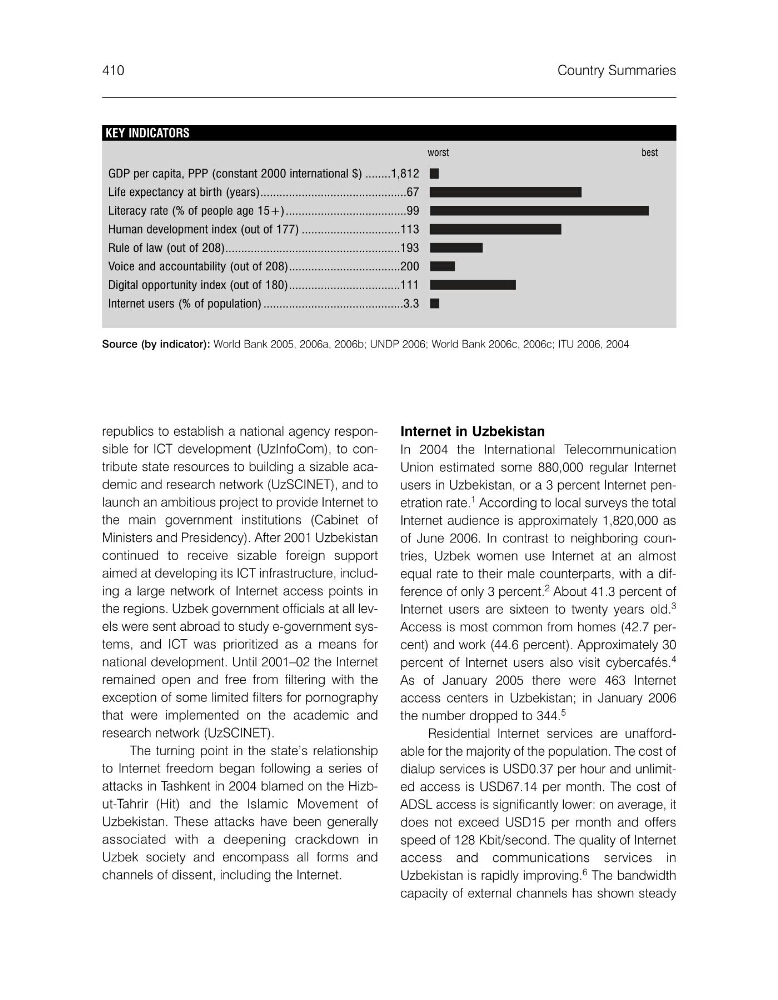
KEY INDICATORS
worst
best
GDP per capita, PPP (constant 2000 international $) ........1,812 3.57
Life expectancy at birth (years)..............................................67 5.15
Literacy rate (% of people age 15+)......................................99 6.87
Human development index (out of 177) ...............................113 4.82
Rule of law (out of 208).......................................................193 2.38
Voice and accountability (out of 208)...................................200 1.48
Digital opportunity index (out of 180)...................................111 4.34
Internet users (% of population) ............................................3.3 3.37
Source (by indicator): World Bank 2005, 2006a, 2006b; UNDP 2006; World Bank 2006c, 2006c; ITU 2006, 2004
launch an ambitious project to provide Internet to
the main government institutions (Cabinet of
Ministers and Presidency). After 2001 Uzbekistan
continued to receive sizable foreign support
aimed at developing its ICT infrastructure, including a large network of Internet access points in
the regions. Uzbek government officials at all levels were sent abroad to study e-government systems, and ICT was prioritized as a means for
national development. Until 2001–02 the Internet
remained open and free from filtering with the
exception of some limited filters for pornography
that were implemented on the academic and
research network (UzSCINET).
The turning point in the state’s relationship
to Internet freedom began following a series of
attacks in Tashkent in 2004 blamed on the Hizbut-Tahrir (Hit) and the Islamic Movement of
Uzbekistan. These attacks have been generally
associated with a deepening crackdown in
Uzbek society and encompass all forms and
channels of dissent, including the Internet.
Internet in Uzbekistan
In 2004 the International Telecommunication
Union estimated some 880,000 regular Internet
users in Uzbekistan, or a 3 percent Internet penetration rate. 1 According to local surveys the total
Internet audience is approximately 1,820,000 as
of June 2006. In contrast to neighboring countries, Uzbek women use Internet at an almost
equal rate to their male counterparts, with a difference of only 3 percent. 2 About 41.3 percent of
Internet users are sixteen to twenty years old.
3
Access is most common from homes (42.7 percent) and work (44.6 percent). Approximately 30
percent of Internet users also visit cybercafés. 4
As of January 2005 there were 463 Internet
access centers in Uzbekistan; in January 2006
the number dropped to 344. 5
Residential Internet services are unaffordable for the majority of the population. The cost of
dialup services is USD0.37 per hour and unlimited access is USD67.14 per month. The cost of
ADSL access is significantly lower: on average, it
does not exceed USD15 per month and offers
speed of 128 Kbit/second. The quality of Internet
access and communications services in
Uzbekistan is rapidly improving. 6 The bandwidth
capacity of external channels has shown steady
410
Country Summaries
KEY INDICATORS
worst
best
GDP per capita, PPP (constant 2000 international $) ........1,812 3.57
Life expectancy at birth (years)..............................................67 5.15
Literacy rate (% of people age 15+)......................................99 6.87
Human development index (out of 177) ...............................113 4.82
Rule of law (out of 208).......................................................193 2.38
Voice and accountability (out of 208)...................................200 1.48
Digital opportunity index (out of 180)...................................111 4.34
Internet users (% of population) ............................................3.3 3.37
Source (by indicator): World Bank 2005, 2006a, 2006b; UNDP 2006; World Bank 2006c, 2006c; ITU 2006, 2004