

Internet.
7
It is believed that more people may use
the Internet as content becomes available in local
languages rather than English.
8
Although no significant gender divide has emerged, over half of
Thai Internet users are between fifteen and twenty-four years old. 9 Of this group nearly 27 percent
use the Internet at cybercafés while 18 percent
access from home.
10
Broadband Internet access
is available, but it is still undeveloped at less than
2 percent household penetration.
11
Internet connectivity in Thailand is built
around education/research networks, commercial networks (Internet service providers, or ISPs),
and government networks. 12 CAT Telecom (CAT,
formerly the Communications Authority of
Thailand) and the Telephone Organization of
Thailand (TOT), the two big state-owned telecoms, each operate an international Internet
Gateway (IIG) as well as one each of three
domestic exchanges for twenty-one licensed
ISPs and four noncommercial Internet hubs. 13
Legal and regulatory frameworks
The Ministry of Information and Communications
Technology (MICT) and its subordinate bodies,
including the National Information Technology
Committee (NITC), CAT, TOT, and the National
Electronics and Computer Technology Center
(NECTEC), all regulate the Internet. 14
Prior to the coup the constitution provided a
nominal legal basis for censorship, although the
precise authority for filtering Internet content
remains unclear. Under the abrogated 1997
Constitution, Thai citizens were guaranteed the
rights to express opinions; to communicate by
“lawful” means; and to access information with
certain limitations for state security, maintaining
public order or morals, and safeguarding others’
right to privacy and reputation. 15 It remains
unconstitutional to criticize or level accusations
against the king.
16
Broad claims associating criticism of government with injury to the king, or lèse majesté,
have also been used to enforce censorship.
Thailand is one of the few remaining countries in
the world to prosecute crimes of lèse majesté,
where individuals who insult, defame, or threaten
the Thai royal family can be sentenced to three to
fifteen years of imprisonment. Such allegations,
in spite of King Bhumibol’s own sanction of public criticism of the Thai crown, are leveled infrequently but have targeted independent media
voices 17 and been used as a “political tool to discredit opponents.”
18 Lèse majesté, which in
Country Summaries
391
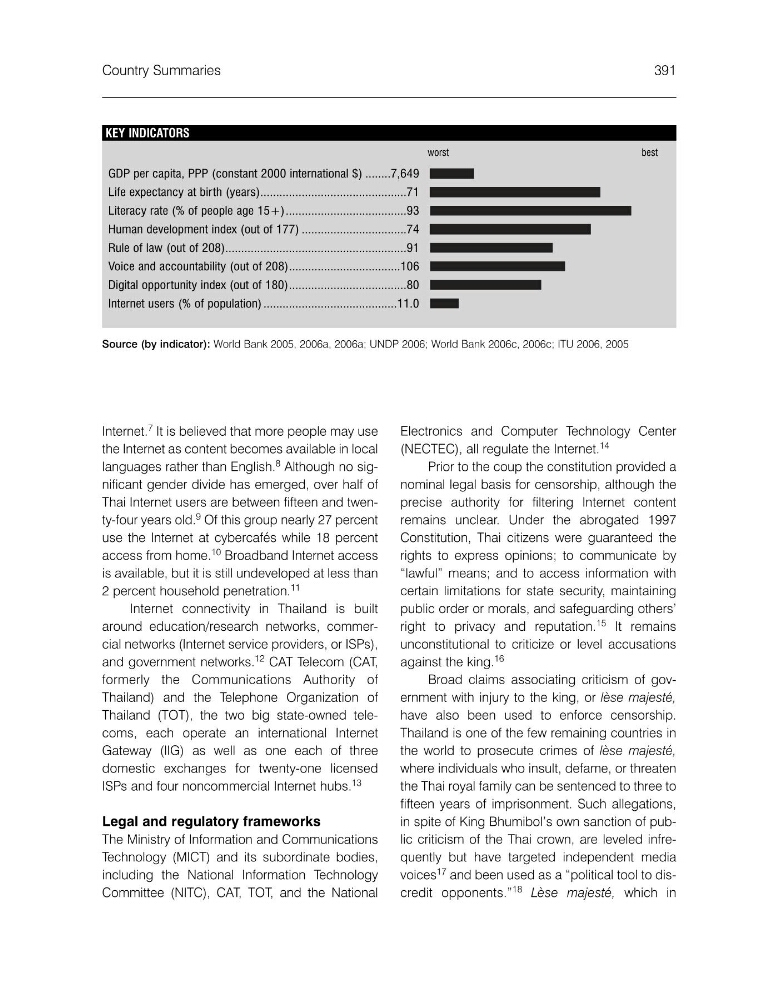
KEY INDICATORS
worst
best
GDP per capita, PPP (constant 2000 international $) ........7,649 4.69
Life expectancy at birth (years)..............................................71 5.80
Literacy rate (% of people age 15+)......................................93 6.29
Human development index (out of 177) .................................74 5.82
Rule of law (out of 208).........................................................91 5.20
Voice and accountability (out of 208)...................................106 5.14
Digital opportunity index (out of 180).....................................80 5.33
Internet users (% of population) ..........................................11.0 4.09
Source (by indicator): World Bank 2005, 2006a, 2006a; UNDP 2006; World Bank 2006c, 2006c; ITU 2006, 2005
7
It is believed that more people may use
the Internet as content becomes available in local
languages rather than English.
8
Although no significant gender divide has emerged, over half of
Thai Internet users are between fifteen and twenty-four years old. 9 Of this group nearly 27 percent
use the Internet at cybercafés while 18 percent
access from home.
10
Broadband Internet access
is available, but it is still undeveloped at less than
2 percent household penetration.
11
Internet connectivity in Thailand is built
around education/research networks, commercial networks (Internet service providers, or ISPs),
and government networks. 12 CAT Telecom (CAT,
formerly the Communications Authority of
Thailand) and the Telephone Organization of
Thailand (TOT), the two big state-owned telecoms, each operate an international Internet
Gateway (IIG) as well as one each of three
domestic exchanges for twenty-one licensed
ISPs and four noncommercial Internet hubs. 13
Legal and regulatory frameworks
The Ministry of Information and Communications
Technology (MICT) and its subordinate bodies,
including the National Information Technology
Committee (NITC), CAT, TOT, and the National
Electronics and Computer Technology Center
(NECTEC), all regulate the Internet. 14
Prior to the coup the constitution provided a
nominal legal basis for censorship, although the
precise authority for filtering Internet content
remains unclear. Under the abrogated 1997
Constitution, Thai citizens were guaranteed the
rights to express opinions; to communicate by
“lawful” means; and to access information with
certain limitations for state security, maintaining
public order or morals, and safeguarding others’
right to privacy and reputation. 15 It remains
unconstitutional to criticize or level accusations
against the king.
16
Broad claims associating criticism of government with injury to the king, or lèse majesté,
have also been used to enforce censorship.
Thailand is one of the few remaining countries in
the world to prosecute crimes of lèse majesté,
where individuals who insult, defame, or threaten
the Thai royal family can be sentenced to three to
fifteen years of imprisonment. Such allegations,
in spite of King Bhumibol’s own sanction of public criticism of the Thai crown, are leveled infrequently but have targeted independent media
voices 17 and been used as a “political tool to discredit opponents.”
18 Lèse majesté, which in
Country Summaries
391
KEY INDICATORS
worst
best
GDP per capita, PPP (constant 2000 international $) ........7,649 4.69
Life expectancy at birth (years)..............................................71 5.80
Literacy rate (% of people age 15+)......................................93 6.29
Human development index (out of 177) .................................74 5.82
Rule of law (out of 208).........................................................91 5.20
Voice and accountability (out of 208)...................................106 5.14
Digital opportunity index (out of 180).....................................80 5.33
Internet users (% of population) ..........................................11.0 4.09
Source (by indicator): World Bank 2005, 2006a, 2006a; UNDP 2006; World Bank 2006c, 2006c; ITU 2006, 2005