

subscribing to Internet services.
10
The proliferation of Internet cafés
11
has helped raise the
Internet penetration rate to approximately 6 percent,
12
but many Syrians still find the cost of
these cafés prohibitive.
13
In recent years, the government has
endeavored to expand Internet access by
installing hardware and telecommunications
capabilities in schools, by subsidizing the cost of
personal computers, and, most recently, by fostering competition among Internet service
providers (ISPs). 14
There are four ISPs that are neither owned
nor funded by the government. Still, the two government-affiliated ISPs,
15
Syria Telecommunication Establishment (STE) and SCS-net (now
Aloola), continue to occupy the majority of the
market. 16 Aya, one of the privately owned ISPs,
has close ties to the government.
17
Legal and regulatory frameworks
In addition to maintaining regulatory control over
ISPs, the Syrian government imposes financial
and technical constraints on Internet users.
Syrian Internet subscribers wishing to use ports
other than port 80—the port most often used for
Web browsing—must apply for a special service
and pay a small monthly fee. 18 Aya and other
ISPs offer plans that allow users to access the
Internet with a fixed IP address, which is necessary to host sites, to use Virtual Private Networks,
and to bypass the ISP’s proxy server. They may
also pay for a special plan that allows them to
open otherwise blocked ports, such as those
used for Voice-over Internet Protocol (VoIP) and
video chat. 19
Points of Internet access are also strictly
regulated and sometimes monitored. To open an
Internet café an owner must obtain a license from
the Telecommunications Department’s office in
the local governorate. To acquire a license, the
owner must follow the regulations in the
Conditions Manual, which include specifications
on the spacing between computers. 20 Though
users at Internet cafés are not required to show
ID or give their names, some Syrians have reported that plainclothes officials watch Internet cafés
and take note of the users. 21
The Constitution of the Arab Republic of
Syria affords every citizen “the right to freely and
openly express his views in words, in writing, and
through all other means of expression,” while
also guaranteeing “the freedom of the press, of
printing, and publication in accordance with the
Country Summaries
381
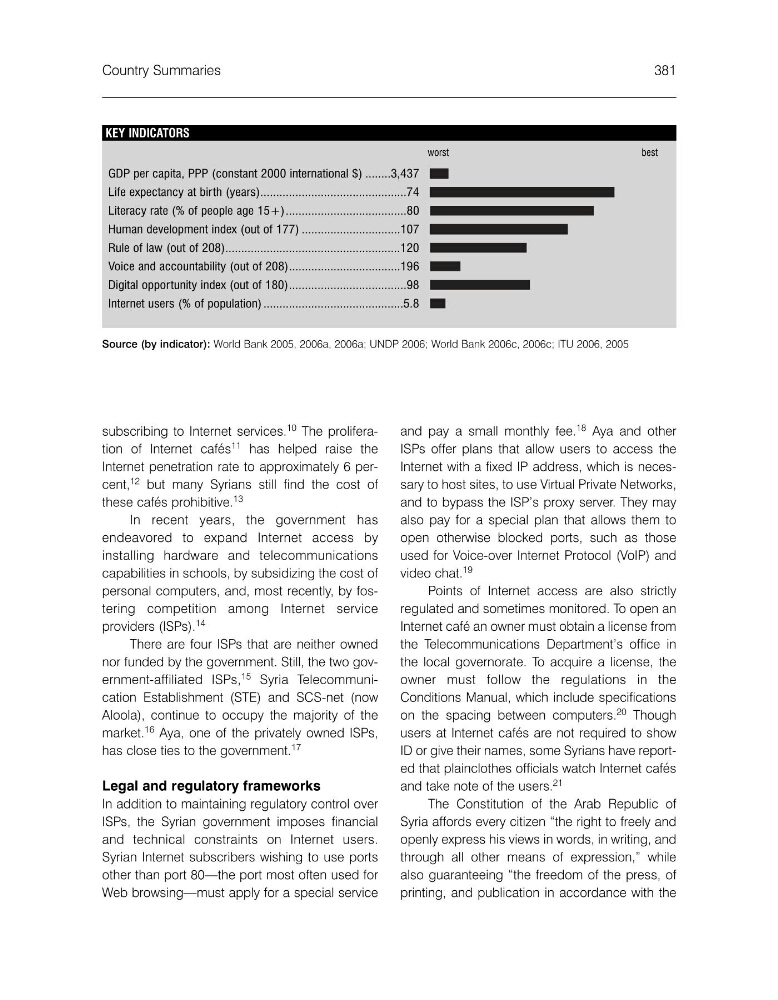
KEY INDICATORS
worst
best
GDP per capita, PPP (constant 2000 international $) ........3,437 3.88
Life expectancy at birth (years)..............................................74 6.28
Literacy rate (% of people age 15+)......................................80 5.02
Human development index (out of 177) ...............................107 5.05
Rule of law (out of 208).......................................................120 4.15
Voice and accountability (out of 208)...................................196 1.67
Digital opportunity index (out of 180).....................................98 4.89
Internet users (% of population) ............................................5.8 3.60
Source (by indicator): World Bank 2005, 2006a, 2006a; UNDP 2006; World Bank 2006c, 2006c; ITU 2006, 2005
10
The proliferation of Internet cafés
11
has helped raise the
Internet penetration rate to approximately 6 percent,
12
but many Syrians still find the cost of
these cafés prohibitive.
13
In recent years, the government has
endeavored to expand Internet access by
installing hardware and telecommunications
capabilities in schools, by subsidizing the cost of
personal computers, and, most recently, by fostering competition among Internet service
providers (ISPs). 14
There are four ISPs that are neither owned
nor funded by the government. Still, the two government-affiliated ISPs,
15
Syria Telecommunication Establishment (STE) and SCS-net (now
Aloola), continue to occupy the majority of the
market. 16 Aya, one of the privately owned ISPs,
has close ties to the government.
17
Legal and regulatory frameworks
In addition to maintaining regulatory control over
ISPs, the Syrian government imposes financial
and technical constraints on Internet users.
Syrian Internet subscribers wishing to use ports
other than port 80—the port most often used for
Web browsing—must apply for a special service
and pay a small monthly fee. 18 Aya and other
ISPs offer plans that allow users to access the
Internet with a fixed IP address, which is necessary to host sites, to use Virtual Private Networks,
and to bypass the ISP’s proxy server. They may
also pay for a special plan that allows them to
open otherwise blocked ports, such as those
used for Voice-over Internet Protocol (VoIP) and
video chat. 19
Points of Internet access are also strictly
regulated and sometimes monitored. To open an
Internet café an owner must obtain a license from
the Telecommunications Department’s office in
the local governorate. To acquire a license, the
owner must follow the regulations in the
Conditions Manual, which include specifications
on the spacing between computers. 20 Though
users at Internet cafés are not required to show
ID or give their names, some Syrians have reported that plainclothes officials watch Internet cafés
and take note of the users. 21
The Constitution of the Arab Republic of
Syria affords every citizen “the right to freely and
openly express his views in words, in writing, and
through all other means of expression,” while
also guaranteeing “the freedom of the press, of
printing, and publication in accordance with the
Country Summaries
381
KEY INDICATORS
worst
best
GDP per capita, PPP (constant 2000 international $) ........3,437 3.88
Life expectancy at birth (years)..............................................74 6.28
Literacy rate (% of people age 15+)......................................80 5.02
Human development index (out of 177) ...............................107 5.05
Rule of law (out of 208).......................................................120 4.15
Voice and accountability (out of 208)...................................196 1.67
Digital opportunity index (out of 180).....................................98 4.89
Internet users (% of population) ............................................5.8 3.60
Source (by indicator): World Bank 2005, 2006a, 2006a; UNDP 2006; World Bank 2006c, 2006c; ITU 2006, 2005