

Violence and human rights abuses continue
in the Darfur region of western Sudan, in a conflict that has spread across the Chad border. In
February 2007, the government of Sudan denied
the U.N. Human Rights Council visas to enter
Darfur to conduct an impartial review. 8 U.N. officials say that conflict in the region has resulted in
over 400,000 deaths and displaced approximately two million people. 9
Internet in Sudan
Internet usage in Sudan is limited. Where infrastructure does exist, access can be prohibitively
expensive. There are few locally produced Web
pages. 10
The infrastructure in Sudan is not optimized
for high-speed data communications services,
and both the capability and reliability of domestic
data networks need improvement. Fifteen
Internet service providers (ISPs) operate in
Sudan (2006), but only two have direct connectivity to the global Internet; the rest are considered by the Sudanese government to be operating illegally. 11
The number of home Internet subscriptions
increased by a factor of ten between 2001 and
2005, rising from 50,000 to 500,000. During the
same period, the number of Internet cafés more
than doubled. However, Internet usage remains
concentrated in Khartoum, accounting for 95 percent of Internet users. The majority of Internet
users in Sudan rely on dialup connections (59
percent), and very few have high-speed Internet
(19 percent). While 81 percent of universities in
Sudan are Internet-equipped, most (65 percent)
still use dialup connections.
The information and telecommunications
sector in Sudan is regulated by the National
Telecommunication Corporation (NTC). In 1993,
the state-owned Public Telecommunication
Corporation was transformed into the Sudan
Telecommunication Company (Sudatel), allowing
private investors to purchase a share in the enterprise. However, two-thirds of the shares of the
company remained in government hands while it
assumed exclusive operational control of the
sector. 12
In 2001, the Sudanese government adopted
the National Strategy for Building the Information
Industry, with the goal of enabling “all sectors of
society to access information media in a way
leading to the widest dissemination and utilization of information, all of which shall contribute to
achieve an appreciated economic growth, wealth
376
Country Summaries
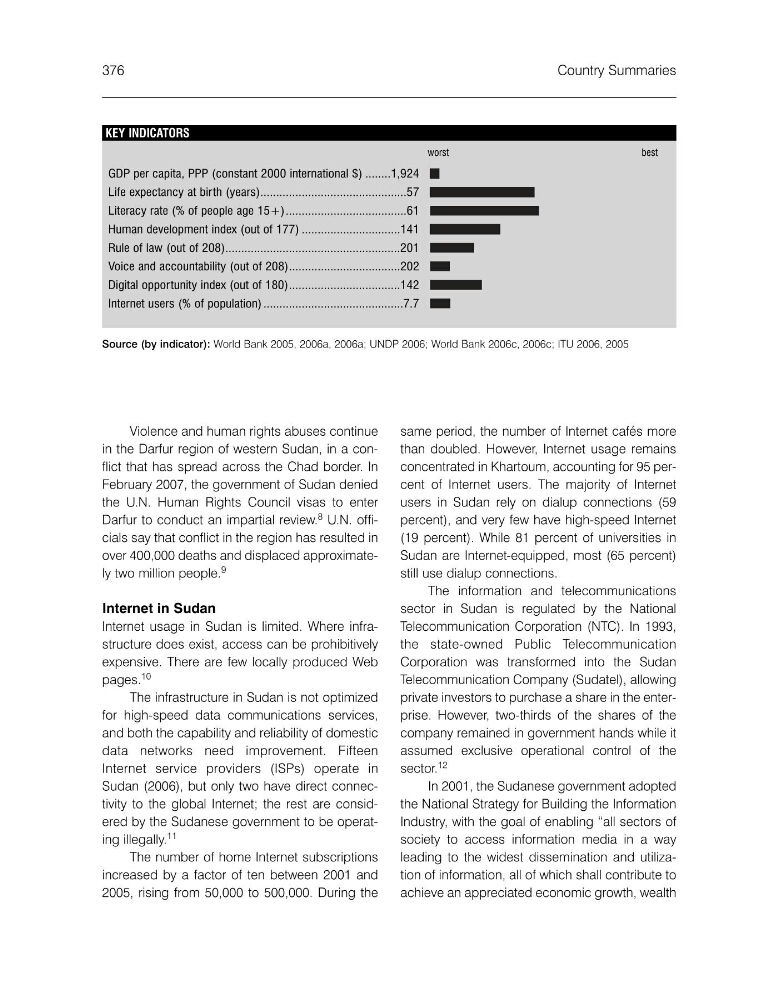
KEY INDICATORS
worst
best
GDP per capita, PPP (constant 2000 international $) ........1,924 3.59
Life expectancy at birth (years)..............................................57 3.55
Literacy rate (% of people age 15+)......................................61 3.17
Human development index (out of 177) ...............................141 2.79
Rule of law (out of 208).......................................................201 2.03
Voice and accountability (out of 208)...................................202 1.32
Digital opportunity index (out of 180)...................................142 3.02
Internet users (% of population) ............................................7.7 3.78
Source (by indicator): World Bank 2005, 2006a, 2006a; UNDP 2006; World Bank 2006c, 2006c; ITU 2006, 2005
in the Darfur region of western Sudan, in a conflict that has spread across the Chad border. In
February 2007, the government of Sudan denied
the U.N. Human Rights Council visas to enter
Darfur to conduct an impartial review. 8 U.N. officials say that conflict in the region has resulted in
over 400,000 deaths and displaced approximately two million people. 9
Internet in Sudan
Internet usage in Sudan is limited. Where infrastructure does exist, access can be prohibitively
expensive. There are few locally produced Web
pages. 10
The infrastructure in Sudan is not optimized
for high-speed data communications services,
and both the capability and reliability of domestic
data networks need improvement. Fifteen
Internet service providers (ISPs) operate in
Sudan (2006), but only two have direct connectivity to the global Internet; the rest are considered by the Sudanese government to be operating illegally. 11
The number of home Internet subscriptions
increased by a factor of ten between 2001 and
2005, rising from 50,000 to 500,000. During the
same period, the number of Internet cafés more
than doubled. However, Internet usage remains
concentrated in Khartoum, accounting for 95 percent of Internet users. The majority of Internet
users in Sudan rely on dialup connections (59
percent), and very few have high-speed Internet
(19 percent). While 81 percent of universities in
Sudan are Internet-equipped, most (65 percent)
still use dialup connections.
The information and telecommunications
sector in Sudan is regulated by the National
Telecommunication Corporation (NTC). In 1993,
the state-owned Public Telecommunication
Corporation was transformed into the Sudan
Telecommunication Company (Sudatel), allowing
private investors to purchase a share in the enterprise. However, two-thirds of the shares of the
company remained in government hands while it
assumed exclusive operational control of the
sector. 12
In 2001, the Sudanese government adopted
the National Strategy for Building the Information
Industry, with the goal of enabling “all sectors of
society to access information media in a way
leading to the widest dissemination and utilization of information, all of which shall contribute to
achieve an appreciated economic growth, wealth
376
Country Summaries
KEY INDICATORS
worst
best
GDP per capita, PPP (constant 2000 international $) ........1,924 3.59
Life expectancy at birth (years)..............................................57 3.55
Literacy rate (% of people age 15+)......................................61 3.17
Human development index (out of 177) ...............................141 2.79
Rule of law (out of 208).......................................................201 2.03
Voice and accountability (out of 208)...................................202 1.32
Digital opportunity index (out of 180)...................................142 3.02
Internet users (% of population) ............................................7.7 3.78
Source (by indicator): World Bank 2005, 2006a, 2006a; UNDP 2006; World Bank 2006c, 2006c; ITU 2006, 2005