

cripple basic freedoms of expression and
assembly under the guise of protecting public
security and preserving order.
Internet in Singapore
In 2005, the number of Internet users in
Singapore reached 2.42 million, or 67.2 percent
of the population, 6 giving the country one of the
highest Internet penetration rates in the world.
Home access is commonplace, with residential
dialup and broadband subscriptions totaling
more than 2.1 million. 7 Over 70 percent of businesses use the Internet,
8
and public access is
widespread and expanding. In December 2006,
a three-year national wireless service was
launched, providing laptop users with free Wi-Fi
Internet access in high-traffic areas across the
island. 9 Terminals in cybercafés and libraries
supply the public with additional connectivity.
Three main Internet Access Service
Providers (IASPs)—SingNet, StarHub, and
Pacific Internet—serve as the “gateways” to the
Web, providing access to Internet service
resellers (ISRs) for sale to the public. 10 Though all
three IASPs are public corporations, Temasek
Holdings (the government’s holding company)
remains the majority shareholder in SingNet and
StarHub. 11
Legal and regulatory frameworks
Singapore’s Media Development Authority (MDA)
claims to have instituted a “light-touch” regulatory framework for the Internet, promoting responsible use while giving industry players “maximum
flexibility.” 12 In addition to promoting self-regulation and public education, the MDA maintains
license and registration requirements that subject
Internet content and service providers to penalties for noncompliance with restrictions on prohibited material. The MDA is charged with ensuring that “nothing is included in the content of any
media service which is against public interest or
order, or national harmony, or which offends
good taste or decency.” 13 The core of this framework is a class license scheme stipulated by
national statute (the Broadcasting Act) 14 and by
industry policies and regulations issued by the
MDA.
Under the class license scheme, all Internet
service providers (ISPs) and those Internet content providers (ICPs) determined to be political
parties or persons “engaged in the propagation,
promotion or discussion of political or religious
Country Summaries
365
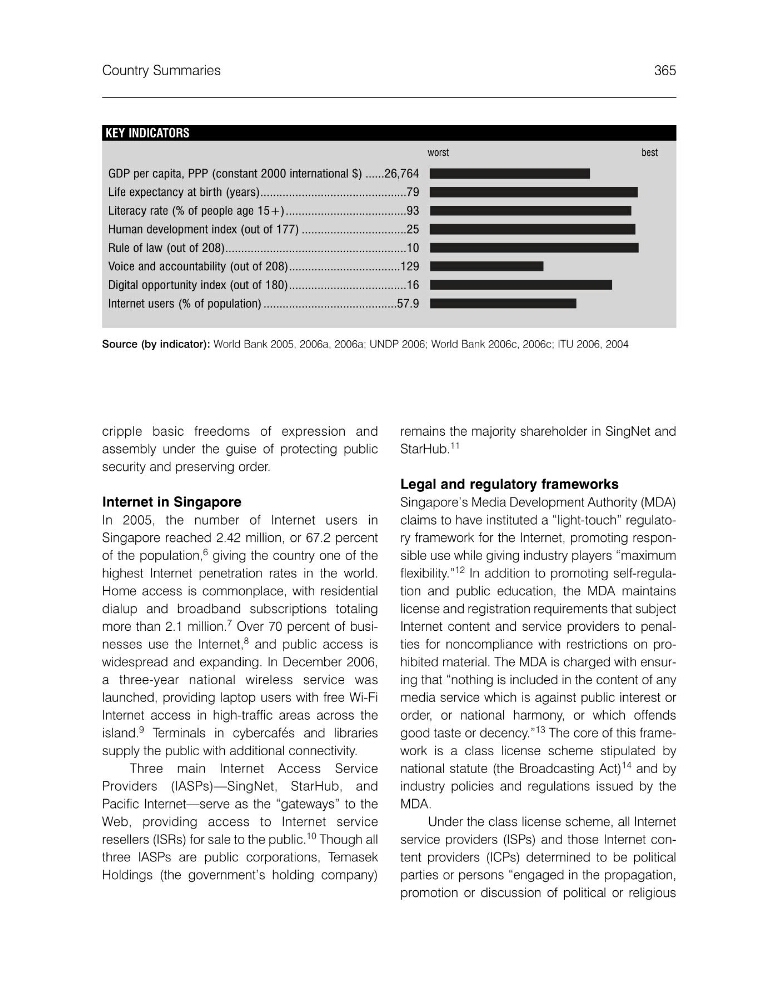
KEY INDICATORS
worst
best
GDP per capita, PPP (constant 2000 international $) ......26,764 8.36
Life expectancy at birth (years)..............................................79 7.09
Literacy rate (% of people age 15+)......................................93 6.29
Human development index (out of 177) .................................25 7.31
Rule of law (out of 208).........................................................10 8.67
Voice and accountability (out of 208)...................................129 4.42
Digital opportunity index (out of 180).....................................16 8.09
Internet users (% of population) ..........................................57.9 8.50
Source (by indicator): World Bank 2005, 2006a, 2006a; UNDP 2006; World Bank 2006c, 2006c; ITU 2006, 2004
assembly under the guise of protecting public
security and preserving order.
Internet in Singapore
In 2005, the number of Internet users in
Singapore reached 2.42 million, or 67.2 percent
of the population, 6 giving the country one of the
highest Internet penetration rates in the world.
Home access is commonplace, with residential
dialup and broadband subscriptions totaling
more than 2.1 million. 7 Over 70 percent of businesses use the Internet,
8
and public access is
widespread and expanding. In December 2006,
a three-year national wireless service was
launched, providing laptop users with free Wi-Fi
Internet access in high-traffic areas across the
island. 9 Terminals in cybercafés and libraries
supply the public with additional connectivity.
Three main Internet Access Service
Providers (IASPs)—SingNet, StarHub, and
Pacific Internet—serve as the “gateways” to the
Web, providing access to Internet service
resellers (ISRs) for sale to the public. 10 Though all
three IASPs are public corporations, Temasek
Holdings (the government’s holding company)
remains the majority shareholder in SingNet and
StarHub. 11
Legal and regulatory frameworks
Singapore’s Media Development Authority (MDA)
claims to have instituted a “light-touch” regulatory framework for the Internet, promoting responsible use while giving industry players “maximum
flexibility.” 12 In addition to promoting self-regulation and public education, the MDA maintains
license and registration requirements that subject
Internet content and service providers to penalties for noncompliance with restrictions on prohibited material. The MDA is charged with ensuring that “nothing is included in the content of any
media service which is against public interest or
order, or national harmony, or which offends
good taste or decency.” 13 The core of this framework is a class license scheme stipulated by
national statute (the Broadcasting Act) 14 and by
industry policies and regulations issued by the
MDA.
Under the class license scheme, all Internet
service providers (ISPs) and those Internet content providers (ICPs) determined to be political
parties or persons “engaged in the propagation,
promotion or discussion of political or religious
Country Summaries
365
KEY INDICATORS
worst
best
GDP per capita, PPP (constant 2000 international $) ......26,764 8.36
Life expectancy at birth (years)..............................................79 7.09
Literacy rate (% of people age 15+)......................................93 6.29
Human development index (out of 177) .................................25 7.31
Rule of law (out of 208).........................................................10 8.67
Voice and accountability (out of 208)...................................129 4.42
Digital opportunity index (out of 180).....................................16 8.09
Internet users (% of population) ..........................................57.9 8.50
Source (by indicator): World Bank 2005, 2006a, 2006a; UNDP 2006; World Bank 2006c, 2006c; ITU 2006, 2004