

Content on Kwangmyong is chosen, and user
conduct monitored, by the government.
Information comes primarily from databases
maintained by the Central Scientific and
Technological Information Agency, the Grand
People’s Study House, and other repositories. 3
This content is intended for use at select
research institutes, schools, and factories. Aside
from these establishments, only government
ministries and a handful of enterprises and individuals have the computers, telecommunications
capacity, and the authorization needed to utilize
the national intranet.
Small, government-sanctioned businesses
offering public intranet access have been
observed in urban areas, but user fees are likely
prohibitive for the average North Korean. In 2005
human rights groups revealed photographs of
one such venue—called the Information
Technology Store—in the city of Chungjin. The
facility houses several terminals with intranet connectivity and offers computer classes at the
steep price of 20,000 won per month—seven to
eight times the average monthly wage. 4 Such
costs are believed to be mandated by the state
so as to deter ordinary citizens from using the
resources and services of these facilities.
Legal and regulatory frameworks
The near absence of connectivity, even to the isolated and heavily filtered Kwangmyong intranet,
is consistent with the North Korean regime’s
efforts to regulate all information and communication in the country. There are no independent
media in North Korea. Personal radios and televisions must be modified to receive only government stations and registered with the authorities.
A nationwide ban on mobile phones has also
been in place since May 2004.
It is the state’s command of institutions and
resources that allows it to achieve such pervasive
control over online media. The government allocates available technologies to establishments
and authorizes user access as it sees fit. Legal
measures play only a subsidiary role in actualizing state control, and for citizens, they confer no
actionable rights vis-à-vis the state. Thus,
although Article 67 of the DPRK’s Socialist
Constitution guarantees freedom of speech and
of the press, there is no means of instituting a
legal challenge to the state’s dominion over
online access and expression.
348
Country Summaries
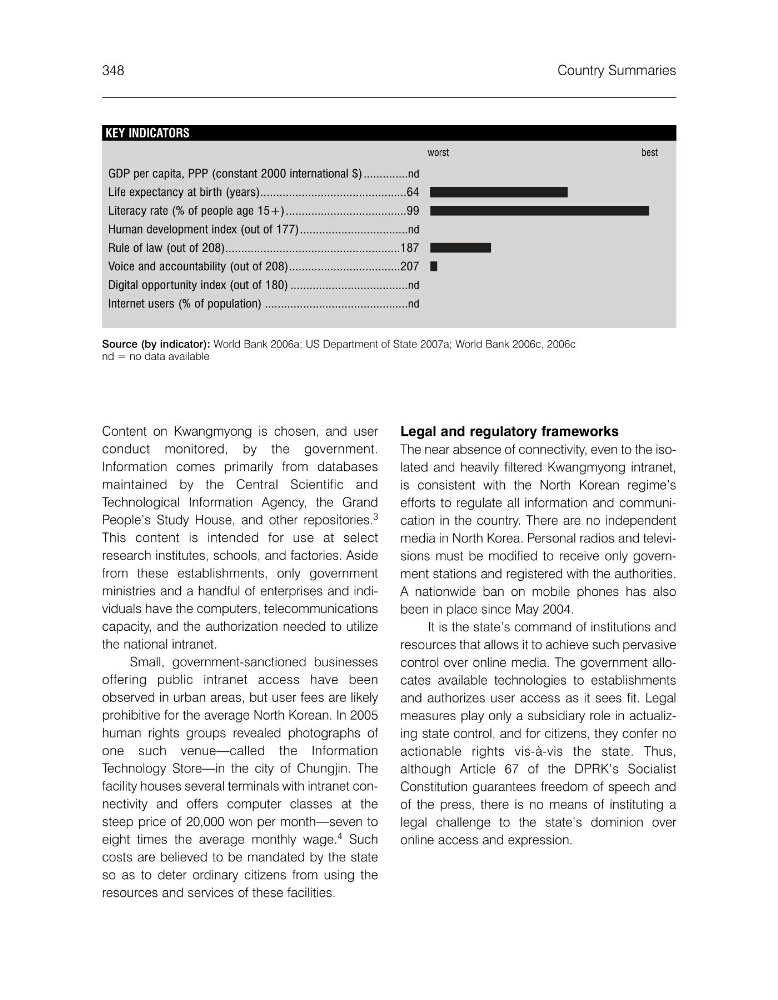
KEY INDICATORS
worst
best
GDP per capita, PPP (constant 2000 international $)..............nd —
Life expectancy at birth (years)..............................................64 4.67
Literacy rate (% of people age 15+)......................................99 6.87
Human development index (out of 177)..................................nd —
Rule of law (out of 208).......................................................187 2.70
Voice and accountability (out of 208)...................................207 0.88
Digital opportunity index (out of 180) .....................................nd —
Internet users (% of population) .............................................nd —
Source (by indicator): World Bank 2006a; US Department of State 2007a; World Bank 2006c, 2006c
nd = no data available
conduct monitored, by the government.
Information comes primarily from databases
maintained by the Central Scientific and
Technological Information Agency, the Grand
People’s Study House, and other repositories. 3
This content is intended for use at select
research institutes, schools, and factories. Aside
from these establishments, only government
ministries and a handful of enterprises and individuals have the computers, telecommunications
capacity, and the authorization needed to utilize
the national intranet.
Small, government-sanctioned businesses
offering public intranet access have been
observed in urban areas, but user fees are likely
prohibitive for the average North Korean. In 2005
human rights groups revealed photographs of
one such venue—called the Information
Technology Store—in the city of Chungjin. The
facility houses several terminals with intranet connectivity and offers computer classes at the
steep price of 20,000 won per month—seven to
eight times the average monthly wage. 4 Such
costs are believed to be mandated by the state
so as to deter ordinary citizens from using the
resources and services of these facilities.
Legal and regulatory frameworks
The near absence of connectivity, even to the isolated and heavily filtered Kwangmyong intranet,
is consistent with the North Korean regime’s
efforts to regulate all information and communication in the country. There are no independent
media in North Korea. Personal radios and televisions must be modified to receive only government stations and registered with the authorities.
A nationwide ban on mobile phones has also
been in place since May 2004.
It is the state’s command of institutions and
resources that allows it to achieve such pervasive
control over online media. The government allocates available technologies to establishments
and authorizes user access as it sees fit. Legal
measures play only a subsidiary role in actualizing state control, and for citizens, they confer no
actionable rights vis-à-vis the state. Thus,
although Article 67 of the DPRK’s Socialist
Constitution guarantees freedom of speech and
of the press, there is no means of instituting a
legal challenge to the state’s dominion over
online access and expression.
348
Country Summaries
KEY INDICATORS
worst
best
GDP per capita, PPP (constant 2000 international $)..............nd —
Life expectancy at birth (years)..............................................64 4.67
Literacy rate (% of people age 15+)......................................99 6.87
Human development index (out of 177)..................................nd —
Rule of law (out of 208).......................................................187 2.70
Voice and accountability (out of 208)...................................207 0.88
Digital opportunity index (out of 180) .....................................nd —
Internet users (% of population) .............................................nd —
Source (by indicator): World Bank 2006a; US Department of State 2007a; World Bank 2006c, 2006c
nd = no data available