

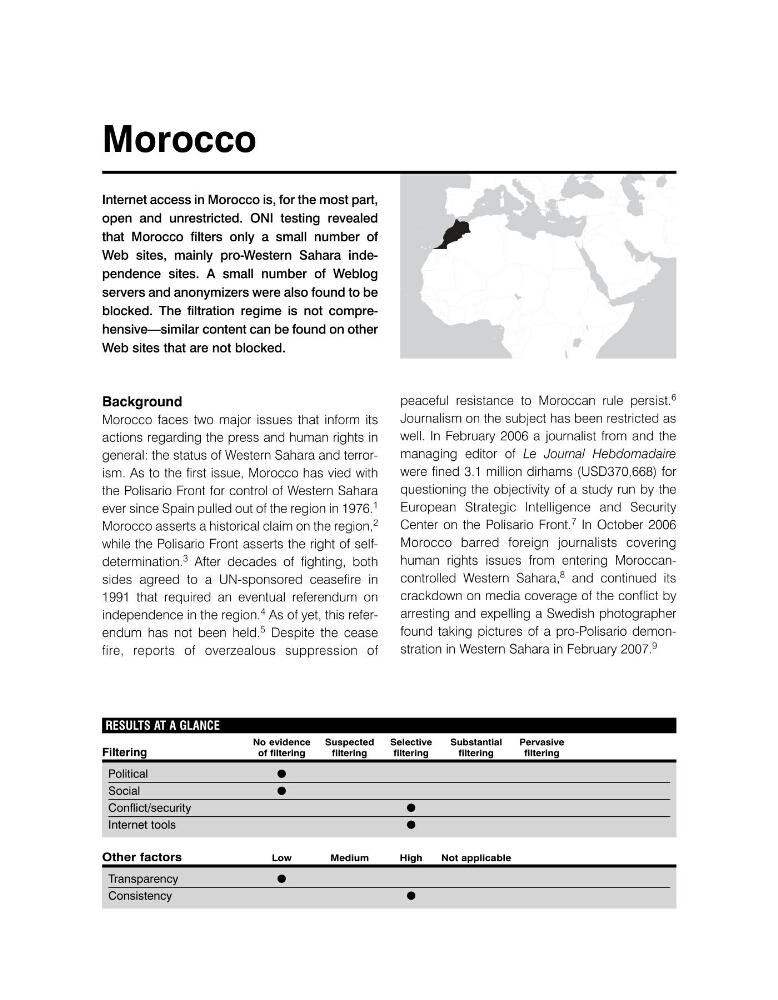
Internet access in Morocco is, for the most part,
open and unrestricted. ONI testing revealed
that Morocco filters only a small number of
Web sites, mainly pro-Western Sahara independence sites. A small number of Weblog
servers and anonymizers were also found to be
blocked. The filtration regime is not comprehensive—similar content can be found on other
Web sites that are not blocked.
Background
Morocco faces two major issues that inform its
actions regarding the press and human rights in
general: the status of Western Sahara and terrorism. As to the first issue, Morocco has vied with
the Polisario Front for control of Western Sahara
ever since Spain pulled out of the region in 1976. 1
Morocco asserts a historical claim on the region,
2
while the Polisario Front asserts the right of selfdetermination.
3
After decades of fighting, both
sides agreed to a UN-sponsored ceasefire in
1991 that required an eventual referendum on
independence in the region. 4 As of yet, this referendum has not been held.
5
Despite the cease
fire, reports of overzealous suppression of
peaceful resistance to Moroccan rule persist.
6
Journalism on the subject has been restricted as
well. In February 2006 a journalist from and the
managing editor of Le Journal Hebdomadaire
were fined 3.1 million dirhams (USD370,668) for
questioning the objectivity of a study run by the
European Strategic Intelligence and Security
Center on the Polisario Front. 7 In October 2006
Morocco barred foreign journalists covering
human rights issues from entering Moroccancontrolled Western Sahara, 8 and continued its
crackdown on media coverage of the conflict by
arresting and expelling a Swedish photographer
found taking pictures of a pro-Polisario demonstration in Western Sahara in February 2007. 9
RESULTS AT A GLANCE
No evidence
Suspected
Selective
Substantial
Pervasive
Filtering
of filtering
filtering
filtering
filtering
filtering
Political
●
Social
●
Conflict/security
●
Internet tools
●
Other factors
Low
Medium
High
Not applicable
Transparency
●
Consistency
●
Morocco
open and unrestricted. ONI testing revealed
that Morocco filters only a small number of
Web sites, mainly pro-Western Sahara independence sites. A small number of Weblog
servers and anonymizers were also found to be
blocked. The filtration regime is not comprehensive—similar content can be found on other
Web sites that are not blocked.
Background
Morocco faces two major issues that inform its
actions regarding the press and human rights in
general: the status of Western Sahara and terrorism. As to the first issue, Morocco has vied with
the Polisario Front for control of Western Sahara
ever since Spain pulled out of the region in 1976. 1
Morocco asserts a historical claim on the region,
2
while the Polisario Front asserts the right of selfdetermination.
3
After decades of fighting, both
sides agreed to a UN-sponsored ceasefire in
1991 that required an eventual referendum on
independence in the region. 4 As of yet, this referendum has not been held.
5
Despite the cease
fire, reports of overzealous suppression of
peaceful resistance to Moroccan rule persist.
6
Journalism on the subject has been restricted as
well. In February 2006 a journalist from and the
managing editor of Le Journal Hebdomadaire
were fined 3.1 million dirhams (USD370,668) for
questioning the objectivity of a study run by the
European Strategic Intelligence and Security
Center on the Polisario Front. 7 In October 2006
Morocco barred foreign journalists covering
human rights issues from entering Moroccancontrolled Western Sahara, 8 and continued its
crackdown on media coverage of the conflict by
arresting and expelling a Swedish photographer
found taking pictures of a pro-Polisario demonstration in Western Sahara in February 2007. 9
RESULTS AT A GLANCE
No evidence
Suspected
Selective
Substantial
Pervasive
Filtering
of filtering
filtering
filtering
filtering
filtering
Political
●
Social
●
Conflict/security
●
Internet tools
●
Other factors
Low
Medium
High
Not applicable
Transparency
●
Consistency
●
Morocco