

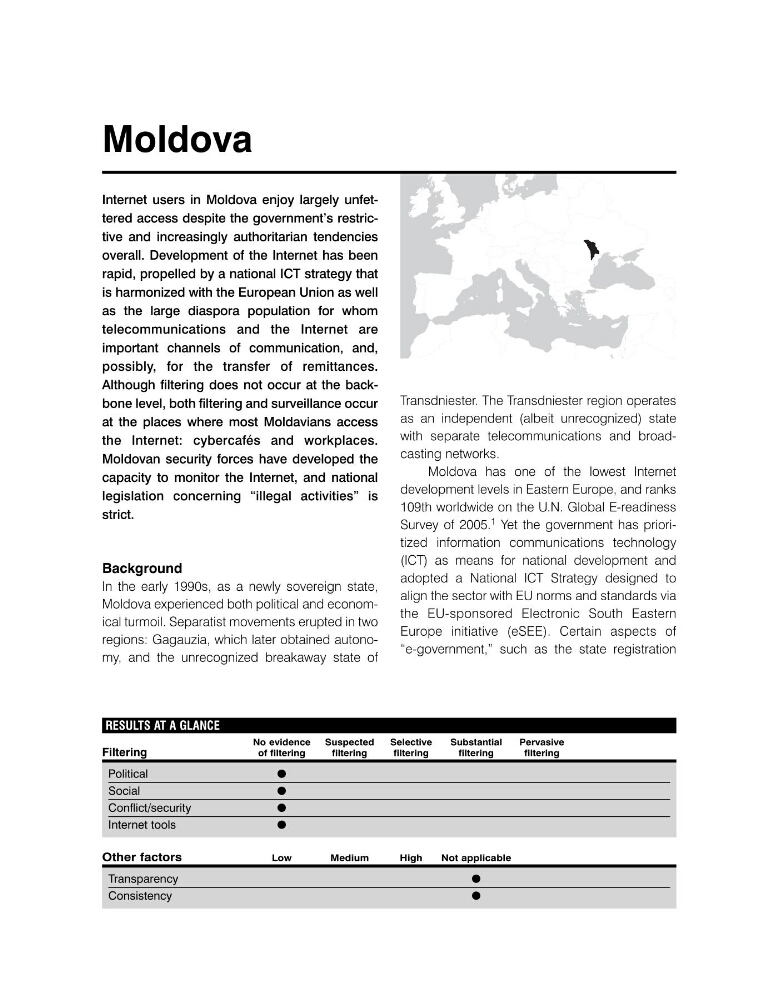
Internet users in Moldova enjoy largely unfettered access despite the government’s restrictive and increasingly authoritarian tendencies
overall. Development of the Internet has been
rapid, propelled by a national ICT strategy that
is harmonized with the European Union as well
as the large diaspora population for whom
telecommunications and the Internet are
important channels of communication, and,
possibly, for the transfer of remittances.
Although filtering does not occur at the backbone level, both filtering and surveillance occur
at the places where most Moldavians access
the Internet: cybercafés and workplaces.
Moldovan security forces have developed the
capacity to monitor the Internet, and national
legislation concerning “illegal activities” is
strict.
Background
In the early 1990s, as a newly sovereign state,
Moldova experienced both political and economical turmoil. Separatist movements erupted in two
regions: Gagauzia, which later obtained autonomy, and the unrecognized breakaway state of
Transdniester. The Transdniester region operates
as an independent (albeit unrecognized) state
with separate telecommunications and broadcasting networks.
Moldova has one of the lowest Internet
development levels in Eastern Europe, and ranks
109th worldwide on the U.N. Global E-readiness
Survey of 2005. 1 Yet the government has prioritized information communications technology
(ICT) as means for national development and
adopted a National ICT Strategy designed to
align the sector with EU norms and standards via
the EU-sponsored Electronic South Eastern
Europe initiative (eSEE). Certain aspects of
“e-government,” such as the state registration
RESULTS AT A GLANCE
No evidence
Suspected
Selective
Substantial
Pervasive
Filtering
of filtering
filtering
filtering
filtering
filtering
Political
●
Social
●
Conflict/security
●
Internet tools
●
Other factors
Low
Medium
High
Not applicable
Transparency
●
Consistency
●
Moldova
overall. Development of the Internet has been
rapid, propelled by a national ICT strategy that
is harmonized with the European Union as well
as the large diaspora population for whom
telecommunications and the Internet are
important channels of communication, and,
possibly, for the transfer of remittances.
Although filtering does not occur at the backbone level, both filtering and surveillance occur
at the places where most Moldavians access
the Internet: cybercafés and workplaces.
Moldovan security forces have developed the
capacity to monitor the Internet, and national
legislation concerning “illegal activities” is
strict.
Background
In the early 1990s, as a newly sovereign state,
Moldova experienced both political and economical turmoil. Separatist movements erupted in two
regions: Gagauzia, which later obtained autonomy, and the unrecognized breakaway state of
Transdniester. The Transdniester region operates
as an independent (albeit unrecognized) state
with separate telecommunications and broadcasting networks.
Moldova has one of the lowest Internet
development levels in Eastern Europe, and ranks
109th worldwide on the U.N. Global E-readiness
Survey of 2005. 1 Yet the government has prioritized information communications technology
(ICT) as means for national development and
adopted a National ICT Strategy designed to
align the sector with EU norms and standards via
the EU-sponsored Electronic South Eastern
Europe initiative (eSEE). Certain aspects of
“e-government,” such as the state registration
RESULTS AT A GLANCE
No evidence
Suspected
Selective
Substantial
Pervasive
Filtering
of filtering
filtering
filtering
filtering
filtering
Political
●
Social
●
Conflict/security
●
Internet tools
●
Other factors
Low
Medium
High
Not applicable
Transparency
●
Consistency
●
Moldova