

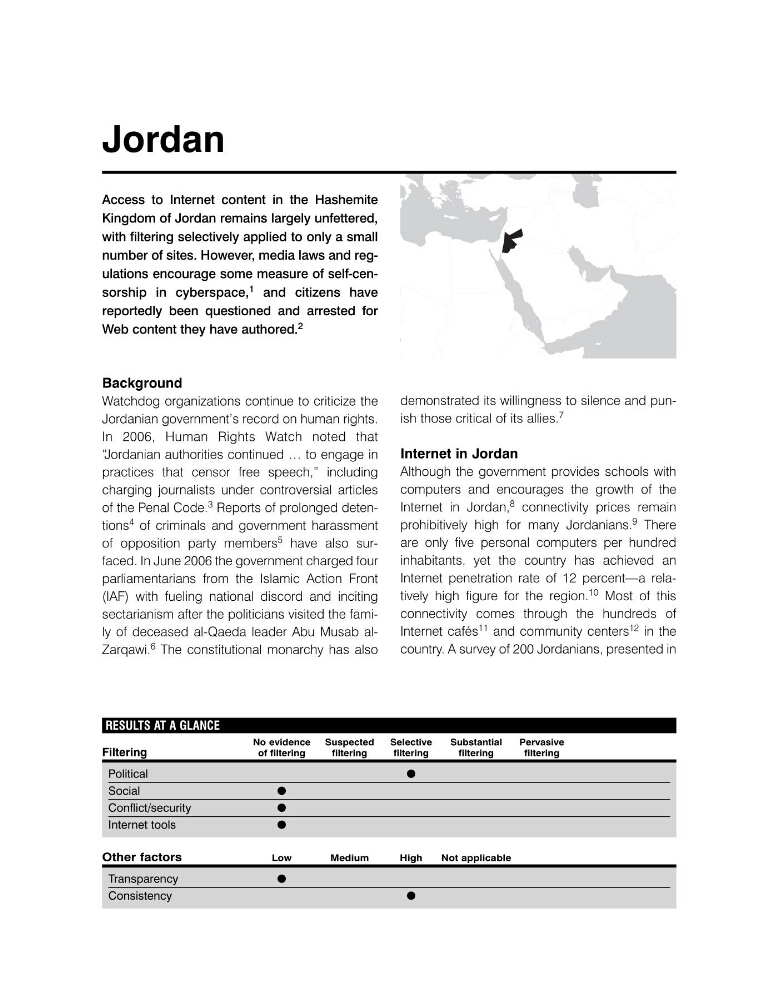
Access to Internet content in the Hashemite
Kingdom of Jordan remains largely unfettered,
with filtering selectively applied to only a small
number of sites. However, media laws and regulations encourage some measure of self-censorship in cyberspace,
1 and citizens have
reportedly been questioned and arrested for
Web content they have authored.
2
Background
Watchdog organizations continue to criticize the
Jordanian government’s record on human rights.
In 2006, Human Rights Watch noted that
“Jordanian authorities continued … to engage in
practices that censor free speech,” including
charging journalists under controversial articles
of the Penal Code. 3 Reports of prolonged detentions
4
of criminals and government harassment
of opposition party members
5
have also surfaced. In June 2006 the government charged four
parliamentarians from the Islamic Action Front
(IAF) with fueling national discord and inciting
sectarianism after the politicians visited the family of deceased al-Qaeda leader Abu Musab alZarqawi. 6 The constitutional monarchy has also
demonstrated its willingness to silence and punish those critical of its allies. 7
Internet in Jordan
Although the government provides schools with
computers and encourages the growth of the
Internet in Jordan, 8 connectivity prices remain
prohibitively high for many Jordanians.
9
There
are only five personal computers per hundred
inhabitants, yet the country has achieved an
Internet penetration rate of 12 percent—a relatively high figure for the region. 10 Most of this
connectivity comes through the hundreds of
Internet cafés 11 and community centers
12
in the
country. A survey of 200 Jordanians, presented in
RESULTS AT A GLANCE
No evidence
Suspected
Selective
Substantial
Pervasive
Filtering
of filtering
filtering
filtering
filtering
filtering
Political
●
Social
●
Conflict/security
●
Internet tools
●
Other factors
Low
Medium
High
Not applicable
Transparency
●
Consistency
●
Jordan
Kingdom of Jordan remains largely unfettered,
with filtering selectively applied to only a small
number of sites. However, media laws and regulations encourage some measure of self-censorship in cyberspace,
1 and citizens have
reportedly been questioned and arrested for
Web content they have authored.
2
Background
Watchdog organizations continue to criticize the
Jordanian government’s record on human rights.
In 2006, Human Rights Watch noted that
“Jordanian authorities continued … to engage in
practices that censor free speech,” including
charging journalists under controversial articles
of the Penal Code. 3 Reports of prolonged detentions
4
of criminals and government harassment
of opposition party members
5
have also surfaced. In June 2006 the government charged four
parliamentarians from the Islamic Action Front
(IAF) with fueling national discord and inciting
sectarianism after the politicians visited the family of deceased al-Qaeda leader Abu Musab alZarqawi. 6 The constitutional monarchy has also
demonstrated its willingness to silence and punish those critical of its allies. 7
Internet in Jordan
Although the government provides schools with
computers and encourages the growth of the
Internet in Jordan, 8 connectivity prices remain
prohibitively high for many Jordanians.
9
There
are only five personal computers per hundred
inhabitants, yet the country has achieved an
Internet penetration rate of 12 percent—a relatively high figure for the region. 10 Most of this
connectivity comes through the hundreds of
Internet cafés 11 and community centers
12
in the
country. A survey of 200 Jordanians, presented in
RESULTS AT A GLANCE
No evidence
Suspected
Selective
Substantial
Pervasive
Filtering
of filtering
filtering
filtering
filtering
filtering
Political
●
Social
●
Conflict/security
●
Internet tools
●
Other factors
Low
Medium
High
Not applicable
Transparency
●
Consistency
●
Jordan