

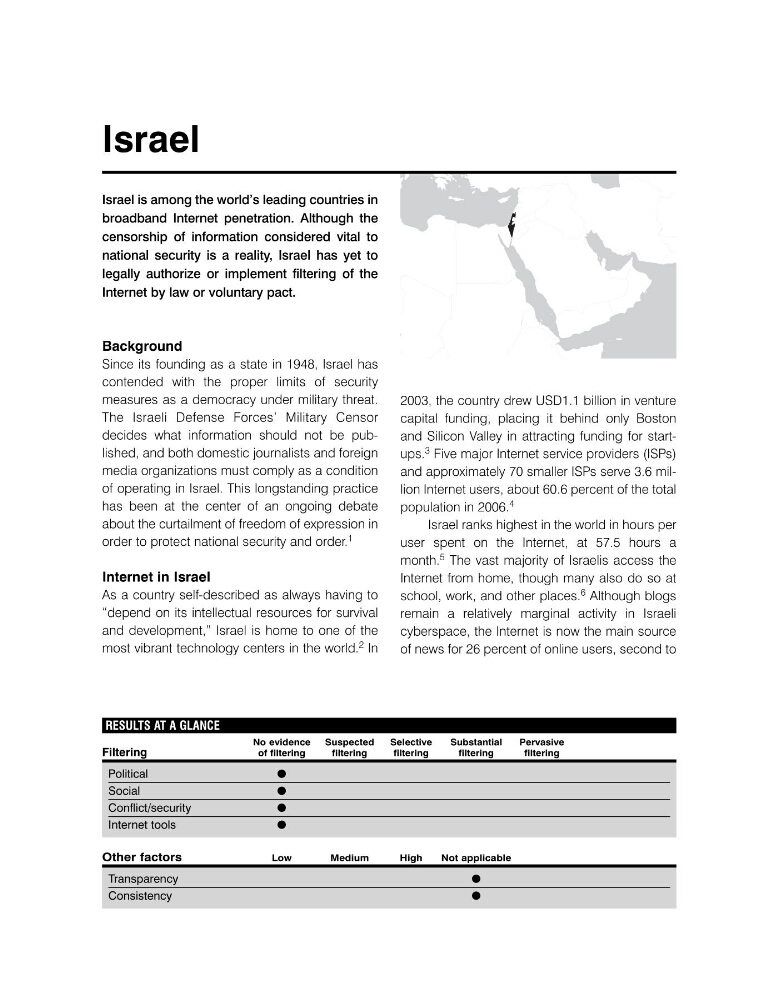
Israel is among the world’s leading countries in
broadband Internet penetration. Although the
censorship of information considered vital to
national security is a reality, Israel has yet to
legally authorize or implement filtering of the
Internet by law or voluntary pact.
Background
Since its founding as a state in 1948, Israel has
contended with the proper limits of security
measures as a democracy under military threat.
The Israeli Defense Forces’ Military Censor
decides what information should not be published, and both domestic journalists and foreign
media organizations must comply as a condition
of operating in Israel. This longstanding practice
has been at the center of an ongoing debate
about the curtailment of freedom of expression in
order to protect national security and order. 1
Internet in Israel
As a country self-described as always having to
“depend on its intellectual resources for survival
and development,” Israel is home to one of the
most vibrant technology centers in the world. 2 In
2003, the country drew USD1.1 billion in venture
capital funding, placing it behind only Boston
and Silicon Valley in attracting funding for startups. 3 Five major Internet service providers (ISPs)
and approximately 70 smaller ISPs serve 3.6 million Internet users, about 60.6 percent of the total
population in 2006. 4
Israel ranks highest in the world in hours per
user spent on the Internet, at 57.5 hours a
month. 5 The vast majority of Israelis access the
Internet from home, though many also do so at
school, work, and other places. 6 Although blogs
remain a relatively marginal activity in Israeli
cyberspace, the Internet is now the main source
of news for 26 percent of online users, second to
RESULTS AT A GLANCE
No evidence
Suspected
Selective
Substantial
Pervasive
Filtering
of filtering
filtering
filtering
filtering
filtering
Political
●
Social
●
Conflict/security
●
Internet tools
●
Other factors
Low
Medium
High
Not applicable
Transparency
●
Consistency
●
Israel
broadband Internet penetration. Although the
censorship of information considered vital to
national security is a reality, Israel has yet to
legally authorize or implement filtering of the
Internet by law or voluntary pact.
Background
Since its founding as a state in 1948, Israel has
contended with the proper limits of security
measures as a democracy under military threat.
The Israeli Defense Forces’ Military Censor
decides what information should not be published, and both domestic journalists and foreign
media organizations must comply as a condition
of operating in Israel. This longstanding practice
has been at the center of an ongoing debate
about the curtailment of freedom of expression in
order to protect national security and order. 1
Internet in Israel
As a country self-described as always having to
“depend on its intellectual resources for survival
and development,” Israel is home to one of the
most vibrant technology centers in the world. 2 In
2003, the country drew USD1.1 billion in venture
capital funding, placing it behind only Boston
and Silicon Valley in attracting funding for startups. 3 Five major Internet service providers (ISPs)
and approximately 70 smaller ISPs serve 3.6 million Internet users, about 60.6 percent of the total
population in 2006. 4
Israel ranks highest in the world in hours per
user spent on the Internet, at 57.5 hours a
month. 5 The vast majority of Israelis access the
Internet from home, though many also do so at
school, work, and other places. 6 Although blogs
remain a relatively marginal activity in Israeli
cyberspace, the Internet is now the main source
of news for 26 percent of online users, second to
RESULTS AT A GLANCE
No evidence
Suspected
Selective
Substantial
Pervasive
Filtering
of filtering
filtering
filtering
filtering
filtering
Political
●
Social
●
Conflict/security
●
Internet tools
●
Other factors
Low
Medium
High
Not applicable
Transparency
●
Consistency
●
Israel