

East, with an increase of 2,900 percent between
2000 and 2005.
4
Today an estimated 7.2 million
people are online in Iran, and there are approximately 400,000 blogs in Farsi.
5
Yet even as the
government continues to promote the Internet as
an engine of economic growth, one Iranian official recently boasted that Iran has censored ten
million Web sites, and that the judiciary requests
an additional 1,000 sites to be blocked every
month. 6
On October 11, 2006, an order reportedly
issued to Internet service providers (ISPs) by the
Ministry of Communications and Information
Technology (MCIT) made providing Internet services—for use in private or public places—at a
speed higher than 128 kilobytes per second illegal, reportedly with the aim of hindering users’
ability to download foreign cultural products
(such as music and films) and organize political
opposition. 7 Such an about-face contradicts
Iran’s fourth Five-Year Development Plan, which
calls for 1.5 million high-speed Internet ports
throughout the country. 8
At that time, some 250,000 users were using
broadband services, with demand growing
sharply. 9 Though the order applies to both public
and home use, high-speed Internet services are
most commonly available for commercial and
office use. Over the previous two years eleven
companies had been licensed to provide such
high-speed services free from government competition and had invested significant capital in
importing the required machinery and setting up
the required infrastructure. 10 The ban on highspeed Internet services has pushed these private
sector companies to the verge of bankruptcy.
Furthermore, projects such as the USD6 million
Internet television project of the ITC (Information
Technology Company), as well as virtual surgery
lab projects and e-universities and many more
scientific and commercial projects being implemented in the country may be doomed to fail. 11
Members of parliament are campaigning
against the broadband ban and have started a
Web site, www.more-speed-more-progress.ir, which
is hosted on Iranian government servers. 12
Although the head of the Public Relations
Department of the Regulation Organization said
that the ban would be lifted in four months’ time,
after the government had had a chance to put in
place measures to more effectively monitor
Internet use, the Minister of the MCIT stated
that “positive” results could make the measure
permanent. Individuals can file a written comCountry Summaries
293
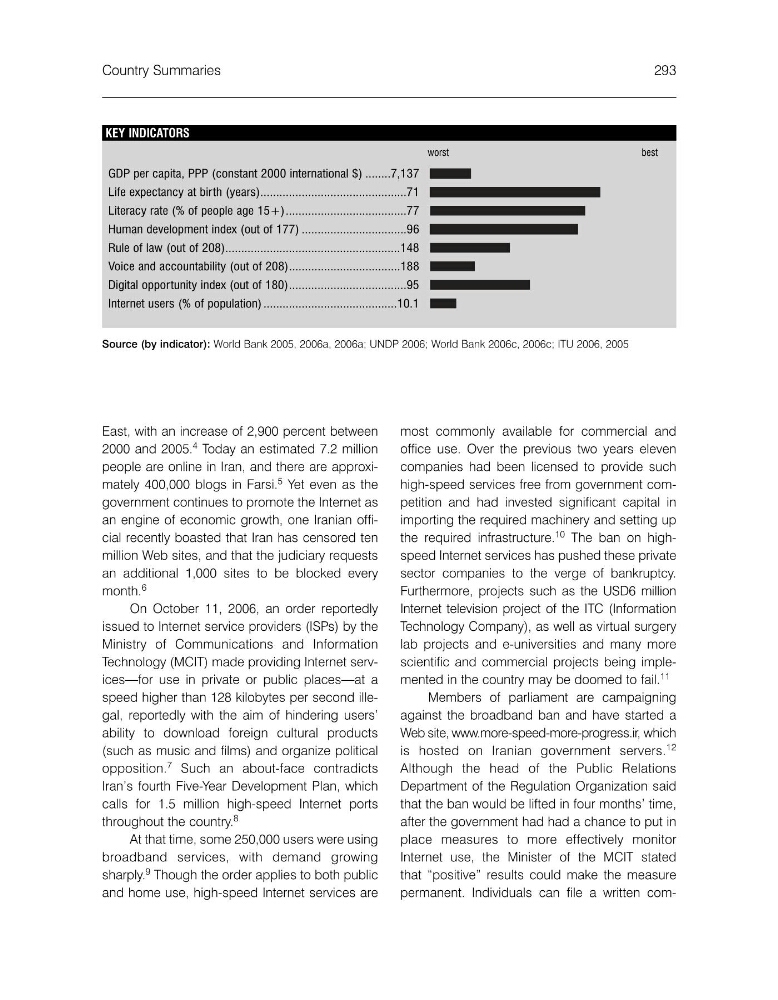
KEY INDICATORS
worst
best
GDP per capita, PPP (constant 2000 international $) ........7,137 4.59
Life expectancy at birth (years)..............................................71 5.80
Literacy rate (% of people age 15+)......................................77 4.73
Human development index (out of 177) .................................96 5.39
Rule of law (out of 208).......................................................148 3.47
Voice and accountability (out of 208)...................................188 2.15
Digital opportunity index (out of 180).....................................95 4.89
Internet users (% of population) ..........................................10.1 4.00
Source (by indicator): World Bank 2005, 2006a, 2006a; UNDP 2006; World Bank 2006c, 2006c; ITU 2006, 2005
2000 and 2005.
4
Today an estimated 7.2 million
people are online in Iran, and there are approximately 400,000 blogs in Farsi.
5
Yet even as the
government continues to promote the Internet as
an engine of economic growth, one Iranian official recently boasted that Iran has censored ten
million Web sites, and that the judiciary requests
an additional 1,000 sites to be blocked every
month. 6
On October 11, 2006, an order reportedly
issued to Internet service providers (ISPs) by the
Ministry of Communications and Information
Technology (MCIT) made providing Internet services—for use in private or public places—at a
speed higher than 128 kilobytes per second illegal, reportedly with the aim of hindering users’
ability to download foreign cultural products
(such as music and films) and organize political
opposition. 7 Such an about-face contradicts
Iran’s fourth Five-Year Development Plan, which
calls for 1.5 million high-speed Internet ports
throughout the country. 8
At that time, some 250,000 users were using
broadband services, with demand growing
sharply. 9 Though the order applies to both public
and home use, high-speed Internet services are
most commonly available for commercial and
office use. Over the previous two years eleven
companies had been licensed to provide such
high-speed services free from government competition and had invested significant capital in
importing the required machinery and setting up
the required infrastructure. 10 The ban on highspeed Internet services has pushed these private
sector companies to the verge of bankruptcy.
Furthermore, projects such as the USD6 million
Internet television project of the ITC (Information
Technology Company), as well as virtual surgery
lab projects and e-universities and many more
scientific and commercial projects being implemented in the country may be doomed to fail. 11
Members of parliament are campaigning
against the broadband ban and have started a
Web site, www.more-speed-more-progress.ir, which
is hosted on Iranian government servers. 12
Although the head of the Public Relations
Department of the Regulation Organization said
that the ban would be lifted in four months’ time,
after the government had had a chance to put in
place measures to more effectively monitor
Internet use, the Minister of the MCIT stated
that “positive” results could make the measure
permanent. Individuals can file a written comCountry Summaries
293
KEY INDICATORS
worst
best
GDP per capita, PPP (constant 2000 international $) ........7,137 4.59
Life expectancy at birth (years)..............................................71 5.80
Literacy rate (% of people age 15+)......................................77 4.73
Human development index (out of 177) .................................96 5.39
Rule of law (out of 208).......................................................148 3.47
Voice and accountability (out of 208)...................................188 2.15
Digital opportunity index (out of 180).....................................95 4.89
Internet users (% of population) ..........................................10.1 4.00
Source (by indicator): World Bank 2005, 2006a, 2006a; UNDP 2006; World Bank 2006c, 2006c; ITU 2006, 2005