

Overview
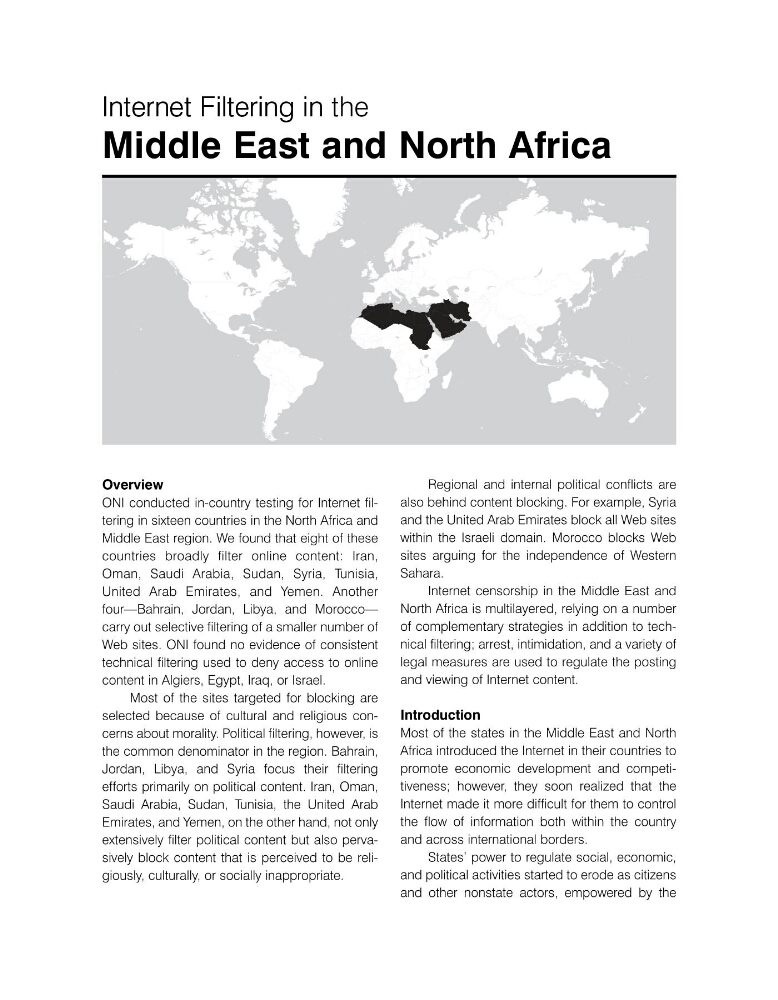
ONI conducted in-country testing for Internet filtering in sixteen countries in the North Africa and
Middle East region. We found that eight of these
countries broadly filter online content: Iran,
Oman, Saudi Arabia, Sudan, Syria, Tunisia,
United Arab Emirates, and Yemen. Another
four—Bahrain, Jordan, Libya, and Morocco—
carry out selective filtering of a smaller number of
Web sites. ONI found no evidence of consistent
technical filtering used to deny access to online
content in Algiers, Egypt, Iraq, or Israel.
Most of the sites targeted for blocking are
selected because of cultural and religious concerns about morality. Political filtering, however, is
the common denominator in the region. Bahrain,
Jordan, Libya, and Syria focus their filtering
efforts primarily on political content. Iran, Oman,
Saudi Arabia, Sudan, Tunisia, the United Arab
Emirates, and Yemen, on the other hand, not only
extensively filter political content but also pervasively block content that is perceived to be religiously, culturally, or socially inappropriate.
Regional and internal political conflicts are
also behind content blocking. For example, Syria
and the United Arab Emirates block all Web sites
within the Israeli domain. Morocco blocks Web
sites arguing for the independence of Western
Sahara.
Internet censorship in the Middle East and
North Africa is multilayered, relying on a number
of complementary strategies in addition to technical filtering; arrest, intimidation, and a variety of
legal measures are used to regulate the posting
and viewing of Internet content.
Introduction
Most of the states in the Middle East and North
Africa introduced the Internet in their countries to
promote economic development and competitiveness; however, they soon realized that the
Internet made it more difficult for them to control
the flow of information both within the country
and across international borders.
States’ power to regulate social, economic,
and political activities started to erode as citizens
and other nonstate actors, empowered by the
Internet Filtering in
Internet Filtering in the
Middle East and North Africa
ONI conducted in-country testing for Internet filtering in sixteen countries in the North Africa and
Middle East region. We found that eight of these
countries broadly filter online content: Iran,
Oman, Saudi Arabia, Sudan, Syria, Tunisia,
United Arab Emirates, and Yemen. Another
four—Bahrain, Jordan, Libya, and Morocco—
carry out selective filtering of a smaller number of
Web sites. ONI found no evidence of consistent
technical filtering used to deny access to online
content in Algiers, Egypt, Iraq, or Israel.
Most of the sites targeted for blocking are
selected because of cultural and religious concerns about morality. Political filtering, however, is
the common denominator in the region. Bahrain,
Jordan, Libya, and Syria focus their filtering
efforts primarily on political content. Iran, Oman,
Saudi Arabia, Sudan, Tunisia, the United Arab
Emirates, and Yemen, on the other hand, not only
extensively filter political content but also pervasively block content that is perceived to be religiously, culturally, or socially inappropriate.
Regional and internal political conflicts are
also behind content blocking. For example, Syria
and the United Arab Emirates block all Web sites
within the Israeli domain. Morocco blocks Web
sites arguing for the independence of Western
Sahara.
Internet censorship in the Middle East and
North Africa is multilayered, relying on a number
of complementary strategies in addition to technical filtering; arrest, intimidation, and a variety of
legal measures are used to regulate the posting
and viewing of Internet content.
Introduction
Most of the states in the Middle East and North
Africa introduced the Internet in their countries to
promote economic development and competitiveness; however, they soon realized that the
Internet made it more difficult for them to control
the flow of information both within the country
and across international borders.
States’ power to regulate social, economic,
and political activities started to erode as citizens
and other nonstate actors, empowered by the
Internet Filtering in
Internet Filtering in the
Middle East and North Africa