

Overview
As a former superpower—with a tradition of
authoritarianism, poorly developed independent
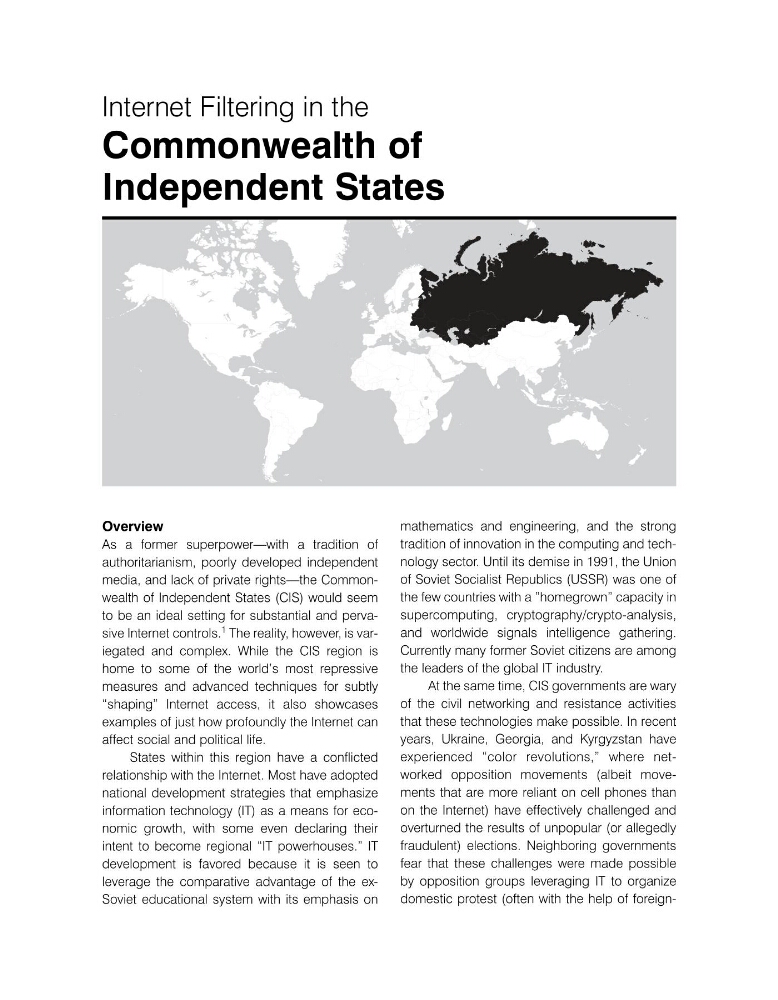
media, and lack of private rights—the Commonwealth of Independent States (CIS) would seem
to be an ideal setting for substantial and pervasive Internet controls. 1 The reality, however, is variegated and complex. While the CIS region is
home to some of the world’s most repressive
measures and advanced techniques for subtly
“shaping” Internet access, it also showcases
examples of just how profoundly the Internet can
affect social and political life.
States within this region have a conflicted
relationship with the Internet. Most have adopted
national development strategies that emphasize
information technology (IT) as a means for economic growth, with some even declaring their
intent to become regional “IT powerhouses.” IT
development is favored because it is seen to
leverage the comparative advantage of the exSoviet educational system with its emphasis on
mathematics and engineering, and the strong
tradition of innovation in the computing and technology sector. Until its demise in 1991, the Union
of Soviet Socialist Republics (USSR) was one of
the few countries with a ”homegrown” capacity in
supercomputing, cryptography/crypto-analysis,
and worldwide signals intelligence gathering.
Currently many former Soviet citizens are among
the leaders of the global IT industry.
At the same time, CIS governments are wary
of the civil networking and resistance activities
that these technologies make possible. In recent
years, Ukraine, Georgia, and Kyrgyzstan have
experienced “color revolutions,” where networked opposition movements (albeit movements that are more reliant on cell phones than
on the Internet) have effectively challenged and
overturned the results of unpopular (or allegedly
fraudulent) elections. Neighboring governments
fear that these challenges were made possible
by opposition groups leveraging IT to organize
domestic protest (often with the help of foreignInternet Filtering in the
Commonwealth of
Independent States
As a former superpower—with a tradition of
authoritarianism, poorly developed independent
media, and lack of private rights—the Commonwealth of Independent States (CIS) would seem
to be an ideal setting for substantial and pervasive Internet controls. 1 The reality, however, is variegated and complex. While the CIS region is
home to some of the world’s most repressive
measures and advanced techniques for subtly
“shaping” Internet access, it also showcases
examples of just how profoundly the Internet can
affect social and political life.
States within this region have a conflicted
relationship with the Internet. Most have adopted
national development strategies that emphasize
information technology (IT) as a means for economic growth, with some even declaring their
intent to become regional “IT powerhouses.” IT
development is favored because it is seen to
leverage the comparative advantage of the exSoviet educational system with its emphasis on
mathematics and engineering, and the strong
tradition of innovation in the computing and technology sector. Until its demise in 1991, the Union
of Soviet Socialist Republics (USSR) was one of
the few countries with a ”homegrown” capacity in
supercomputing, cryptography/crypto-analysis,
and worldwide signals intelligence gathering.
Currently many former Soviet citizens are among
the leaders of the global IT industry.
At the same time, CIS governments are wary
of the civil networking and resistance activities
that these technologies make possible. In recent
years, Ukraine, Georgia, and Kyrgyzstan have
experienced “color revolutions,” where networked opposition movements (albeit movements that are more reliant on cell phones than
on the Internet) have effectively challenged and
overturned the results of unpopular (or allegedly
fraudulent) elections. Neighboring governments
fear that these challenges were made possible
by opposition groups leveraging IT to organize
domestic protest (often with the help of foreignInternet Filtering in the
Commonwealth of
Independent States