

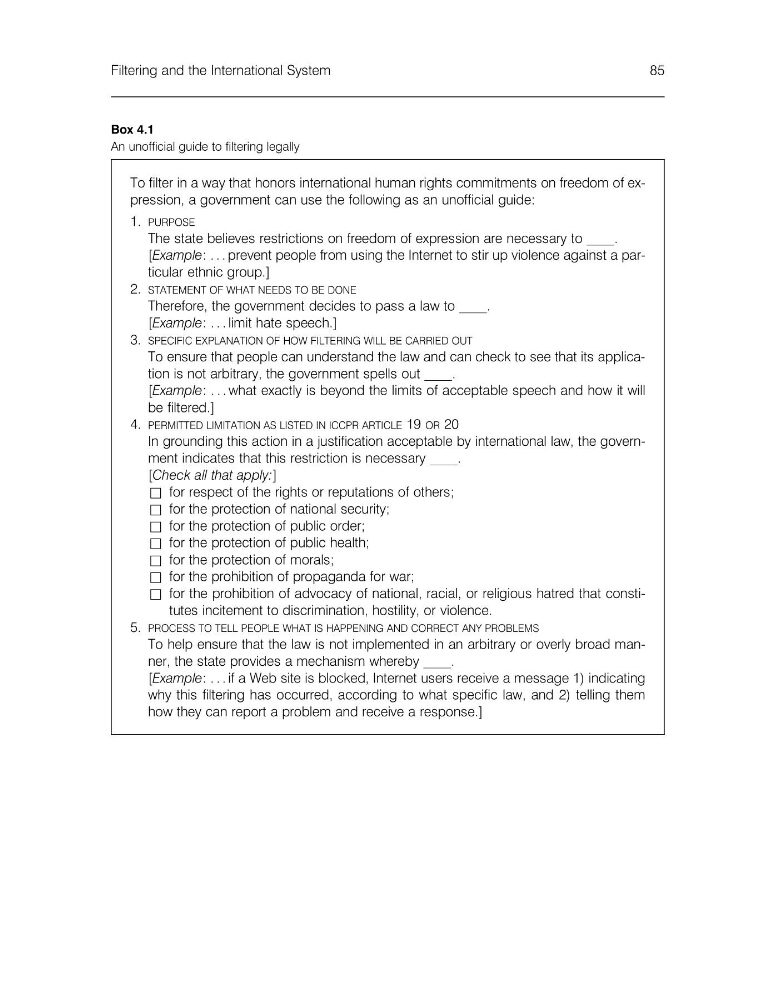
Box 4.1
An unofficial guide to filtering legally
To filter in a way that honors international human rights commitments on freedom of expression, a government can use the following as an unofficial guide:
1. PURPOSE
The state believes restrictions on freedom of expression are necessary to
.
[Example: . . . prevent people from using the Internet to stir up violence against a particular ethnic group.]
2. STATEMENT OF WHAT NEEDS TO BE DONE
Therefore, the government decides to pass a law to
.
[Example: . . . limit hate speech.]
3. SPECIFIC EXPLANATION OF HOW FILTERING WILL BE CARRIED OUT
To ensure that people can understand the law and can check to see that its application is not arbitrary, the government spells out
.
[Example: . . . what exactly is beyond the limits of acceptable speech and how it will
be filtered.]
4. PERMITTED LIMITATION AS LISTED IN ICCPR ARTICLE 19 OR 20
In grounding this action in a justification acceptable by international law, the government indicates that this restriction is necessary
.
[Check all that apply:]
r for respect of the rights or reputations of others;
r for the protection of national security;
r for the protection of public order;
r for the protection of public health;
r for the protection of morals;
r for the prohibition of propaganda for war;
r for the prohibition of advocacy of national, racial, or religious hatred that constitutes incitement to discrimination, hostility, or violence.
5. PROCESS TO TELL PEOPLE WHAT IS HAPPENING AND CORRECT ANY PROBLEMS
To help ensure that the law is not implemented in an arbitrary or overly broad manner, the state provides a mechanism whereby
.
[Example: . . . if a Web site is blocked, Internet users receive a message 1) indicating
why this filtering has occurred, according to what specific law, and 2) telling them
how they can report a problem and receive a response.]
Filtering and the International System
85
An unofficial guide to filtering legally
To filter in a way that honors international human rights commitments on freedom of expression, a government can use the following as an unofficial guide:
1. PURPOSE
The state believes restrictions on freedom of expression are necessary to
.
[Example: . . . prevent people from using the Internet to stir up violence against a particular ethnic group.]
2. STATEMENT OF WHAT NEEDS TO BE DONE
Therefore, the government decides to pass a law to
.
[Example: . . . limit hate speech.]
3. SPECIFIC EXPLANATION OF HOW FILTERING WILL BE CARRIED OUT
To ensure that people can understand the law and can check to see that its application is not arbitrary, the government spells out
.
[Example: . . . what exactly is beyond the limits of acceptable speech and how it will
be filtered.]
4. PERMITTED LIMITATION AS LISTED IN ICCPR ARTICLE 19 OR 20
In grounding this action in a justification acceptable by international law, the government indicates that this restriction is necessary
.
[Check all that apply:]
r for respect of the rights or reputations of others;
r for the protection of national security;
r for the protection of public order;
r for the protection of public health;
r for the protection of morals;
r for the prohibition of propaganda for war;
r for the prohibition of advocacy of national, racial, or religious hatred that constitutes incitement to discrimination, hostility, or violence.
5. PROCESS TO TELL PEOPLE WHAT IS HAPPENING AND CORRECT ANY PROBLEMS
To help ensure that the law is not implemented in an arbitrary or overly broad manner, the state provides a mechanism whereby
.
[Example: . . . if a Web site is blocked, Internet users receive a message 1) indicating
why this filtering has occurred, according to what specific law, and 2) telling them
how they can report a problem and receive a response.]
Filtering and the International System
85