

4.6 Applying Stakeholder Identification Theory
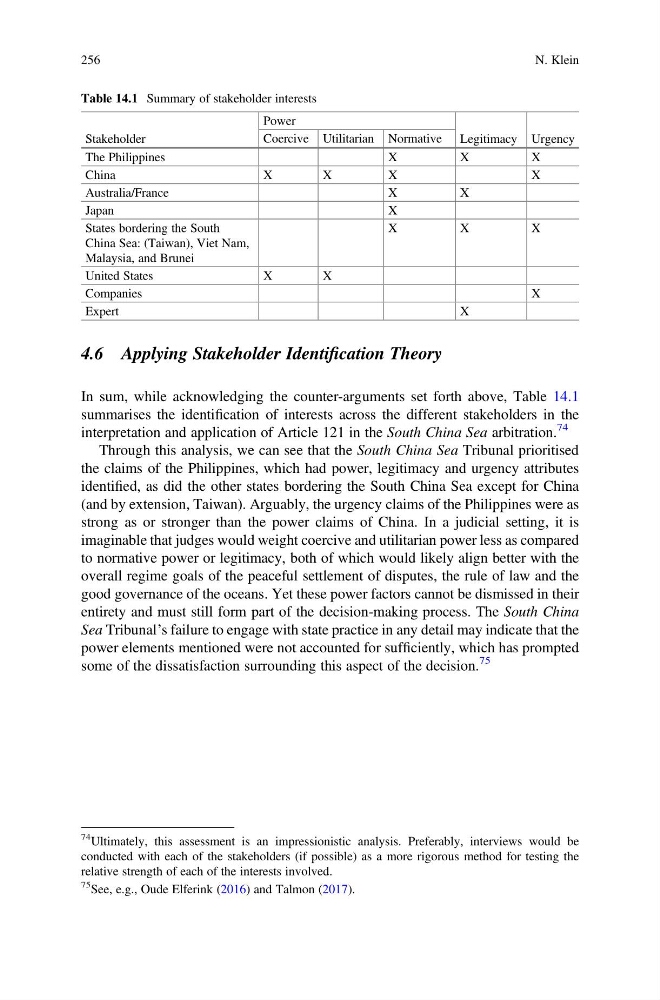
In sum, while acknowledging the counter-arguments set forth above, Table 14.1
summarises the identification of interests across the different stakeholders in the
interpretation and application of Article 121 in the South China Sea arbitration.
74
Through this analysis, we can see that the South China Sea Tribunal prioritised
the claims of the Philippines, which had power, legitimacy and urgency attributes
identified, as did the other states bordering the South China Sea except for China
(and by extension, Taiwan). Arguably, the urgency claims of the Philippines were as
strong as or stronger than the power claims of China. In a judicial setting, it is
imaginable that judges would weight coercive and utilitarian power less as compared
to normative power or legitimacy, both of which would likely align better with the
overall regime goals of the peaceful settlement of disputes, the rule of law and the
good governance of the oceans. Yet these power factors cannot be dismissed in their
entirety and must still form part of the decision-making process. The South China
Sea Tribunal’s failure to engage with state practice in any detail may indicate that the
power elements mentioned were not accounted for sufficiently, which has prompted
some of the dissatisfaction surrounding this aspect of the decision.
75
Table 14.1 Summary of stakeholder interests
Stakeholder
Power
Legitimacy Urgency
Coercive Utilitarian Normative
The Philippines
X
X
X
China
X
X
X
X
Australia/France
X
X
Japan
X
States bordering the South
China Sea: (Taiwan), Viet Nam,
Malaysia, and Brunei
X
X
X
United States
X
X
Companies
X
Expert
X
74 Ultimately, this assessment is an impressionistic analysis. Preferably, interviews would be
conducted with each of the stakeholders (if possible) as a more rigorous method for testing the
relative strength of each of the interests involved.
75 See, e.g., Oude Elferink (2016) and Talmon (2017).
256
N. Klein
In sum, while acknowledging the counter-arguments set forth above, Table 14.1
summarises the identification of interests across the different stakeholders in the
interpretation and application of Article 121 in the South China Sea arbitration.
74
Through this analysis, we can see that the South China Sea Tribunal prioritised
the claims of the Philippines, which had power, legitimacy and urgency attributes
identified, as did the other states bordering the South China Sea except for China
(and by extension, Taiwan). Arguably, the urgency claims of the Philippines were as
strong as or stronger than the power claims of China. In a judicial setting, it is
imaginable that judges would weight coercive and utilitarian power less as compared
to normative power or legitimacy, both of which would likely align better with the
overall regime goals of the peaceful settlement of disputes, the rule of law and the
good governance of the oceans. Yet these power factors cannot be dismissed in their
entirety and must still form part of the decision-making process. The South China
Sea Tribunal’s failure to engage with state practice in any detail may indicate that the
power elements mentioned were not accounted for sufficiently, which has prompted
some of the dissatisfaction surrounding this aspect of the decision.
75
Table 14.1 Summary of stakeholder interests
Stakeholder
Power
Legitimacy Urgency
Coercive Utilitarian Normative
The Philippines
X
X
X
China
X
X
X
X
Australia/France
X
X
Japan
X
States bordering the South
China Sea: (Taiwan), Viet Nam,
Malaysia, and Brunei
X
X
X
United States
X
X
Companies
X
Expert
X
74 Ultimately, this assessment is an impressionistic analysis. Preferably, interviews would be
conducted with each of the stakeholders (if possible) as a more rigorous method for testing the
relative strength of each of the interests involved.
75 See, e.g., Oude Elferink (2016) and Talmon (2017).
256
N. Klein