

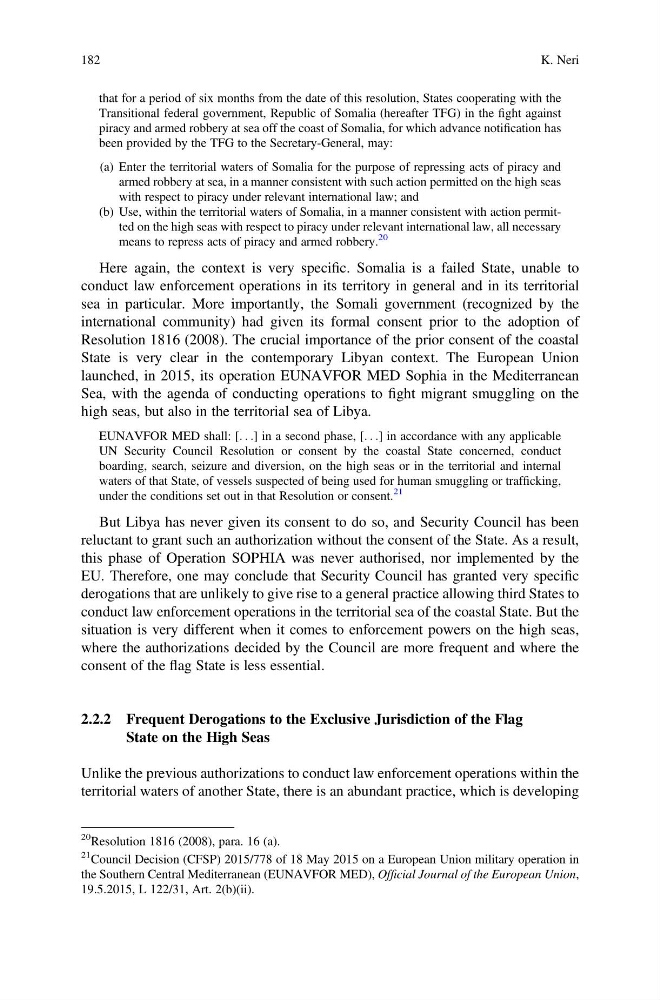
that for a period of six months from the date of this resolution, States cooperating with the
Transitional federal government, Republic of Somalia (hereafter TFG) in the fight against
piracy and armed robbery at sea off the coast of Somalia, for which advance notification has
been provided by the TFG to the Secretary-General, may:
(a) Enter the territorial waters of Somalia for the purpose of repressing acts of piracy and
armed robbery at sea, in a manner consistent with such action permitted on the high seas
with respect to piracy under relevant international law; and
(b) Use, within the territorial waters of Somalia, in a manner consistent with action permitted on the high seas with respect to piracy under relevant international law, all necessary
means to repress acts of piracy and armed robbery.
20
Here again, the context is very specific. Somalia is a failed State, unable to
conduct law enforcement operations in its territory in general and in its territorial
sea in particular. More importantly, the Somali government (recognized by the
international community) had given its formal consent prior to the adoption of
Resolution 1816 (2008). The crucial importance of the prior consent of the coastal
State is very clear in the contemporary Libyan context. The European Union
launched, in 2015, its operation EUNAVFOR MED Sophia in the Mediterranean
Sea, with the agenda of conducting operations to fight migrant smuggling on the
high seas, but also in the territorial sea of Libya.
EUNAVFOR MED shall: [. . .] in a second phase, [. . .] in accordance with any applicable
UN Security Council Resolution or consent by the coastal State concerned, conduct
boarding, search, seizure and diversion, on the high seas or in the territorial and internal
waters of that State, of vessels suspected of being used for human smuggling or trafficking,
under the conditions set out in that Resolution or consent.
21
But Libya has never given its consent to do so, and Security Council has been
reluctant to grant such an authorization without the consent of the State. As a result,
this phase of Operation SOPHIA was never authorised, nor implemented by the
EU. Therefore, one may conclude that Security Council has granted very specific
derogations that are unlikely to give rise to a general practice allowing third States to
conduct law enforcement operations in the territorial sea of the coastal State. But the
situation is very different when it comes to enforcement powers on the high seas,
where the authorizations decided by the Council are more frequent and where the
consent of the flag State is less essential.
2.2.2 Frequent Derogations to the Exclusive Jurisdiction of the Flag
State on the High Seas
Unlike the previous authorizations to conduct law enforcement operations within the
territorial waters of another State, there is an abundant practice, which is developing
20 Resolution 1816 (2008), para. 16 (a).
21 Council Decision (CFSP) 2015/778 of 18 May 2015 on a European Union military operation in
the Southern Central Mediterranean (EUNAVFOR MED), Official Journal of the European Union,
19.5.2015, L 122/31, Art. 2(b)(ii).
182
K. Neri
Transitional federal government, Republic of Somalia (hereafter TFG) in the fight against
piracy and armed robbery at sea off the coast of Somalia, for which advance notification has
been provided by the TFG to the Secretary-General, may:
(a) Enter the territorial waters of Somalia for the purpose of repressing acts of piracy and
armed robbery at sea, in a manner consistent with such action permitted on the high seas
with respect to piracy under relevant international law; and
(b) Use, within the territorial waters of Somalia, in a manner consistent with action permitted on the high seas with respect to piracy under relevant international law, all necessary
means to repress acts of piracy and armed robbery.
20
Here again, the context is very specific. Somalia is a failed State, unable to
conduct law enforcement operations in its territory in general and in its territorial
sea in particular. More importantly, the Somali government (recognized by the
international community) had given its formal consent prior to the adoption of
Resolution 1816 (2008). The crucial importance of the prior consent of the coastal
State is very clear in the contemporary Libyan context. The European Union
launched, in 2015, its operation EUNAVFOR MED Sophia in the Mediterranean
Sea, with the agenda of conducting operations to fight migrant smuggling on the
high seas, but also in the territorial sea of Libya.
EUNAVFOR MED shall: [. . .] in a second phase, [. . .] in accordance with any applicable
UN Security Council Resolution or consent by the coastal State concerned, conduct
boarding, search, seizure and diversion, on the high seas or in the territorial and internal
waters of that State, of vessels suspected of being used for human smuggling or trafficking,
under the conditions set out in that Resolution or consent.
21
But Libya has never given its consent to do so, and Security Council has been
reluctant to grant such an authorization without the consent of the State. As a result,
this phase of Operation SOPHIA was never authorised, nor implemented by the
EU. Therefore, one may conclude that Security Council has granted very specific
derogations that are unlikely to give rise to a general practice allowing third States to
conduct law enforcement operations in the territorial sea of the coastal State. But the
situation is very different when it comes to enforcement powers on the high seas,
where the authorizations decided by the Council are more frequent and where the
consent of the flag State is less essential.
2.2.2 Frequent Derogations to the Exclusive Jurisdiction of the Flag
State on the High Seas
Unlike the previous authorizations to conduct law enforcement operations within the
territorial waters of another State, there is an abundant practice, which is developing
20 Resolution 1816 (2008), para. 16 (a).
21 Council Decision (CFSP) 2015/778 of 18 May 2015 on a European Union military operation in
the Southern Central Mediterranean (EUNAVFOR MED), Official Journal of the European Union,
19.5.2015, L 122/31, Art. 2(b)(ii).
182
K. Neri