

4.4 Adsorption Investigation
75
whereas the contents of the flask were rattled for 150 min. The influence of adsorbent
dosage on metal ion adsorption was made possible through active stirring of the
adsorbent in the range of 1.5–6.0 mg/L, in 100 mL sample, with an initial 40 mg/L
concentration. Contact time influence was examined over a time range of 30–180 min
while initial concentration influence was investigated upon at a concentration range of
40–220 mg/L. The adsorption isotherms were performed at 25–45 °C temperatures.
Adsorption kinetics was conducted at a concentration range of 40–220 mg/L, with a
time range of 30–150 min. The adsorption power of the equilibrium was determined
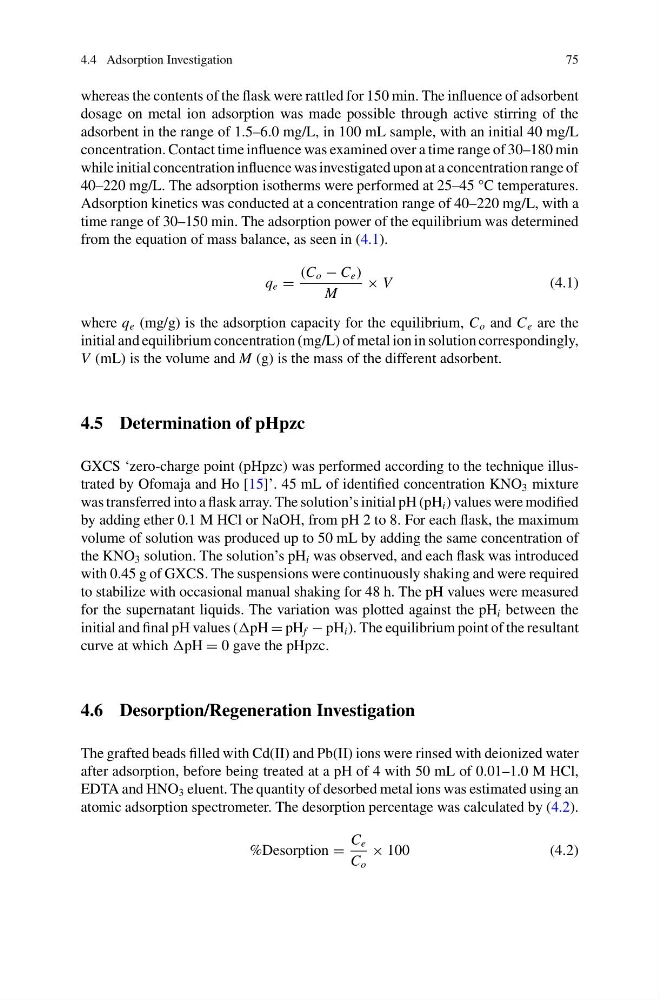
from the equation of mass balance, as seen in (4.1).
q e =
(C o − C e )
M
× V
(4.1)
where q e (mg/g) is the adsorption capacity for the equilibrium, C o and C e are the
initial and equilibrium concentration (mg/L) of metal ion in solution correspondingly,
V (mL) is the volume and M (g) is the mass of the different adsorbent.
4.5 Determination of pHpzc
GXCS ‘zero-charge point (pHpzc) was performed according to the technique illustrated by Ofomaja and Ho [15]’. 45 mL of identified concentration KNO 3 mixture
was transferred into a flask array. The solution’s initial pH (pH i ) values were modified
by adding ether 0.1 M HCl or NaOH, from pH 2 to 8. For each flask, the maximum
volume of solution was produced up to 50 mL by adding the same concentration of
the KNO 3 solution. The solution’s pH i was observed, and each flask was introduced
with 0.45 g of GXCS. The suspensions were continuously shaking and were required
to stabilize with occasional manual shaking for 48 h. The pH values were measured
for the supernatant liquids. The variation was plotted against the pH i between the
initial and final pH values (pH = pH f − pH i ). The equilibrium point of the resultant
curve at which pH = 0 gave the pHpzc.
4.6 Desorption/Regeneration Investigation
The grafted beads filled with Cd(II) and Pb(II) ions were rinsed with deionized water
after adsorption, before being treated at a pH of 4 with 50 mL of 0.01–1.0 M HCl,
EDTA and HNO 3 eluent. The quantity of desorbed metal ions was estimated using an
atomic adsorption spectrometer. The desorption percentage was calculated by (4.2).
%Desorption =
C e
C o
× 100
(4.2)
75
whereas the contents of the flask were rattled for 150 min. The influence of adsorbent
dosage on metal ion adsorption was made possible through active stirring of the
adsorbent in the range of 1.5–6.0 mg/L, in 100 mL sample, with an initial 40 mg/L
concentration. Contact time influence was examined over a time range of 30–180 min
while initial concentration influence was investigated upon at a concentration range of
40–220 mg/L. The adsorption isotherms were performed at 25–45 °C temperatures.
Adsorption kinetics was conducted at a concentration range of 40–220 mg/L, with a
time range of 30–150 min. The adsorption power of the equilibrium was determined
from the equation of mass balance, as seen in (4.1).
q e =
(C o − C e )
M
× V
(4.1)
where q e (mg/g) is the adsorption capacity for the equilibrium, C o and C e are the
initial and equilibrium concentration (mg/L) of metal ion in solution correspondingly,
V (mL) is the volume and M (g) is the mass of the different adsorbent.
4.5 Determination of pHpzc
GXCS ‘zero-charge point (pHpzc) was performed according to the technique illustrated by Ofomaja and Ho [15]’. 45 mL of identified concentration KNO 3 mixture
was transferred into a flask array. The solution’s initial pH (pH i ) values were modified
by adding ether 0.1 M HCl or NaOH, from pH 2 to 8. For each flask, the maximum
volume of solution was produced up to 50 mL by adding the same concentration of
the KNO 3 solution. The solution’s pH i was observed, and each flask was introduced
with 0.45 g of GXCS. The suspensions were continuously shaking and were required
to stabilize with occasional manual shaking for 48 h. The pH values were measured
for the supernatant liquids. The variation was plotted against the pH i between the
initial and final pH values (pH = pH f − pH i ). The equilibrium point of the resultant
curve at which pH = 0 gave the pHpzc.
4.6 Desorption/Regeneration Investigation
The grafted beads filled with Cd(II) and Pb(II) ions were rinsed with deionized water
after adsorption, before being treated at a pH of 4 with 50 mL of 0.01–1.0 M HCl,
EDTA and HNO 3 eluent. The quantity of desorbed metal ions was estimated using an
atomic adsorption spectrometer. The desorption percentage was calculated by (4.2).
%Desorption =
C e
C o
× 100
(4.2)