

66
3 Adsorption of Pb(II), Cu(II), Ni(II), Zn(II), Cr(VI) …
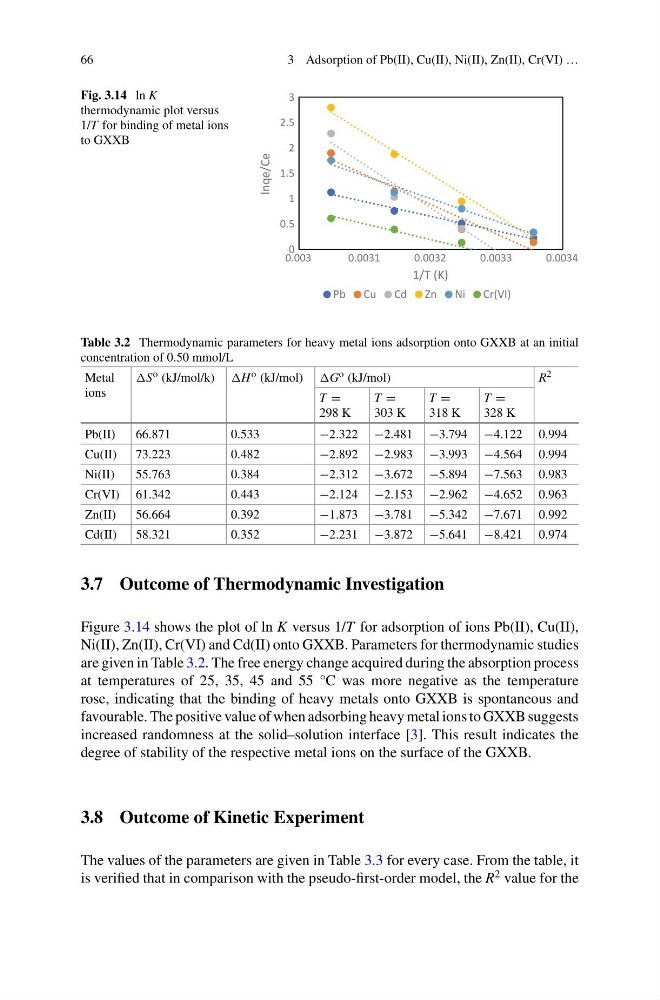
Fig. 3.14 ln K
thermodynamic plot versus
1/T for binding of metal ions
to GXXB
0
0.5
1
1.5
2
2.5
3
0.003
0.0031
0.0032
0.0033
0.0034
lnqe/Ce
1/T (K)
Pb Cu Cd Zn Ni Cr(VI)
Table 3.2 Thermodynamic parameters for heavy metal ions adsorption onto GXXB at an initial
concentration of 0.50 mmol/L
Metal
ions
o (kJ/mol/k) o (kJ/mol) o (kJ/mol)
R 2
T =
298 K
T =
303 K
T =
318 K
T =
328 K
Pb(II)
66.871
0.533
−2.322 −2.481 −3.794 −4.122 0.994
Cu(II)
73.223
0.482
−2.892 −2.983 −3.993 −4.564 0.994
Ni(II)
55.763
0.384
−2.312 −3.672 −5.894 −7.563 0.983
Cr(VI) 61.342
0.443
−2.124 −2.153 −2.962 −4.652 0.963
Zn(II)
56.664
0.392
−1.873 −3.781 −5.342 −7.671 0.992
Cd(II)
58.321
0.352
−2.231 −3.872 −5.641 −8.421 0.974
3.7 Outcome of Thermodynamic Investigation
Figure 3.14 shows the plot of ln K versus 1/T for adsorption of ions Pb(II), Cu(II),
Ni(II), Zn(II), Cr(VI) and Cd(II) onto GXXB. Parameters for thermodynamic studies
are given in Table 3.2. The free energy change acquired during the absorption process
at temperatures of 25, 35, 45 and 55 °C was more negative as the temperature
rose, indicating that the binding of heavy metals onto GXXB is spontaneous and
favourable. The positive value of when adsorbing heavy metal ions to GXXB suggests
increased randomness at the solid–solution interface [3]. This result indicates the
degree of stability of the respective metal ions on the surface of the GXXB.
3.8 Outcome of Kinetic Experiment
The values of the parameters are given in Table 3.3 for every case. From the table, it
is verified that in comparison with the pseudo-first-order model, the R
2 value for the
3 Adsorption of Pb(II), Cu(II), Ni(II), Zn(II), Cr(VI) …
Fig. 3.14 ln K
thermodynamic plot versus
1/T for binding of metal ions
to GXXB
0
0.5
1
1.5
2
2.5
3
0.003
0.0031
0.0032
0.0033
0.0034
lnqe/Ce
1/T (K)
Pb Cu Cd Zn Ni Cr(VI)
Table 3.2 Thermodynamic parameters for heavy metal ions adsorption onto GXXB at an initial
concentration of 0.50 mmol/L
Metal
ions
o (kJ/mol/k) o (kJ/mol) o (kJ/mol)
R 2
T =
298 K
T =
303 K
T =
318 K
T =
328 K
Pb(II)
66.871
0.533
−2.322 −2.481 −3.794 −4.122 0.994
Cu(II)
73.223
0.482
−2.892 −2.983 −3.993 −4.564 0.994
Ni(II)
55.763
0.384
−2.312 −3.672 −5.894 −7.563 0.983
Cr(VI) 61.342
0.443
−2.124 −2.153 −2.962 −4.652 0.963
Zn(II)
56.664
0.392
−1.873 −3.781 −5.342 −7.671 0.992
Cd(II)
58.321
0.352
−2.231 −3.872 −5.641 −8.421 0.974
3.7 Outcome of Thermodynamic Investigation
Figure 3.14 shows the plot of ln K versus 1/T for adsorption of ions Pb(II), Cu(II),
Ni(II), Zn(II), Cr(VI) and Cd(II) onto GXXB. Parameters for thermodynamic studies
are given in Table 3.2. The free energy change acquired during the absorption process
at temperatures of 25, 35, 45 and 55 °C was more negative as the temperature
rose, indicating that the binding of heavy metals onto GXXB is spontaneous and
favourable. The positive value of when adsorbing heavy metal ions to GXXB suggests
increased randomness at the solid–solution interface [3]. This result indicates the
degree of stability of the respective metal ions on the surface of the GXXB.
3.8 Outcome of Kinetic Experiment
The values of the parameters are given in Table 3.3 for every case. From the table, it
is verified that in comparison with the pseudo-first-order model, the R
2 value for the