

56
3 Adsorption of Pb(II), Cu(II), Ni(II), Zn(II), Cr(VI) …
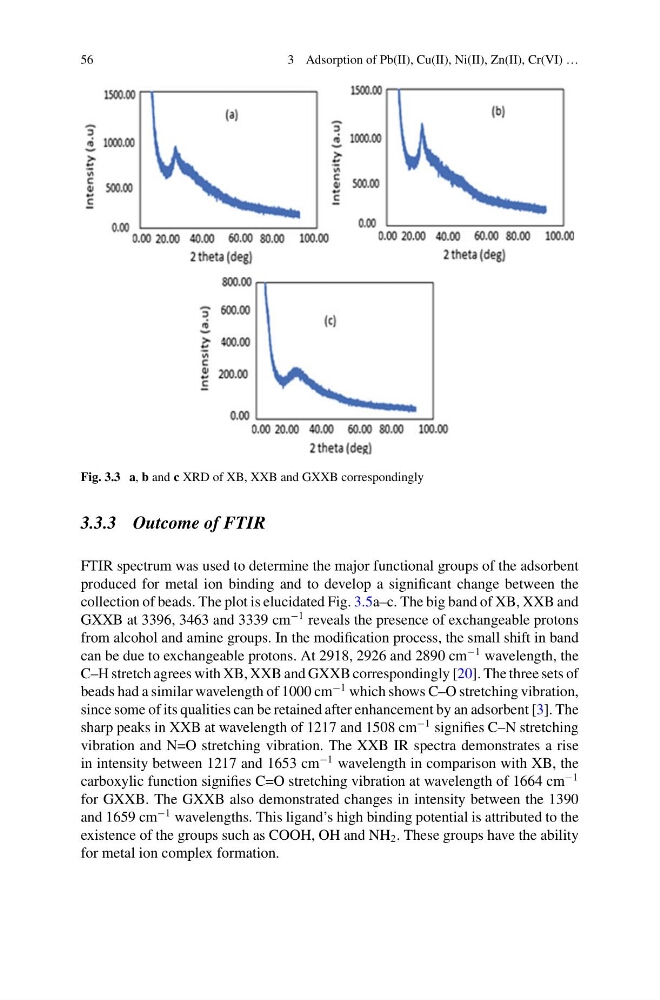
Fig. 3.3 a, b and c XRD of XB, XXB and GXXB correspondingly
3.3.3 Outcome of FTIR
FTIR spectrum was used to determine the major functional groups of the adsorbent
produced for metal ion binding and to develop a significant change between the
collection of beads. The plot is elucidated Fig. 3.5a–c. The big band of XB, XXB and
GXXB at 3396, 3463 and 3339 cm
−1 reveals the presence of exchangeable protons
from alcohol and amine groups. In the modification process, the small shift in band
can be due to exchangeable protons. At 2918, 2926 and 2890 cm
−1 wavelength, the
C–H stretch agrees with XB, XXB and GXXB correspondingly [20]. The three sets of
beads had a similar wavelength of 1000 cm
−1 which shows C–O stretching vibration,
since some of its qualities can be retained after enhancement by an adsorbent [3]. The
sharp peaks in XXB at wavelength of 1217 and 1508 cm
−1 signifies C–N stretching
vibration and N=O stretching vibration. The XXB IR spectra demonstrates a rise
in intensity between 1217 and 1653 cm
−1 wavelength in comparison with XB, the
carboxylic function signifies C=O stretching vibration at wavelength of 1664 cm
−1
for GXXB. The GXXB also demonstrated changes in intensity between the 1390
and 1659 cm
−1 wavelengths. This ligand’s high binding potential is attributed to the
existence of the groups such as COOH, OH and NH 2 . These groups have the ability
for metal ion complex formation.
3 Adsorption of Pb(II), Cu(II), Ni(II), Zn(II), Cr(VI) …
Fig. 3.3 a, b and c XRD of XB, XXB and GXXB correspondingly
3.3.3 Outcome of FTIR
FTIR spectrum was used to determine the major functional groups of the adsorbent
produced for metal ion binding and to develop a significant change between the
collection of beads. The plot is elucidated Fig. 3.5a–c. The big band of XB, XXB and
GXXB at 3396, 3463 and 3339 cm
−1 reveals the presence of exchangeable protons
from alcohol and amine groups. In the modification process, the small shift in band
can be due to exchangeable protons. At 2918, 2926 and 2890 cm
−1 wavelength, the
C–H stretch agrees with XB, XXB and GXXB correspondingly [20]. The three sets of
beads had a similar wavelength of 1000 cm
−1 which shows C–O stretching vibration,
since some of its qualities can be retained after enhancement by an adsorbent [3]. The
sharp peaks in XXB at wavelength of 1217 and 1508 cm
−1 signifies C–N stretching
vibration and N=O stretching vibration. The XXB IR spectra demonstrates a rise
in intensity between 1217 and 1653 cm
−1 wavelength in comparison with XB, the
carboxylic function signifies C=O stretching vibration at wavelength of 1664 cm
−1
for GXXB. The GXXB also demonstrated changes in intensity between the 1390
and 1659 cm
−1 wavelengths. This ligand’s high binding potential is attributed to the
existence of the groups such as COOH, OH and NH 2 . These groups have the ability
for metal ion complex formation.