

48
3 Adsorption of Pb(II), Cu(II), Ni(II), Zn(II), Cr(VI) …
numerous diseases such as lung and kidney problems, pulmonary fibrosis, circulatory collapse, intravascular hemolysis, renal failure, nephritis, fever, vertigo, diarrhea,
epigastric vomiting, nausea, extreme gastrointestinal discomfort, acute multisystem
organ failure, comma and even death were documented owning to extreme intake [3,
5]. In this point, before their release into water supplies, the United States Environmental Protection Agency (USEPA) issued specific rules for the permissible level for
heavy metals in water and wastewater. Because of this firm guideline on the emission of toxic contaminants in waterways, it becomes relevant to acquire different
techniques that reduce or remove metal ions from water. Numerous practices for
binding metal ions have been developed in the past decades but such techniques
including chemical precipitation, membrane separation, ion exchange and electrolysis have proved unproductive due to rising running costs and low metal ion removal
[6]. The quest for effective, low cost, ready-to-use, sludge-free service, profitable
and effortless service has led to the application of adsorption method [7, 8]. Chitosan
has become very convincing in development as a binding material with market availability, wide surface area, high adsorption efficiency, easy processing, non-toxicity,
environmentally friendly and post-adsorption regeneration capability [9]. Chitosan
is an N-deacetylation derivative of chitin, and chitin is a naturally occurring polysaccharide found in crustaceans. The presence of the functional group amine (–NH 2 ) and
hydroxyl gives the biopolymer its unusual binding characteristics. Chitosan, however,
has its weakness that limits its use, and therefore, researchers have concentrated on
physical and chemical alteration. Physical modification involves changing chitosan
powder or flakes into gel beads for easier handling and better diffusion to binding
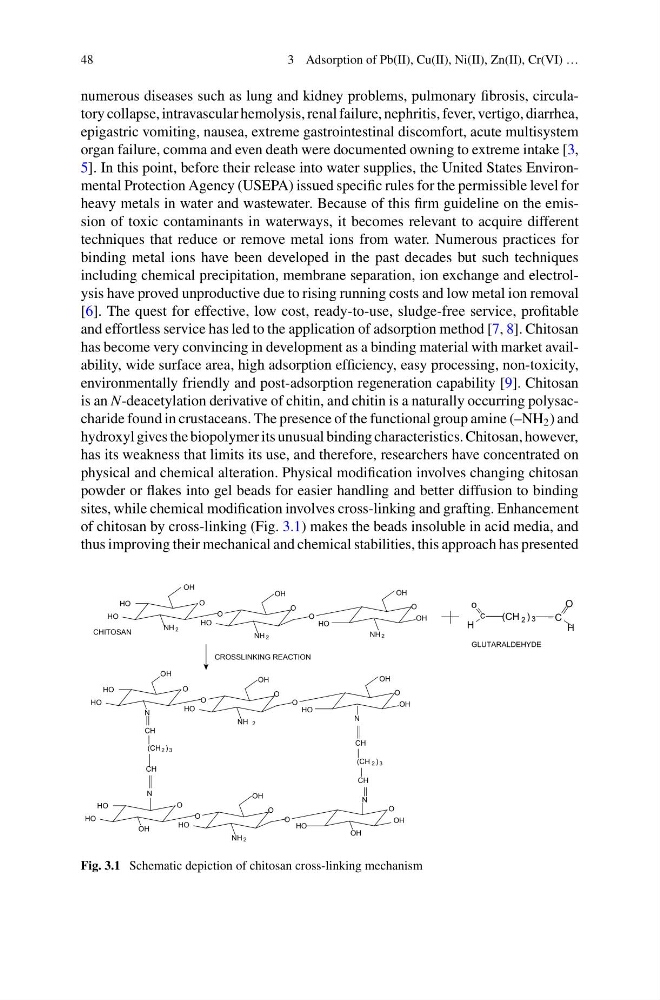
sites, while chemical modification involves cross-linking and grafting. Enhancement
of chitosan by cross-linking (Fig. 3.1) makes the beads insoluble in acid media, and
thus improving their mechanical and chemical stabilities, this approach has presented
HO
HO
OH
O
HO
OH
O
NH 2
O
OH
O
NH 2
HO
OH
O
HO
HO
O
N
O
HO
OH
O
NH 2
O
OH
O
HO
OH
O
c
H
o
(CH 2 ) 3
C
H
O
H
NH 2
(CH 2 ) 3
CH
CH
GLUTARALDEHYDE
HO
HO
OH
O
HO
OH
O
NH 2
OH
O
N
O
HO
OH
O
N
N
CH
(CH 2 ) 3
CH
CROSSLINKING REACTION
CHITOSAN
Fig. 3.1 Schematic depiction of chitosan cross-linking mechanism
3 Adsorption of Pb(II), Cu(II), Ni(II), Zn(II), Cr(VI) …
numerous diseases such as lung and kidney problems, pulmonary fibrosis, circulatory collapse, intravascular hemolysis, renal failure, nephritis, fever, vertigo, diarrhea,
epigastric vomiting, nausea, extreme gastrointestinal discomfort, acute multisystem
organ failure, comma and even death were documented owning to extreme intake [3,
5]. In this point, before their release into water supplies, the United States Environmental Protection Agency (USEPA) issued specific rules for the permissible level for
heavy metals in water and wastewater. Because of this firm guideline on the emission of toxic contaminants in waterways, it becomes relevant to acquire different
techniques that reduce or remove metal ions from water. Numerous practices for
binding metal ions have been developed in the past decades but such techniques
including chemical precipitation, membrane separation, ion exchange and electrolysis have proved unproductive due to rising running costs and low metal ion removal
[6]. The quest for effective, low cost, ready-to-use, sludge-free service, profitable
and effortless service has led to the application of adsorption method [7, 8]. Chitosan
has become very convincing in development as a binding material with market availability, wide surface area, high adsorption efficiency, easy processing, non-toxicity,
environmentally friendly and post-adsorption regeneration capability [9]. Chitosan
is an N-deacetylation derivative of chitin, and chitin is a naturally occurring polysaccharide found in crustaceans. The presence of the functional group amine (–NH 2 ) and
hydroxyl gives the biopolymer its unusual binding characteristics. Chitosan, however,
has its weakness that limits its use, and therefore, researchers have concentrated on
physical and chemical alteration. Physical modification involves changing chitosan
powder or flakes into gel beads for easier handling and better diffusion to binding
sites, while chemical modification involves cross-linking and grafting. Enhancement
of chitosan by cross-linking (Fig. 3.1) makes the beads insoluble in acid media, and
thus improving their mechanical and chemical stabilities, this approach has presented
HO
HO
OH
O
HO
OH
O
NH 2
O
OH
O
NH 2
HO
OH
O
HO
HO
O
N
O
HO
OH
O
NH 2
O
OH
O
HO
OH
O
c
H
o
(CH 2 ) 3
C
H
O
H
NH 2
(CH 2 ) 3
CH
CH
GLUTARALDEHYDE
HO
HO
OH
O
HO
OH
O
NH 2
OH
O
N
O
HO
OH
O
N
N
CH
(CH 2 ) 3
CH
CROSSLINKING REACTION
CHITOSAN
Fig. 3.1 Schematic depiction of chitosan cross-linking mechanism