

32
2 Thermodynamics, Kinetics and Desorption Studies …
and amine (N–H) functional groups enables the good binding performances of G/CRCS towards metal ions micropollutants.
2.4.1.2 XRD Analysis
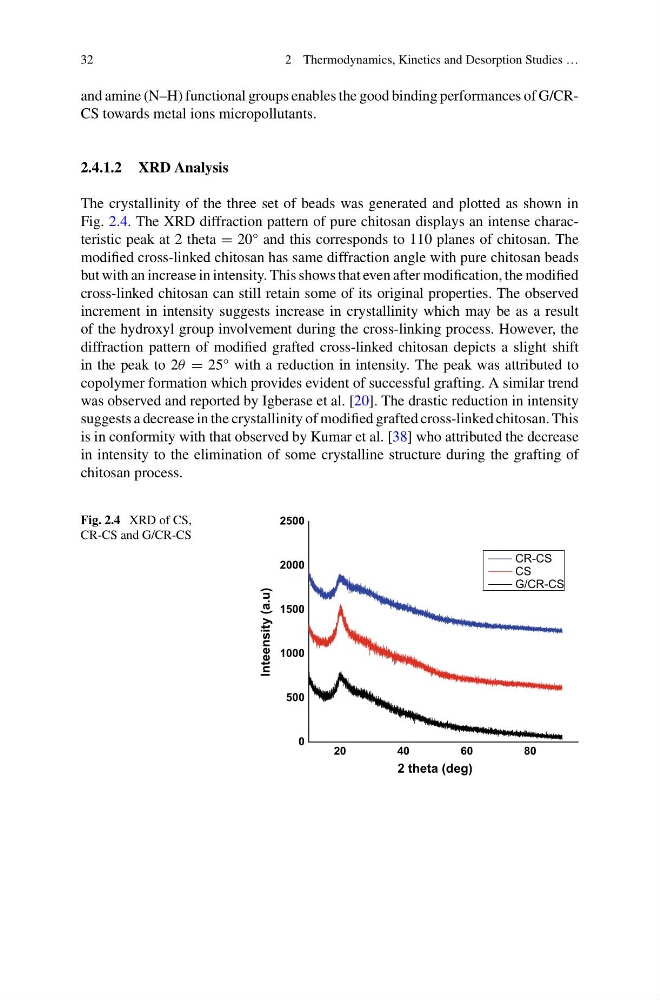
The crystallinity of the three set of beads was generated and plotted as shown in
Fig. 2.4. The XRD diffraction pattern of pure chitosan displays an intense characteristic peak at 2 theta = 20° and this corresponds to 110 planes of chitosan. The
modified cross-linked chitosan has same diffraction angle with pure chitosan beads
but with an increase in intensity. This shows that even after modification, the modified
cross-linked chitosan can still retain some of its original properties. The observed
increment in intensity suggests increase in crystallinity which may be as a result
of the hydroxyl group involvement during the cross-linking process. However, the
diffraction pattern of modified grafted cross-linked chitosan depicts a slight shift
in the peak to 2θ = 25° with a reduction in intensity. The peak was attributed to
copolymer formation which provides evident of successful grafting. A similar trend
was observed and reported by Igberase et al. [20]. The drastic reduction in intensity
suggests a decrease in the crystallinity of modified grafted cross-linked chitosan. This
is in conformity with that observed by Kumar et al. [38] who attributed the decrease
in intensity to the elimination of some crystalline structure during the grafting of
chitosan process.
Fig. 2.4 XRD of CS,
CR-CS and G/CR-CS
20
40
60
80
0
500
1000
1500
2000
2500
Inteensity (a.u)
2 theta (deg)
CR-CS
CS
G/CR-CS
2 Thermodynamics, Kinetics and Desorption Studies …
and amine (N–H) functional groups enables the good binding performances of G/CRCS towards metal ions micropollutants.
2.4.1.2 XRD Analysis
The crystallinity of the three set of beads was generated and plotted as shown in
Fig. 2.4. The XRD diffraction pattern of pure chitosan displays an intense characteristic peak at 2 theta = 20° and this corresponds to 110 planes of chitosan. The
modified cross-linked chitosan has same diffraction angle with pure chitosan beads
but with an increase in intensity. This shows that even after modification, the modified
cross-linked chitosan can still retain some of its original properties. The observed
increment in intensity suggests increase in crystallinity which may be as a result
of the hydroxyl group involvement during the cross-linking process. However, the
diffraction pattern of modified grafted cross-linked chitosan depicts a slight shift
in the peak to 2θ = 25° with a reduction in intensity. The peak was attributed to
copolymer formation which provides evident of successful grafting. A similar trend
was observed and reported by Igberase et al. [20]. The drastic reduction in intensity
suggests a decrease in the crystallinity of modified grafted cross-linked chitosan. This
is in conformity with that observed by Kumar et al. [38] who attributed the decrease
in intensity to the elimination of some crystalline structure during the grafting of
chitosan process.
Fig. 2.4 XRD of CS,
CR-CS and G/CR-CS
20
40
60
80
0
500
1000
1500
2000
2500
Inteensity (a.u)
2 theta (deg)
CR-CS
CS
G/CR-CS