

12
1 A Comprehensive Approach to Heavy Metal Removal by Adsorption …
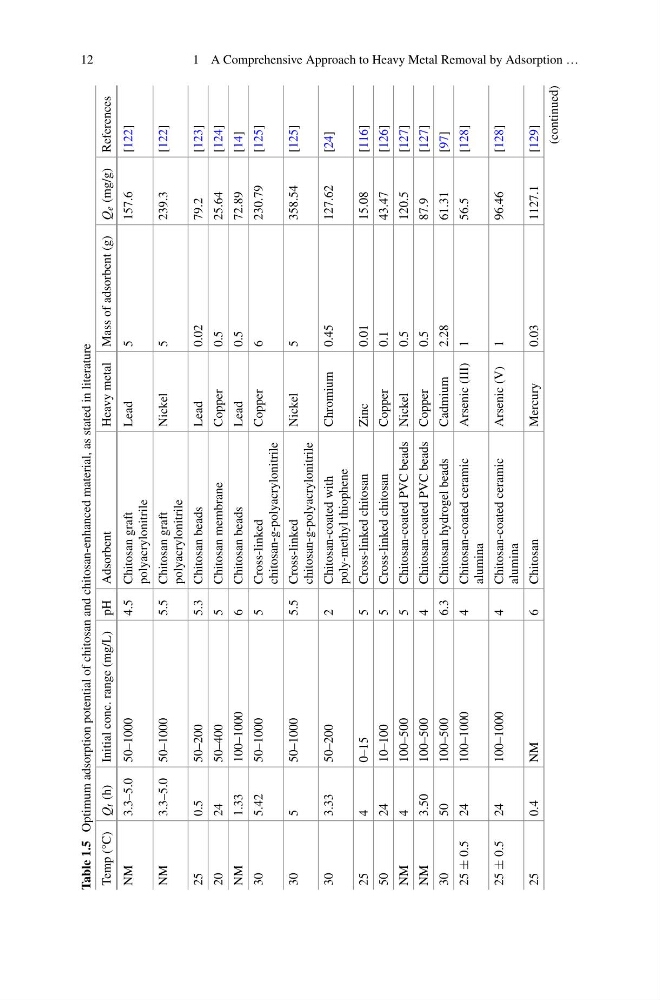
Table 1.5
Optimum adsorption potential of chitosan and chitosan-enhanced material, as stated in literature
Temp (°C) Q
t (h)
Initial conc. range (mg/L) pH Adsorbent
Heavy metal Mass of adsorbent (g) Q
e (mg/g) References
NM
3.3–5.0 50–1000
4.5 Chitosan graft
polyacrylonitrile
Lead
5
157.6
[122]
NM
3.3–5.0 50–1000
5.5 Chitosan graft
polyacrylonitrile
Nickel
5
239.3
[122]
25
0.5
50–200
5.3 Chitosan beads
Lead
0.02
79.2
[123]
20
24
50–400
5
Chitosan membrane
Copper
0.5
25.64
[124]
NM
1.33
100–1000
6
Chitosan beads
Lead
0.5
72.89
[14]
30
5.42
50–1000
5
Cross-linked
chitosan-g-polyacrylonitrile
Copper
6
230.79
[125]
30
5
50–1000
5.5 Cross-linked
chitosan-g-polyacrylonitrile
Nickel
5
358.54
[125]
30
3.33
50–200
2
Chitosan-coated with
poly-methyl thiophene
Chromium
0.45
127.62
[24]
25
4
0–15
5
Cross-linked chitosan
Zinc
0.01
15.08
[116]
50
24
10–100
5
Cross-linked chitosan
Copper
0.1
43.47
[126]
NM
4
100–500
5
Chitosan-coated PVC beads Nickel
0.5
120.5
[127]
NM
3.50
100–500
4
Chitosan-coated PVC beads Copper
0.5
87.9
[127]
30
50
100–500
6.3 Chitosan hydrogel beads
Cadmium
2.28
61.31
[97]
25
± 0.5
24
100–1000
4
Chitosan-coated ceramic
alumina
Arsenic (III) 1
56.5
[128]
25
± 0.5
24
100–1000
4
Chitosan-coated ceramic
alumina
Arsenic (V)
1
96.46
[128]
25
0.4
NM
6
Chitosan
Mercury
0.03
1127.1
[129]
(continued)
1 A Comprehensive Approach to Heavy Metal Removal by Adsorption …
Table 1.5
Optimum adsorption potential of chitosan and chitosan-enhanced material, as stated in literature
Temp (°C) Q
t (h)
Initial conc. range (mg/L) pH Adsorbent
Heavy metal Mass of adsorbent (g) Q
e (mg/g) References
NM
3.3–5.0 50–1000
4.5 Chitosan graft
polyacrylonitrile
Lead
5
157.6
[122]
NM
3.3–5.0 50–1000
5.5 Chitosan graft
polyacrylonitrile
Nickel
5
239.3
[122]
25
0.5
50–200
5.3 Chitosan beads
Lead
0.02
79.2
[123]
20
24
50–400
5
Chitosan membrane
Copper
0.5
25.64
[124]
NM
1.33
100–1000
6
Chitosan beads
Lead
0.5
72.89
[14]
30
5.42
50–1000
5
Cross-linked
chitosan-g-polyacrylonitrile
Copper
6
230.79
[125]
30
5
50–1000
5.5 Cross-linked
chitosan-g-polyacrylonitrile
Nickel
5
358.54
[125]
30
3.33
50–200
2
Chitosan-coated with
poly-methyl thiophene
Chromium
0.45
127.62
[24]
25
4
0–15
5
Cross-linked chitosan
Zinc
0.01
15.08
[116]
50
24
10–100
5
Cross-linked chitosan
Copper
0.1
43.47
[126]
NM
4
100–500
5
Chitosan-coated PVC beads Nickel
0.5
120.5
[127]
NM
3.50
100–500
4
Chitosan-coated PVC beads Copper
0.5
87.9
[127]
30
50
100–500
6.3 Chitosan hydrogel beads
Cadmium
2.28
61.31
[97]
25
± 0.5
24
100–1000
4
Chitosan-coated ceramic
alumina
Arsenic (III) 1
56.5
[128]
25
± 0.5
24
100–1000
4
Chitosan-coated ceramic
alumina
Arsenic (V)
1
96.46
[128]
25
0.4
NM
6
Chitosan
Mercury
0.03
1127.1
[129]
(continued)