

2
1 A Comprehensive Approach to Heavy Metal Removal by Adsorption …
Hence, water contamination is mostly about volume: how much of an environmentally harmful material is released and how high an amount of water is introduced
into it by the contaminant. A minimal volume of a harmful contaminants can have a
marginal effect if a ship dumps it into the water. But when pumped into a lake or river,
where there is less fresh water to spread it, the same volume of the same contaminant
may have a much bigger effect. Water can be turned cancerous in different forms,
including effluent from the chemical, electroplating, clothing, dyestuff, galvanizing,
pigment, dye, mining, pharmaceutical and other processing industries [3–8]. These
industries generate substantial amounts of metal ions including Pb(II), Cu(II), Ni(II),
Zn(II), Cr(VI) and Cd(II) that make their way into aquatic environment and ultimately
trigger probable health risks on humans and other living organisms. Heavy metal ions
are non-biodegradable and carcinogenic pollutants that are harmful to human beings,
wildlife, marine life and the broader ecosystem. In the past, numerous disorders
including lung and kidney disease, respiratory inflammation, circulatory collapse,
intravascular hemolysis, renal failure, nephritis, fever, vertigo, constipation, epigastric vomiting, nausea, extreme digestive issues, severe multisystem organ damage,
comma and even loss of life were documented due to increased intake [9–15]. In this
regard, the United States Environmental Protection Agency (USEPA) has laid down
stringent rules for the permissible limit for heavy metals in water and wastewater
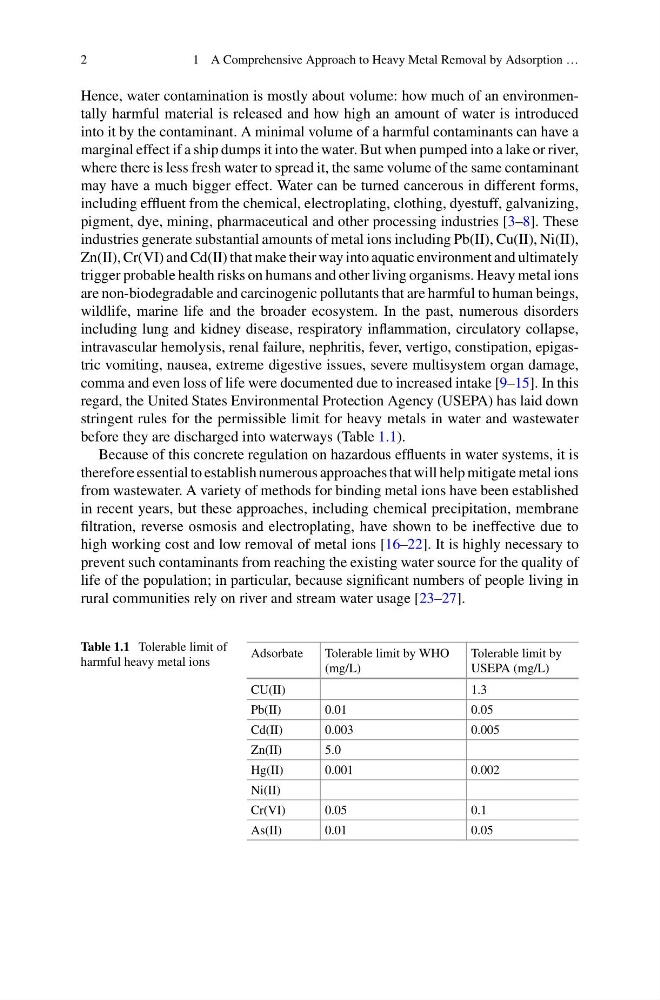
before they are discharged into waterways (Table 1.1).
Because of this concrete regulation on hazardous effluents in water systems, it is
therefore essential to establish numerous approaches that will help mitigate metal ions
from wastewater. A variety of methods for binding metal ions have been established
in recent years, but these approaches, including chemical precipitation, membrane
filtration, reverse osmosis and electroplating, have shown to be ineffective due to
high working cost and low removal of metal ions [16–22]. It is highly necessary to
prevent such contaminants from reaching the existing water source for the quality of
life of the population; in particular, because significant numbers of people living in
rural communities rely on river and stream water usage [23–27].
Table 1.1 Tolerable limit of
harmful heavy metal ions
Adsorbate
Tolerable limit by WHO
(mg/L)
Tolerable limit by
USEPA (mg/L)
CU(II)
1.3
Pb(II)
0.01
0.05
Cd(II)
0.003
0.005
Zn(II)
5.0
Hg(II)
0.001
0.002
Ni(II)
Cr(VI)
0.05
0.1
As(II)
0.01
0.05
1 A Comprehensive Approach to Heavy Metal Removal by Adsorption …
Hence, water contamination is mostly about volume: how much of an environmentally harmful material is released and how high an amount of water is introduced
into it by the contaminant. A minimal volume of a harmful contaminants can have a
marginal effect if a ship dumps it into the water. But when pumped into a lake or river,
where there is less fresh water to spread it, the same volume of the same contaminant
may have a much bigger effect. Water can be turned cancerous in different forms,
including effluent from the chemical, electroplating, clothing, dyestuff, galvanizing,
pigment, dye, mining, pharmaceutical and other processing industries [3–8]. These
industries generate substantial amounts of metal ions including Pb(II), Cu(II), Ni(II),
Zn(II), Cr(VI) and Cd(II) that make their way into aquatic environment and ultimately
trigger probable health risks on humans and other living organisms. Heavy metal ions
are non-biodegradable and carcinogenic pollutants that are harmful to human beings,
wildlife, marine life and the broader ecosystem. In the past, numerous disorders
including lung and kidney disease, respiratory inflammation, circulatory collapse,
intravascular hemolysis, renal failure, nephritis, fever, vertigo, constipation, epigastric vomiting, nausea, extreme digestive issues, severe multisystem organ damage,
comma and even loss of life were documented due to increased intake [9–15]. In this
regard, the United States Environmental Protection Agency (USEPA) has laid down
stringent rules for the permissible limit for heavy metals in water and wastewater
before they are discharged into waterways (Table 1.1).
Because of this concrete regulation on hazardous effluents in water systems, it is
therefore essential to establish numerous approaches that will help mitigate metal ions
from wastewater. A variety of methods for binding metal ions have been established
in recent years, but these approaches, including chemical precipitation, membrane
filtration, reverse osmosis and electroplating, have shown to be ineffective due to
high working cost and low removal of metal ions [16–22]. It is highly necessary to
prevent such contaminants from reaching the existing water source for the quality of
life of the population; in particular, because significant numbers of people living in
rural communities rely on river and stream water usage [23–27].
Table 1.1 Tolerable limit of
harmful heavy metal ions
Adsorbate
Tolerable limit by WHO
(mg/L)
Tolerable limit by
USEPA (mg/L)
CU(II)
1.3
Pb(II)
0.01
0.05
Cd(II)
0.003
0.005
Zn(II)
5.0
Hg(II)
0.001
0.002
Ni(II)
Cr(VI)
0.05
0.1
As(II)
0.01
0.05