

6.10 Regeneration Studies
131
6.10 Regeneration Studies
Regeneration of adsorbents is a critical feature of adsorption studies in that it decides
the adsorbent’s cost effectiveness. Regeneration is important to restore the adsorbent’s initial ability and to recover the adsorbent for proper disposal, avoiding the
re-pollution of the environment [9].
6.10.1 Metal Ions Regeneration from Its Spent Adsorbent
The regeneration of Cu(II) ions from loaded G/CR-CS occurred rapidly, as only
a fragment of the total adsorption time is needed. A substantial amount of Cu(II)
ions is regenerated at each cycle due to larger amount of Cu(II) ions adsorbed at
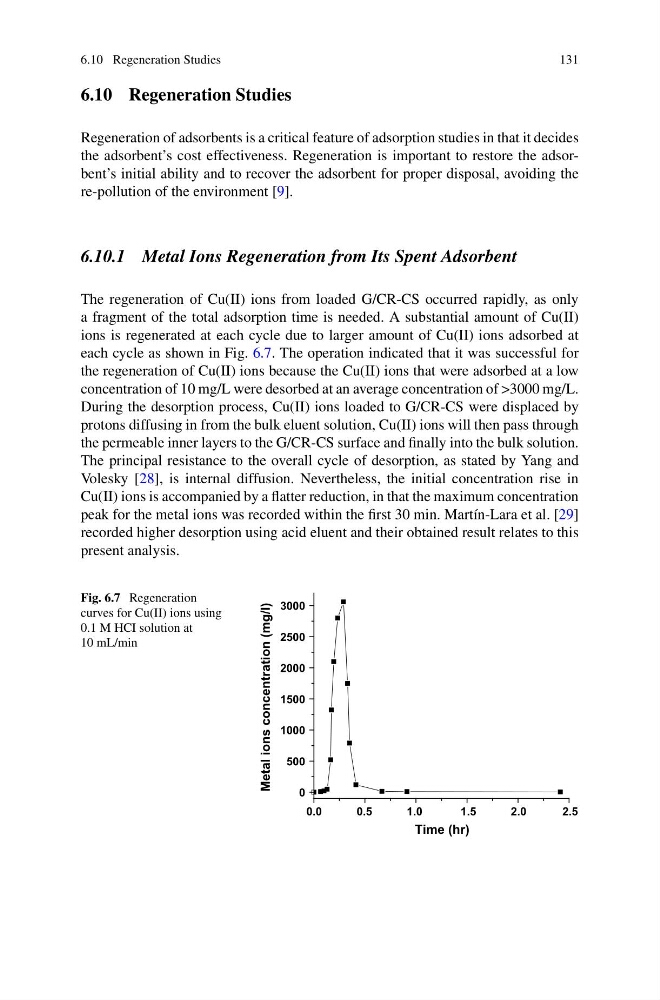
each cycle as shown in Fig. 6.7. The operation indicated that it was successful for
the regeneration of Cu(II) ions because the Cu(II) ions that were adsorbed at a low
concentration of 10 mg/L were desorbed at an average concentration of >3000 mg/L.
During the desorption process, Cu(II) ions loaded to G/CR-CS were displaced by
protons diffusing in from the bulk eluent solution, Cu(II) ions will then pass through
the permeable inner layers to the G/CR-CS surface and finally into the bulk solution.
The principal resistance to the overall cycle of desorption, as stated by Yang and
Volesky [28], is internal diffusion. Nevertheless, the initial concentration rise in
Cu(II) ions is accompanied by a flatter reduction, in that the maximum concentration
peak for the metal ions was recorded within the first 30 min. Martín-Lara et al. [29]
recorded higher desorption using acid eluent and their obtained result relates to this
present analysis.
Fig. 6.7 Regeneration
curves for Cu(II) ions using
0.1 M HCI solution at
10 mL/min
0.0
0.5
1.0
1.5
2.0
2.5
0
500
1000
1500
2000
2500
3000
Metal ions concentration (mg/l)
Time (hr)
131
6.10 Regeneration Studies
Regeneration of adsorbents is a critical feature of adsorption studies in that it decides
the adsorbent’s cost effectiveness. Regeneration is important to restore the adsorbent’s initial ability and to recover the adsorbent for proper disposal, avoiding the
re-pollution of the environment [9].
6.10.1 Metal Ions Regeneration from Its Spent Adsorbent
The regeneration of Cu(II) ions from loaded G/CR-CS occurred rapidly, as only
a fragment of the total adsorption time is needed. A substantial amount of Cu(II)
ions is regenerated at each cycle due to larger amount of Cu(II) ions adsorbed at
each cycle as shown in Fig. 6.7. The operation indicated that it was successful for
the regeneration of Cu(II) ions because the Cu(II) ions that were adsorbed at a low
concentration of 10 mg/L were desorbed at an average concentration of >3000 mg/L.
During the desorption process, Cu(II) ions loaded to G/CR-CS were displaced by
protons diffusing in from the bulk eluent solution, Cu(II) ions will then pass through
the permeable inner layers to the G/CR-CS surface and finally into the bulk solution.
The principal resistance to the overall cycle of desorption, as stated by Yang and
Volesky [28], is internal diffusion. Nevertheless, the initial concentration rise in
Cu(II) ions is accompanied by a flatter reduction, in that the maximum concentration
peak for the metal ions was recorded within the first 30 min. Martín-Lara et al. [29]
recorded higher desorption using acid eluent and their obtained result relates to this
present analysis.
Fig. 6.7 Regeneration
curves for Cu(II) ions using
0.1 M HCI solution at
10 mL/min
0.0
0.5
1.0
1.5
2.0
2.5
0
500
1000
1500
2000
2500
3000
Metal ions concentration (mg/l)
Time (hr)