

6.8 Comparison of Adsorption Capacity with Other Adsorbents
129
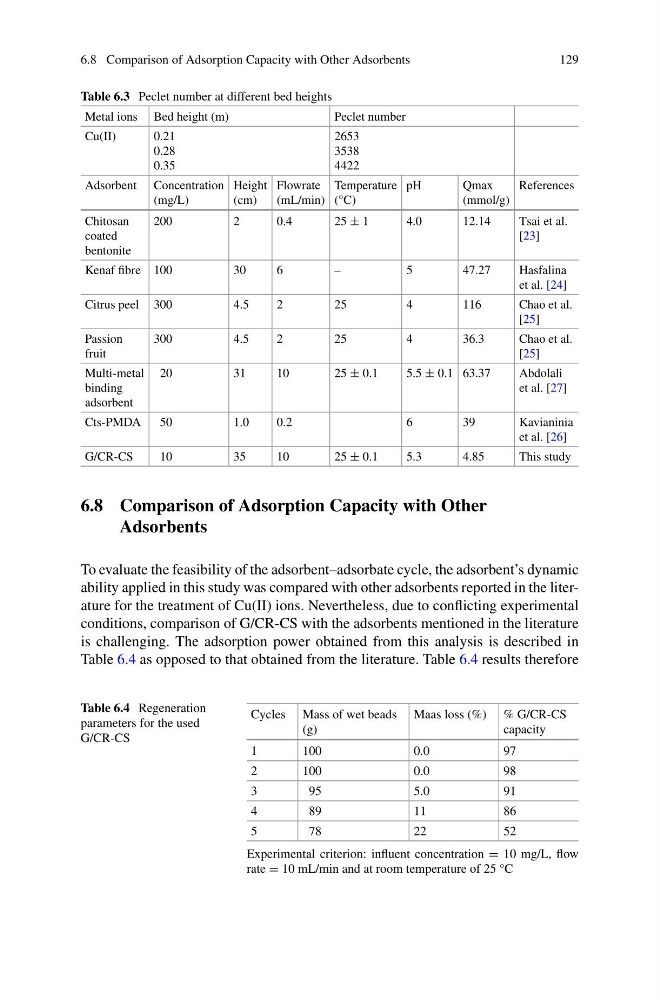
Table 6.3 Peclet number at different bed heights
Metal ions Bed height (m)
Peclet number
Cu(II)
0.21
0.28
0.35
2653
3538
4422
Adsorbent Concentration
(mg/L)
Height
(cm)
Flowrate
(mL/min)
Temperature
(°C)
pH
Qmax
(mmol/g)
References
Chitosan
coated
bentonite
200
2
0.4
25 ± 1
4.0
12.14
Tsai et al.
[23]
Kenaf fibre 100
30
6
–
5
47.27
Hasfalina
et al. [24]
Citrus peel 300
4.5
2
25
4
116
Chao et al.
[25]
Passion
fruit
300
4.5
2
25
4
36.3
Chao et al.
[25]
Multi-metal
binding
adsorbent
20
31
10
25 ± 0.1
5.5 ± 0.1 63.37
Abdolali
et al. [27]
Cts-PMDA
50
1.0
0.2
6
39
Kavianinia
et al. [26]
G/CR-CS
10
35
10
25 ± 0.1
5.3
4.85
This study
6.8 Comparison of Adsorption Capacity with Other
Adsorbents
To evaluate the feasibility of the adsorbent–adsorbate cycle, the adsorbent’s dynamic
ability applied in this study was compared with other adsorbents reported in the literature for the treatment of Cu(II) ions. Nevertheless, due to conflicting experimental
conditions, comparison of G/CR-CS with the adsorbents mentioned in the literature
is challenging. The adsorption power obtained from this analysis is described in
Table 6.4 as opposed to that obtained from the literature. Table 6.4 results therefore
Table 6.4 Regeneration
parameters for the used
G/CR-CS
Cycles Mass of wet beads
(g)
Maas loss (%) % G/CR-CS
capacity
1
100
0.0
97
2
100
0.0
98
3
95
5.0
91
4
89
11
86
5
78
22
52
Experimental criterion: influent concentration = 10 mg/L, flow
rate = 10 mL/min and at room temperature of 25 °C
129
Table 6.3 Peclet number at different bed heights
Metal ions Bed height (m)
Peclet number
Cu(II)
0.21
0.28
0.35
2653
3538
4422
Adsorbent Concentration
(mg/L)
Height
(cm)
Flowrate
(mL/min)
Temperature
(°C)
pH
Qmax
(mmol/g)
References
Chitosan
coated
bentonite
200
2
0.4
25 ± 1
4.0
12.14
Tsai et al.
[23]
Kenaf fibre 100
30
6
–
5
47.27
Hasfalina
et al. [24]
Citrus peel 300
4.5
2
25
4
116
Chao et al.
[25]
Passion
fruit
300
4.5
2
25
4
36.3
Chao et al.
[25]
Multi-metal
binding
adsorbent
20
31
10
25 ± 0.1
5.5 ± 0.1 63.37
Abdolali
et al. [27]
Cts-PMDA
50
1.0
0.2
6
39
Kavianinia
et al. [26]
G/CR-CS
10
35
10
25 ± 0.1
5.3
4.85
This study
6.8 Comparison of Adsorption Capacity with Other
Adsorbents
To evaluate the feasibility of the adsorbent–adsorbate cycle, the adsorbent’s dynamic
ability applied in this study was compared with other adsorbents reported in the literature for the treatment of Cu(II) ions. Nevertheless, due to conflicting experimental
conditions, comparison of G/CR-CS with the adsorbents mentioned in the literature
is challenging. The adsorption power obtained from this analysis is described in
Table 6.4 as opposed to that obtained from the literature. Table 6.4 results therefore
Table 6.4 Regeneration
parameters for the used
G/CR-CS
Cycles Mass of wet beads
(g)
Maas loss (%) % G/CR-CS
capacity
1
100
0.0
97
2
100
0.0
98
3
95
5.0
91
4
89
11
86
5
78
22
52
Experimental criterion: influent concentration = 10 mg/L, flow
rate = 10 mL/min and at room temperature of 25 °C