

6.1 Introduction
117
to the adsorbent. The model is based on the shrinking core model, and the parameters
which are responsible for the shape of the breakthrough curve are the external mass
transfer coefficient K, effective diffusion coefficient D eff and the binding capacity
q max .
6.2 Theory of Evaluation of Data
6.2.1 Shrinking Core Model (SCM)
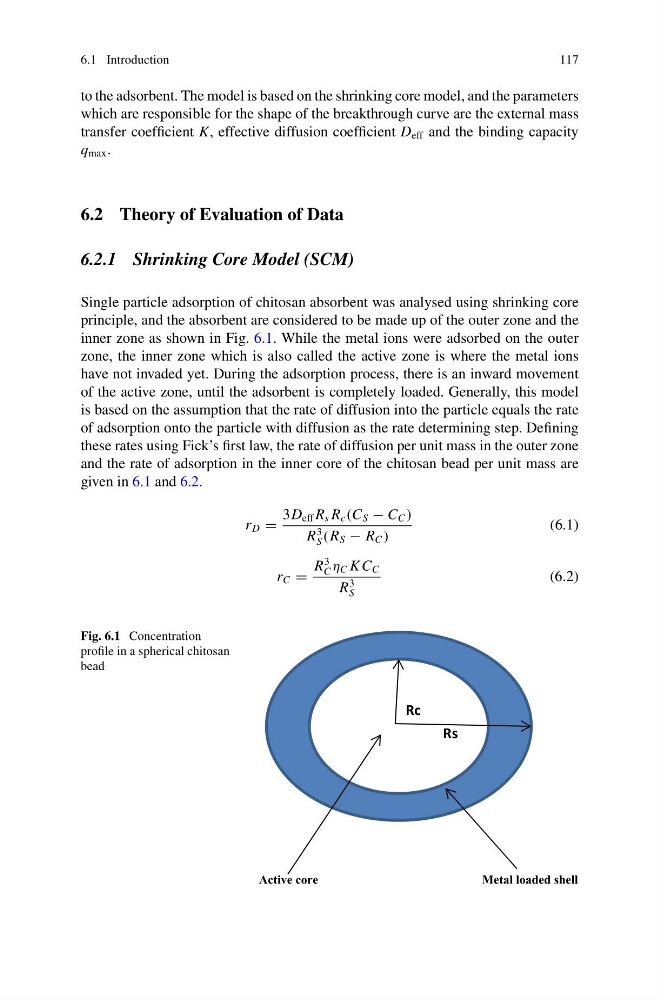
Single particle adsorption of chitosan absorbent was analysed using shrinking core
principle, and the absorbent are considered to be made up of the outer zone and the
inner zone as shown in Fig. 6.1. While the metal ions were adsorbed on the outer
zone, the inner zone which is also called the active zone is where the metal ions
have not invaded yet. During the adsorption process, there is an inward movement
of the active zone, until the adsorbent is completely loaded. Generally, this model
is based on the assumption that the rate of diffusion into the particle equals the rate
of adsorption onto the particle with diffusion as the rate determining step. Defining
these rates using Fick’s first law, the rate of diffusion per unit mass in the outer zone
and the rate of adsorption in the inner core of the chitosan bead per unit mass are
given in 6.1 and 6.2.
r D =
3D eff R s R c (C S − C C )
R
3
S (R S − R C )
(6.1)
r C =
R
3
C η C K C C
R
3
S
(6.2)
Fig. 6.1 Concentration
profile in a spherical chitosan
bead
Active core
Metal loaded shell
Rs
Rc
117
to the adsorbent. The model is based on the shrinking core model, and the parameters
which are responsible for the shape of the breakthrough curve are the external mass
transfer coefficient K, effective diffusion coefficient D eff and the binding capacity
q max .
6.2 Theory of Evaluation of Data
6.2.1 Shrinking Core Model (SCM)
Single particle adsorption of chitosan absorbent was analysed using shrinking core
principle, and the absorbent are considered to be made up of the outer zone and the
inner zone as shown in Fig. 6.1. While the metal ions were adsorbed on the outer
zone, the inner zone which is also called the active zone is where the metal ions
have not invaded yet. During the adsorption process, there is an inward movement
of the active zone, until the adsorbent is completely loaded. Generally, this model
is based on the assumption that the rate of diffusion into the particle equals the rate
of adsorption onto the particle with diffusion as the rate determining step. Defining
these rates using Fick’s first law, the rate of diffusion per unit mass in the outer zone
and the rate of adsorption in the inner core of the chitosan bead per unit mass are
given in 6.1 and 6.2.
r D =
3D eff R s R c (C S − C C )
R
3
S (R S − R C )
(6.1)
r C =
R
3
C η C K C C
R
3
S
(6.2)
Fig. 6.1 Concentration
profile in a spherical chitosan
bead
Active core
Metal loaded shell
Rs
Rc