

104
5 Biopolymer Chitosan Membranes Prepared from Fishery Waste …
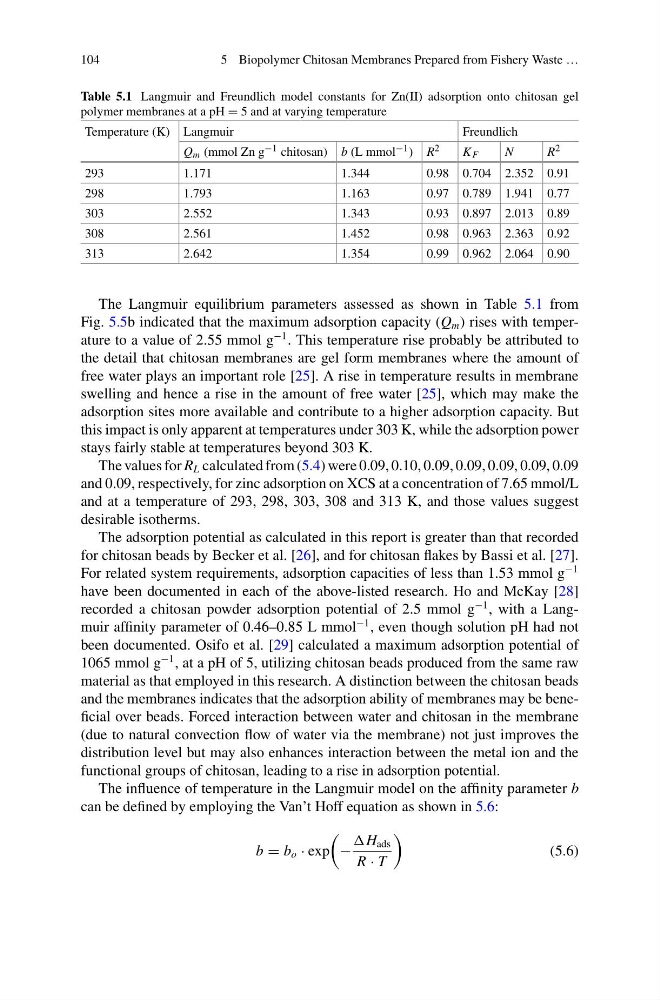
Table 5.1 Langmuir and Freundlich model constants for Zn(II) adsorption onto chitosan gel
polymer membranes at a pH = 5 and at varying temperature
Temperature (K) Langmuir
Freundlich
Q m (mmol Zn g −1 chitosan) b (L mmol −1 ) R 2
K F
N
R 2
293
1.171
1.344
0.98 0.704 2.352 0.91
298
1.793
1.163
0.97 0.789 1.941 0.77
303
2.552
1.343
0.93 0.897 2.013 0.89
308
2.561
1.452
0.98 0.963 2.363 0.92
313
2.642
1.354
0.99 0.962 2.064 0.90
The Langmuir equilibrium parameters assessed as shown in Table 5.1 from
Fig. 5.5b indicated that the maximum adsorption capacity (Q m ) rises with temperature to a value of 2.55 mmol g
−1 . This temperature rise probably be attributed to
the detail that chitosan membranes are gel form membranes where the amount of
free water plays an important role [25]. A rise in temperature results in membrane
swelling and hence a rise in the amount of free water [25], which may make the
adsorption sites more available and contribute to a higher adsorption capacity. But
this impact is only apparent at temperatures under 303 K, while the adsorption power
stays fairly stable at temperatures beyond 303 K.
The values for R L calculated from (5.4) were 0.09, 0.10, 0.09, 0.09, 0.09, 0.09, 0.09
and 0.09, respectively, for zinc adsorption on XCS at a concentration of 7.65 mmol/L
and at a temperature of 293, 298, 303, 308 and 313 K, and those values suggest
desirable isotherms.
The adsorption potential as calculated in this report is greater than that recorded
for chitosan beads by Becker et al. [26], and for chitosan flakes by Bassi et al. [27].
For related system requirements, adsorption capacities of less than 1.53 mmol g
−1
have been documented in each of the above-listed research. Ho and McKay [28]
recorded a chitosan powder adsorption potential of 2.5 mmol g
−1 , with a Langmuir affinity parameter of 0.46–0.85 L mmol
−1 , even though solution pH had not
been documented. Osifo et al. [29] calculated a maximum adsorption potential of
1065 mmol g
−1 , at a pH of 5, utilizing chitosan beads produced from the same raw
material as that employed in this research. A distinction between the chitosan beads
and the membranes indicates that the adsorption ability of membranes may be beneficial over beads. Forced interaction between water and chitosan in the membrane
(due to natural convection flow of water via the membrane) not just improves the
distribution level but may also enhances interaction between the metal ion and the
functional groups of chitosan, leading to a rise in adsorption potential.
The influence of temperature in the Langmuir model on the affinity parameter b
can be defined by employing the Van’t Hoff equation as shown in 5.6:
b = b o · exp
−
H ads
R · T
(5.6)
5 Biopolymer Chitosan Membranes Prepared from Fishery Waste …
Table 5.1 Langmuir and Freundlich model constants for Zn(II) adsorption onto chitosan gel
polymer membranes at a pH = 5 and at varying temperature
Temperature (K) Langmuir
Freundlich
Q m (mmol Zn g −1 chitosan) b (L mmol −1 ) R 2
K F
N
R 2
293
1.171
1.344
0.98 0.704 2.352 0.91
298
1.793
1.163
0.97 0.789 1.941 0.77
303
2.552
1.343
0.93 0.897 2.013 0.89
308
2.561
1.452
0.98 0.963 2.363 0.92
313
2.642
1.354
0.99 0.962 2.064 0.90
The Langmuir equilibrium parameters assessed as shown in Table 5.1 from
Fig. 5.5b indicated that the maximum adsorption capacity (Q m ) rises with temperature to a value of 2.55 mmol g
−1 . This temperature rise probably be attributed to
the detail that chitosan membranes are gel form membranes where the amount of
free water plays an important role [25]. A rise in temperature results in membrane
swelling and hence a rise in the amount of free water [25], which may make the
adsorption sites more available and contribute to a higher adsorption capacity. But
this impact is only apparent at temperatures under 303 K, while the adsorption power
stays fairly stable at temperatures beyond 303 K.
The values for R L calculated from (5.4) were 0.09, 0.10, 0.09, 0.09, 0.09, 0.09, 0.09
and 0.09, respectively, for zinc adsorption on XCS at a concentration of 7.65 mmol/L
and at a temperature of 293, 298, 303, 308 and 313 K, and those values suggest
desirable isotherms.
The adsorption potential as calculated in this report is greater than that recorded
for chitosan beads by Becker et al. [26], and for chitosan flakes by Bassi et al. [27].
For related system requirements, adsorption capacities of less than 1.53 mmol g
−1
have been documented in each of the above-listed research. Ho and McKay [28]
recorded a chitosan powder adsorption potential of 2.5 mmol g
−1 , with a Langmuir affinity parameter of 0.46–0.85 L mmol
−1 , even though solution pH had not
been documented. Osifo et al. [29] calculated a maximum adsorption potential of
1065 mmol g
−1 , at a pH of 5, utilizing chitosan beads produced from the same raw
material as that employed in this research. A distinction between the chitosan beads
and the membranes indicates that the adsorption ability of membranes may be beneficial over beads. Forced interaction between water and chitosan in the membrane
(due to natural convection flow of water via the membrane) not just improves the
distribution level but may also enhances interaction between the metal ion and the
functional groups of chitosan, leading to a rise in adsorption potential.
The influence of temperature in the Langmuir model on the affinity parameter b
can be defined by employing the Van’t Hoff equation as shown in 5.6:
b = b o · exp
−
H ads
R · T
(5.6)